Best rod for throwing a Texas rig
Choosing the right fishing rod for throwing a Texas rig can feel like navigating a maze, especially with all the options out there. You've probably stood in the aisle at a sporting goods store, staring at dozens of rods, each boasting different powers, actions, and materials, wondering which one will truly help you feel those subtle bites and yank a lunker out of the thickest cover. It's a common frustration for anglers across Texas, from the brushy shores of Lake Fork to the stump fields of Sam Rayburn. This guide is here to cut through the confusion and help you understand exactly what makes a rod perfect for mastering the versatile Texas rig, ensuring you're well-equipped for your next big catch.
Understanding the Texas Rig's Demands on Your Rod
The Texas rig isn't just another lure; it's a technique, a feeling, and a commitment to fishing heavy cover. Because of its weedless nature and the way you often present it – slowly dragging or hopping it along the bottom, through grass, or over wood – your rod needs to be an extension of your senses. It's not just about casting; it's about the entire process from presentation to hook set to landing the fish. Many anglers mistakenly believe any rod will do for soft plastics, but a poorly matched rod can lead to missed bites, lost fish, and a lot of frustration.
Imagine fishing a dense hydrilla bed on Lake Palestine. You're trying to feel the difference between a clump of grass and a bass inhaling your creature bait. A rod lacking sensitivity will leave you guessing, often resulting in reeling in a clean lure or, worse, setting the hook into a submerged log. Conversely, if you do feel the bite, you need the backbone to drive a heavy-gauge hook through tough plastic and into the hard mouth of a feisty Texas Largemouth Bass Fishing Guide. It's a demanding technique that requires specific rod characteristics to truly excel, especially when these Texas bass decide to bury themselves in the nastiest cover available.
The Dance Between Sensitivity and Power
At the heart of an effective Texas rig rod is the delicate balance between sensitivity and power. Sensitivity is your ability to feel what your lure is doing underwater, whether it's bumping a rock, dragging through mud, or the faintest "thump" of a fish sucking it in. This sensation travels from your line, through the rod blank, and into your hands. Without good sensitivity, you're fishing blind, missing those crucial signals that tell you when to set the hook. This is often where high-quality graphite rods shine.
Once you feel that bite, power takes over. Power refers to the rod's lifting strength or backbone, essentially how much pressure it takes to bend the rod. For a Texas rig, you need enough power to swiftly drive a wide-gap hook through a soft plastic bait and then penetrate the boney plate in a bass's mouth. If your rod is too light, you'll struggle to get a solid hook set, often just pulling the bait out of the fish's mouth. Furthermore, after the hook set, you need the power to quickly turn a fish away from cover and guide it towards the boat, preventing it from tangling you in structure.
Casting Accuracy and Cover Penetration
The Texas rig is often at its best when pitched or flipped into tight spots: under docks, alongside fallen trees, into small pockets in lily pads. This isn't usually about making long, sweeping casts across open water. Instead, it demands precision. The right rod will load and unload efficiently, allowing you to accurately place your lure exactly where you want it with minimal effort. This ability to make repetitive, accurate casts into tight quarters is paramount, especially when targeting those shy bass tucked deep in the shade.
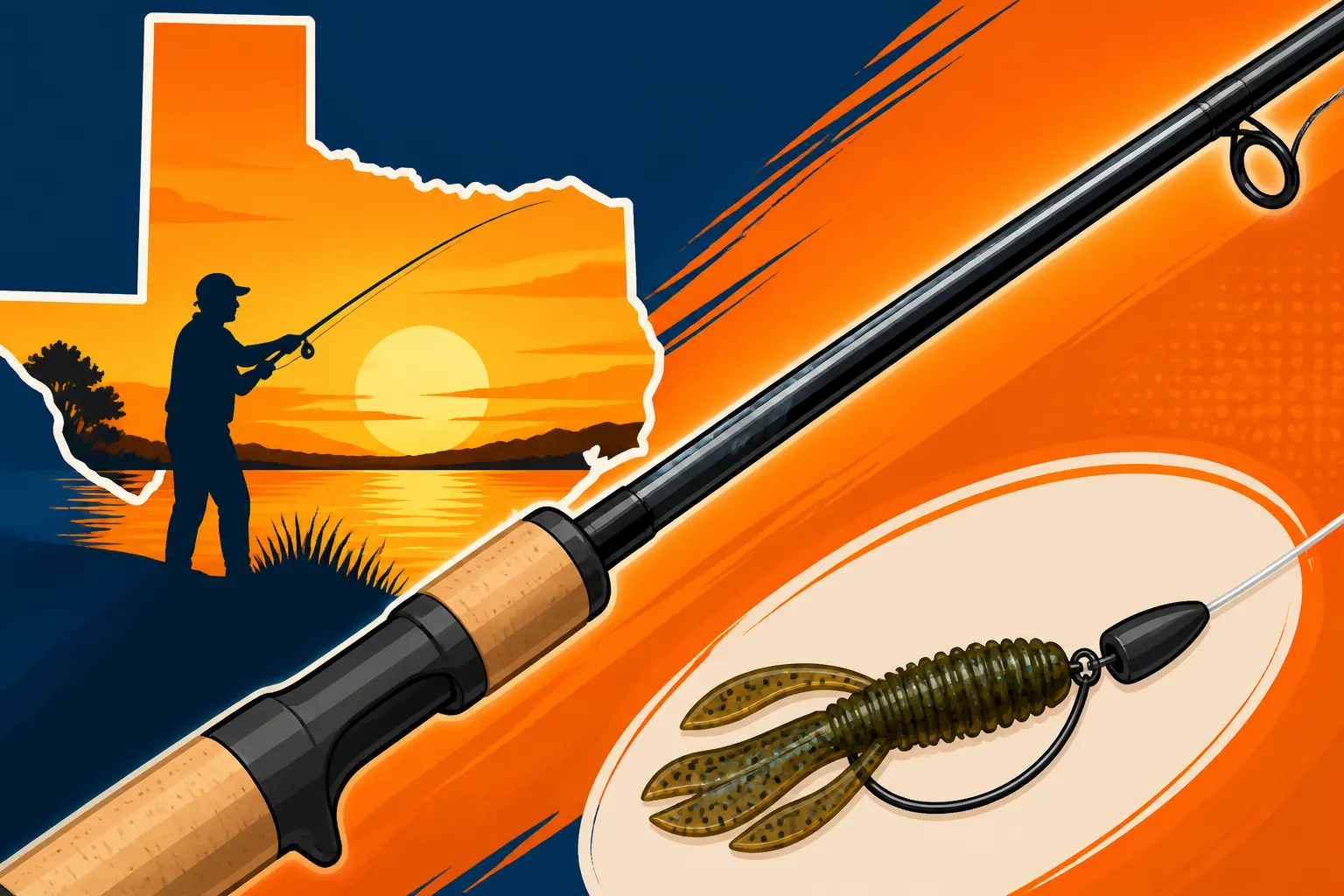
Once your lure is in the desired spot, the weedless design of a Texas rig, often with a bullet weight, is designed to penetrate cover. Your rod, combined with the lure's design, helps achieve this. A rod with the right action will allow the lure to slice through reeds, brush, or dense grass without snagging. After the lure has penetrated, the rod's sensitivity comes back into play, helping you distinguish between cover and a bite. For tips on how to rig your bait for optimal performance, check out our guide on How to tie a Texas rig.
Key Rod Characteristics for a Stellar Texas Rig Setup
When you're sifting through all the options for a Texas rig rod, there are a few key specifications that you absolutely need to pay attention to. These aren't just arbitrary numbers; they directly impact how well you can present your bait, detect bites, and ultimately land fish. Thinking of these elements as a cohesive system rather than individual features will help you make a more informed decision.
Rod Length
The length of your rod plays a significant role in casting distance, accuracy, and leverage during a fight. For Texas rigging, you'll typically find anglers gravitating towards rods in the 6'8" to 7'6" range. Shorter rods, say 6'6" to 6'10", can be excellent for making accurate, short-range pitches and flips into extremely tight cover, especially when you're tucked away in a kayak or boat and need to be compact.
On the other hand, longer rods, from 7' to 7'6" (and sometimes even longer for specialized applications), offer several advantages. They provide more leverage for longer casts, which can be useful when you need to cover more water or reach distant cover from the bank. The extra length also gives you more control over a hooked fish, allowing you to steer it away from snags and obstructions. This added reach can also aid in picking up line quickly after a bite, contributing to a better hook set. For general Texas rigging across various Texas lakes, a 7-foot rod is often a sweet spot, offering a good balance of accuracy, casting distance, and fish-fighting power.
Rod Power Medium-Heavy vs. Heavy
Rod power refers to the amount of force required to bend the rod. For Texas rigging, you're almost always going to be looking at a Medium-Heavy (MH) or Heavy (H) power rod. A Medium-Heavy rod is incredibly versatile and often the go-to for standard Texas rigs with 1/4 to 1/2 ounce weights and worms or creature baits fished in moderate cover. It provides enough backbone for solid hook sets and fish control while still offering good sensitivity.
A Heavy power rod comes into its own when you're fishing extremely dense cover – think thick hydrilla mats, dense brush piles, or heavy timber. This extra power allows you to use heavier weights (e.g., 3/4 to 1 ounce or more) and larger baits, and, most importantly, provides the brute strength needed to rip a big bass out of that cover before it can wrap you up. While a heavy rod might sacrifice a tiny bit of sensitivity compared to a medium-heavy, the sheer power it offers for specific situations is invaluable. Your choice between MH and H will largely depend on the specific conditions and cover you typically fish.
Rod Action Fast vs. Extra-Fast
Rod action describes where the rod bends when pressure is applied. For Texas rigging, a Fast or Extra-Fast action is almost universally preferred. A Fast action rod bends mostly in the top third of the blank, while an Extra-Fast action bends even closer to the tip. This quick tapering to a sensitive tip is crucial for several reasons.
First, an Extra-Fast or Fast tip provides maximum sensitivity, allowing you to feel those subtle "taps" or "thumps" as a bass inhales your plastic. This is vital when the bite is light, or the fish are sluggish. Second, this fast action concentrates the bend near the tip, allowing the rest of the rod blank to remain stiff and powerful. This stiffness translates directly into quick, powerful hook sets. When you detect a bite, you need to drive that hook home instantly, and a fast-action rod prevents excess bend in the midsection, ensuring more of your power goes directly to the hook. A slower action rod (like moderate or slow) would bend too much through the middle, absorbing too much of your hook set force.
Material Matters
The material from which a rod blank is constructed significantly influences its sensitivity, weight, and durability. For Texas rigging, graphite is the undisputed champion. Graphite is incredibly light and excels at transmitting vibrations, which is why it's so sensitive. A high-modulus graphite rod will be exceptionally sensitive, allowing you to feel even the most subtle bites or changes in bottom composition. This sensitivity is paramount for a technique that relies heavily on feel.
While fiberglass rods are known for their durability and parabolic bend, they lack the sensitivity and crisp action needed for effective Texas rigging. You'll often see them used for crankbaits or other reaction baits where stretch and a slower action are beneficial. Some rods might incorporate a blend of graphite and fiberglass, creating a composite rod that offers a balance of sensitivity and durability, but for pure Texas rigging, especially when sensitivity is key, a high-quality graphite blank is typically the best choice. Look for brands known for their graphite technology, which you can often find at reputable retailers like Bass Pro Shops or even online at Amazon.
Pairing Your Rod with Reel and Line for Optimal Performance
A fantastic Texas rig rod is only one piece of the puzzle. To truly unlock its potential and maximize your chances of success, you need to pair it with the right reel and line. These three components work together as a system, and a mismatch can undermine even the best rod. Thinking about how the reel's retrieve speed and the line's characteristics complement your rod's power and action is crucial for a cohesive setup.
Reel Choices
For Texas rigging, a baitcasting reel is almost always the preferred choice over a spinning reel. Baitcasting reels offer greater power, better casting accuracy for pitching and flipping, and more precise control over your line, which is essential when working a Texas rig slowly through cover. The key specification to consider for your baitcasting reel is the gear ratio, which dictates how much line is retrieved with each turn of the handle.
For Texas rigging, you generally want a faster gear ratio. Look for reels in the 7.1:1 to 8.1:1 range. A high gear ratio allows you to pick up slack line very quickly, which is critical after a bite. When a bass takes your Texas rig, it might run towards you, creating slack. Being able to swiftly reel in that slack and make a solid hook set dramatically increases your hook-up ratio. It also helps you quickly retrieve your bait after working a piece of cover to move to the next spot, saving you valuable fishing time. Brands like Shimano and Lew's offer excellent baitcasting reels suitable for Texas rigging.
Line Selection
Your choice of fishing line is as important as your rod and reel for Texas rigging. The line acts as the direct conduit for transmitting those subtle bites to your rod and also needs to withstand the abuses of heavy cover and fighting strong fish. There are primarily two types of line favored for Texas rigging: fluorocarbon and braided line.
Fluorocarbon is a popular choice due to its low visibility underwater and its excellent sensitivity. It has less stretch than monofilament, meaning vibrations travel more efficiently up the line to your rod, helping you feel those faint bites. Its abrasion resistance is also a significant advantage when fishing around rocks, wood, or shell beds. For general Texas rigging in clearer water or moderate cover, a 15-20 lb test fluorocarbon line is a solid starting point.
Braided line, on the other hand, offers extreme strength, zero stretch, and exceptional abrasion resistance. Its lack of stretch makes it incredibly sensitive and provides unrivaled power for hook sets, especially at longer distances or in very deep water. When fishing extremely heavy cover – think thick mats of vegetation or dense standing timber on lakes like Toledo Bend – braided line (typically 30-50 lb test) is often the superior choice. However, braided line is highly visible, so many anglers will tie a short fluorocarbon leader (3-5 feet) to the end of their braid to maintain invisibility near the lure. Understanding the nuances of line choice is part of Best Tackle for Texas Bass Fishing.
Real-World Scenarios and Recommendations for Texas Anglers
Putting all this technical information into practice for your specific Texas fishing adventures is where the rubber meets the road. Texas offers such a diverse range of fishing environments, from vast open reservoirs to tight, brushy creeks, and your ideal Texas rig rod might shift slightly depending on where you're casting your line.
Fishing Heavy Cover (Lake Fork, Sam Rayburn)
When you're targeting the lunkers hiding deep in the dense timber of Lake Fork or the vast hydrilla fields of Sam Rayburn, your gear needs to be up to the challenge. These are places where bass get big and they love to bury themselves in the nastiest cover imaginable. For these situations, you'll want to lean towards the heavier end of the spectrum for your Texas rig rod.
Consider a 7' to 7'6" Heavy power, Extra-Fast action rod. This combination provides the leverage for accurate pitches into tight pockets within the cover, the power to drive a stout hook through heavy plastic and into a big bass's mouth, and the backbone to winch that fish out of the nastiest structure before it can wrap you up. Pair this with 50-65 lb braided line to cut through vegetation and withstand abrasion. This setup is a brute force weapon, designed for quick, decisive battles in challenging environments. Many anglers find great options for these heavy-duty setups at large outdoor retailers like Bass Pro Shops, where you can feel the rods and compare specs firsthand. For more on these legendary lakes, check out our guides on Lake Fork Fishing Guide and Sam Rayburn Reservoir Fishing Guide.
Open Water & Finesse Texas Rigging (Clearer lakes like Canyon Lake)
Not all Texas rigging involves ripping fish out of thickets. Sometimes, you're fishing more open water, around isolated rock piles, subtle depth changes, or sparse grass beds on clearer lakes like Canyon Lake. In these scenarios, a slightly different approach with your rod can pay dividends, focusing more on finesse and heightened sensitivity.
For these conditions, a 6'10" to 7'2" Medium-Heavy power, Fast action rod would be an excellent choice. This rod provides excellent sensitivity for detecting subtle bites in less cluttered environments, while still offering enough power for a solid hook set and fighting fish that might run to deeper water. You might opt for 15-20 lb fluorocarbon line here, or perhaps 30 lb braid with a fluorocarbon leader, to maintain invisibility in clearer water. The slightly lighter power and faster action will allow for a more delicate presentation and better feel when bass are finicky. This setup is all about detecting the whisper of a bite rather than the violent thump. You can learn more about specific techniques in How to fish a Texas rig.
Budget-Friendly vs. Premium Options
Let's be real: not everyone can drop hundreds of dollars on a single fishing rod, and that's perfectly okay. The good news is that advancements in rod technology mean you can find excellent performance at various price points.
- Budget-Friendly Options: If you're just starting out or working with a tighter budget, you can still find a perfectly capable Texas rig rod. Look for rods in the $50-$100 range from reputable brands. These will typically be graphite composite or lower-modulus graphite. They might not be as feather-light or as exquisitely sensitive as their premium counterparts, but they'll absolutely get the job done. Focus on getting the correct power (Medium-Heavy) and action (Fast/Extra-Fast) for your needs. Online retailers like Amazon often have great deals on quality mid-range rods that can serve a Texas angler well. The key is to prioritize the functional specs over brand name or fancy aesthetics at this level.
- Mid-Range Options: Stepping up to the $100-$250 range opens up a world of highly sensitive and powerful graphite rods. Here, you'll start to notice significant improvements in weight, balance, and sensitivity. These rods often feature better quality components like guides and reel seats, which contribute to smoother performance and longer durability. This is where many serious anglers find their workhorse rods that perform consistently.
- Premium Options: For those who demand the absolute best in sensitivity, lightest weight, and top-tier components, premium rods in the $250+ range are available. These rods utilize the highest modulus graphite, often with advanced resin systems, and feature ultra-light, super-hard guides. They are designed for maximum feel and often have impeccable balance, reducing fatigue over a long day of fishing. While they come with a higher price tag, the difference in feel and performance can be truly remarkable for dedicated Texas riggers. Regardless of your budget, remember that matching the rod to the technique is more important than simply buying the most expensive option. For a broader look at rod options, consult Best Fishing Rods for Texas Anglers.
Here’s a quick summary of general Texas Rig rod considerations:
| Feature | Recommendation | Why it Matters |
|---|---|---|
| Length | 6'10" to 7'6" | Balances casting distance, accuracy for pitching, and leverage for fish fighting. |
| Power | Medium-Heavy (MH) to Heavy (H) | Provides backbone for hook sets through plastics and pulling fish from cover. |
| Action | Fast (F) or Extra-Fast (XF) | Maximizes sensitivity for bite detection and creates a strong, quick hook set. |
| Material | High-modulus Graphite | Optimal for lightweight feel and excellent vibration transmission (sensitivity). |
| Reel Type | Baitcasting | Offers power, control, and accuracy for repeated casts and managing line. |
| Gear Ratio | 7.1:1 or higher (fast) | Allows quick line pickup to manage slack and ensure powerful hook sets. |
| Line Type | Fluorocarbon (15-20 lb) or Braided (30-50 lb) | Fluorocarbon for invisibility/sensitivity, Braid for strength/cover penetration. |
Remember, the "best" rod is ultimately the one that feels right in your hands and instills confidence. Take these guidelines as a starting point, and don't be afraid to experiment to find your perfect match for hitting those Texas hotspots.
Disclaimer
This article is for general informational purposes only and does not constitute professional advice. Laws, prices and regulations vary by location and change over time. Consult a qualified professional for guidance on your specific situation.