Best anchor for a fishing kayak
Few things are as frustrating for a kayak angler as finally finding that perfect fishing spot, lining up your cast, only to have a sneaky current or a sudden gust of Texas wind push you right off your mark. You end up paddling frantically, losing precious fishing time, and missing out on what could have been a trophy catch. This guide is all about helping you conquer that drift by exploring the best anchoring solutions specifically designed for kayak fishing, ensuring you can hold your ground and focus on reeling in those fish.
Why an Anchor is Essential for Kayak Fishing in Texas
Fishing from a kayak offers an incredible sense of freedom and access to waters larger boats simply can't reach. But with that freedom comes the challenge of staying put, especially in diverse Texas waters. Whether you're targeting bass in a brushy cove or redfish on a windy flat, a reliable anchor isn't just a convenience; it's a game-changer for precision, safety, and ultimately, your success on the water.
Dealing with Wind and Current in Texas Waters
Texas is a state known for its wide-open spaces, and that often translates to wide-open waters that are susceptible to wind. A gentle breeze on shore can become a strong push out on a big reservoir like Lake Fork or Sam Rayburn. Similarly, in our coastal bays and estuaries, tides and currents can swiftly move your kayak without you even realizing it. Imagine you’ve found a promising oyster reef in Galveston Bay, perfect for speckled trout, but the tide keeps pulling you away from the prime casting zone. Without an anchor, you're constantly paddling, expending energy that could be used for fishing. This relentless struggle against the elements can turn a relaxing day into an exhausting chore, making it hard to concentrate on technique or even enjoy the scenery.
Holding Your Spot for Precise Casting and Angling
For many types of fishing, precision is absolutely key. Think about flipping a jig into a submerged timber pile for a monster Texas Largemouth Bass Fishing Guide, or carefully presenting a live shrimp near a channel edge for a Texas Redfish Fishing Guide. If your kayak is constantly shifting, hitting that tiny sweet spot becomes nearly impossible. An anchor allows you to pinpoint your position and stay there, giving you the time and stability to make repeated, accurate casts. This is particularly crucial when you're fishing a specific piece of structure, like a brush pile, a rock ledge, or a distinct contour change on the bottom. Without the ability to hold your boat still, you're essentially guessing, and that’s a quick way to get frustrated and miss out on bites. Holding your position also becomes critical when you're trying to work a particular lure slowly and methodically, ensuring it stays in the strike zone longer.
Safety and Convenience on the Water
Beyond fishing efficiency, an anchor contributes significantly to your safety and overall convenience. Picture this: you're exploring a new section of the Brazos River, and the current picks up unexpectedly. An anchor can prevent you from being swept into dangerous rapids or obstacles downstream. On the coast, it can keep you from drifting too close to boat channels or busy areas. Furthermore, an anchor provides a crucial break from constant paddling. It allows you to relax, eat a snack, re-rig a line, or even take a quick photo of your catch without worrying about where your kayak is headed. For those long days out on the water, especially when you're trying How to fish a Texas reservoir in the heat, conserving energy is vital, and an anchor is a fantastic tool for doing just that. It means less effort fighting the elements and more enjoyment of your time outdoors.
Understanding Different Kayak Anchor Types
When you start looking for an anchor for your fishing kayak, you'll quickly realize it's not a one-size-fits-all situation. Different environments and fishing styles call for different tools. Choosing the right anchor means understanding the strengths and weaknesses of each type.
Grapnel Anchors: The Go-To for Many
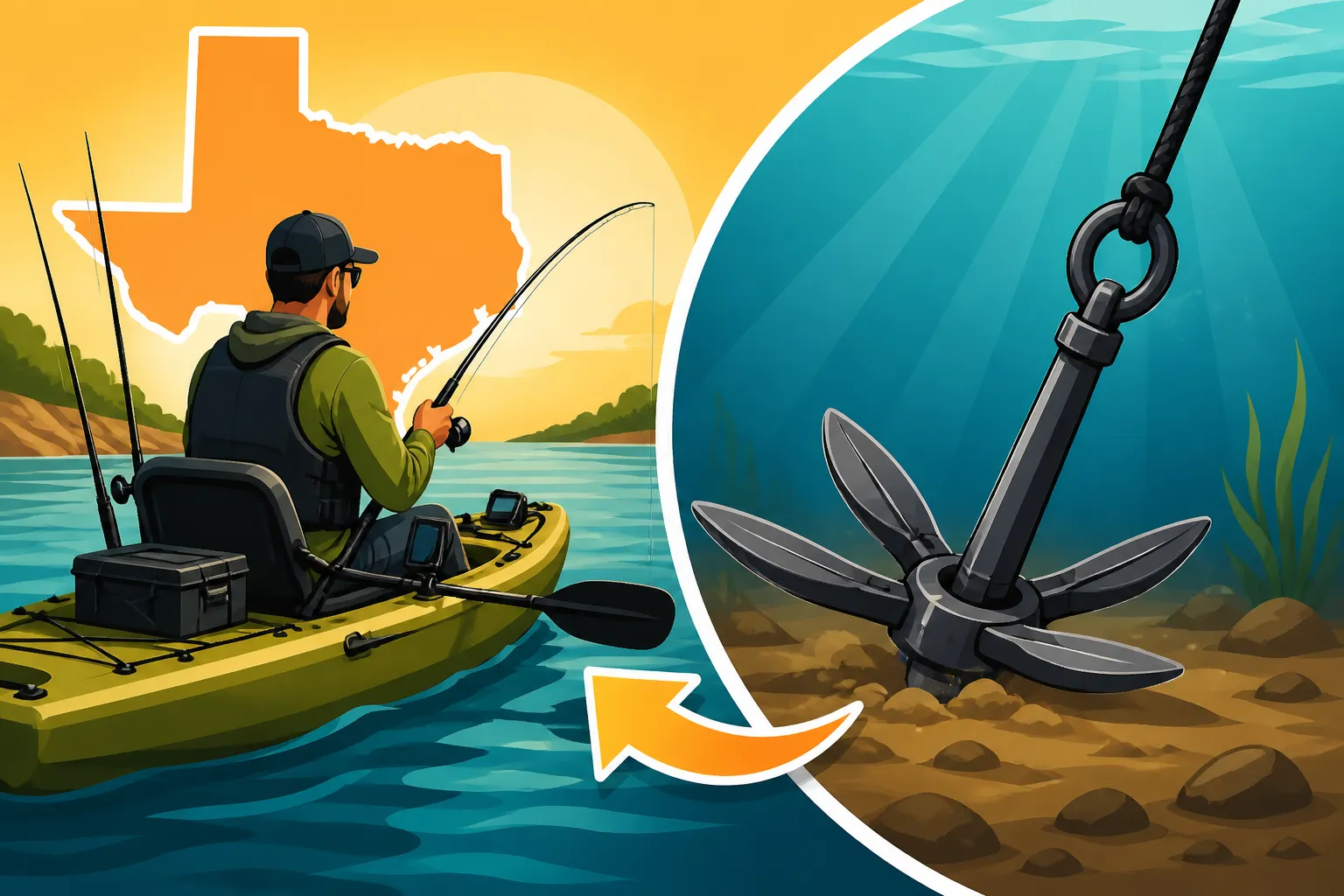
The grapnel anchor is perhaps the most common and versatile choice for kayak anglers, and for good reason. It typically features four foldable prongs, or "flukes," that extend outwards. When deployed, these prongs are designed to snag onto rocks, roots, limbs, or other hard underwater structures.
Pros of Grapnel Anchors:
- Excellent for Rocky and Woody Bottoms: Its snagging ability makes it incredibly effective in areas with submerged timber, rock piles, or dense aquatic vegetation – places where many Texas bass lurk.
- Compact and Easy to Store: Many grapnels fold up into a small package, making them easy to stow in a kayak’s limited storage space, like a milk crate or a front hatch.
- Lightweight: Typically ranging from 1.5 to 3 pounds, they don't add significant bulk or weight to your kayak, which is a major plus for portability.
- Versatile: Can be effective in both freshwater lakes and saltwater flats where structure is present.
Cons of Grapnel Anchors:
- Poor on Soft Bottoms: If you're fishing over soft mud or sand without any structure to grab onto, a grapnel anchor will simply drag, offering little to no holding power.
- Prone to Snags: While snagging is its strength, it can also be its downfall. Getting a grapnel anchor truly stuck can be incredibly frustrating and might even lead to losing the anchor if you can't free it. Many anglers employ a "breakaway" system where the anchor line ties to the bottom of the anchor, with a zip tie holding it to the top. If it snags, a hard pull breaks the zip tie, allowing you to pull it out from the other end.
Grapnel anchors are often a great starting point for many anglers, especially if you find yourself fishing in diverse conditions. You can find a good selection at any outdoor retailer or online on Amazon or at Bass Pro Shops.
Mushroom Anchors: Best for Soft, Muddy Bottoms
Mushroom anchors are exactly what they sound like: anchors shaped like an inverted mushroom or a bell. They work by digging into and creating suction with soft bottoms like mud, silt, or thick sand.
Pros of Mushroom Anchors:
- Superior Hold in Soft Mud/Silt: This is where mushroom anchors truly shine. The wide, concave bottom creates a vacuum effect, allowing the anchor to dig in and hold incredibly well in soupy conditions.
- Less Prone to Snags: With their smooth, rounded design, they are far less likely to get hung up on rocks or timber, making them a safer bet in featureless soft-bottom areas.
- Easy to Retrieve: Generally, they pull free from soft bottoms with less effort than a deeply snagged grapnel.
Cons of Mushroom Anchors:
- Ineffective on Hard Bottoms: If you drop a mushroom anchor on rock, shell, or hard-packed sand, it will simply slide around.
- Bulky: Compared to folding grapnels, mushroom anchors are often bulkier and less convenient to store in a kayak.
- Heavier for Similar Holding Power: To get a good hold, mushroom anchors often need to be heavier than a grapnel for comparable conditions, adding more weight to your kayak.
If your primary fishing involves bayous, shallow lake coves with silty bottoms, or slow-moving rivers with soft beds, a mushroom anchor might be your best bet.
Fluke/Danforth Anchors: Strong Hold for Sand and Shell
Fluke anchors, often referred to as Danforth anchors, are designed with two large, hinged flukes that pivot and dig deep into sandy or shell-covered bottoms. They are particularly popular for larger boats in coastal areas but can be scaled down for kayaks.
Pros of Fluke/Danforth Anchors:
- Exceptional Hold in Sand and Shell: The design allows the flukes to penetrate deeply and effectively set themselves in soft sediment, offering a very strong, reliable hold. This is fantastic for those expansive sandy flats where you might be targeting redfish or flounder.
- Good for Moderate Currents: Their strong holding power makes them a good choice in areas with steady currents or stronger winds, as they resist dragging far better than a grapnel on soft ground.
Cons of Fluke/Danforth Anchors:
- Poor on Hard Bottoms: Like mushroom anchors, they offer little to no grip on rocky or heavily vegetated bottoms.
- Can Be Bulky: Even smaller versions can be somewhat awkward to store on a kayak due to their shape.
- Can Be Hard to Break Free: When fully dug in, retrieving a fluke anchor can sometimes require significant effort, especially if you don't have enough chain to help it reset from a different angle.
For saltwater kayak anglers who spend a lot of time on sandy or shelly flats, a small fluke anchor could be the ideal choice for a strong, reliable hold.
Stakeout Poles and Alternative Anchoring Methods
Sometimes, a traditional anchor isn't the best tool, or you need a quicker, quieter alternative. This is where stakeout poles come into play, especially for shallow water enthusiasts.
Stakeout Poles:
A stakeout pole is essentially a long, sturdy rod (often fiberglass or carbon fiber) that you manually push into the bottom to hold your kayak in shallow water.
- Pros: Ultra-quiet, very fast to deploy and retrieve, no line to tangle, excellent for shallow flats (typically up to 6-8 feet deep). Ideal for stealthy approaches to spooky fish like redfish. Many anglers use them in conjunction with an anchor trolley system for precise positioning.
- Cons: Limited to shallow water, can be bulky to store if not collapsible, ineffective on hard rock or concrete bottoms where they can't penetrate.
Drift Chutes/Socks:
While not an anchor that holds you completely still, a drift chute (or drift sock) is an invaluable tool for slowing your drift in windy conditions or strong currents. It acts like a parachute underwater, dramatically reducing your speed.
- Pros: Allows you to slowly cover ground while maintaining control, perfect for Texas Saltwater Fishing Techniques like drifting across a flat or slowly working a retrieve. Prevents overshooting a productive area.
- Cons: Doesn't stop your movement entirely, so not suitable for holding a precise spot.
Choosing between these often comes down to the specific conditions you'll face. Many seasoned kayak anglers will carry a combination of methods—perhaps a grapnel anchor for deeper, varied bottoms and a stakeout pole for shallow water fishing.
| Anchor Type | Best for Bottom Type | Holding Power | Ease of Storage (Kayak) | Pros | Cons |
|---|---|---|---|---|---|
| Grapnel | Rock, Wood, Vegetation | Moderate | High (often foldable) | Compact, versatile, good snagging | Poor on soft mud/sand, prone to deep snags |
| Mushroom | Soft Mud, Silt | Good | Low (bulky) | Excellent hold in soft bottoms, low snag risk | Ineffective on hard bottoms, bulkier |
| Fluke/Danforth | Sand, Shell, Hard Mud | Very Good | Moderate | Strong hold in soft sediment, resists current | Poor on rock/veg, can be hard to retrieve |
| Stakeout Pole | Soft Mud, Sand (shallow) | Very Good | Moderate (long) | Quiet, fast, no line, perfect for stealth | Limited to shallow water, ineffective on hard bottoms |
Key Factors to Consider When Choosing a Kayak Anchor
Selecting the ideal anchor isn't just about picking one type; it's about matching the anchor to your specific kayak, your fishing environment, and your personal preferences. A little thought upfront can save you a lot of hassle on the water.
Water Type: Freshwater vs. Saltwater Needs
The environment you fish in most often will heavily influence your anchor choice.
- Freshwater (Lakes, Rivers): Texas freshwater lakes like Cedar Creek or Lake Conroe often feature a mix of bottom types: rocky points, muddy coves, submerged timber, and brush piles. For these conditions, a versatile grapnel anchor, perhaps with a breakaway retrieval system, is often a great choice. If you primarily fish slower rivers with muddy bottoms for catfish, a mushroom anchor might be better. Rivers also present current challenges, so the anchor needs to be able to dig in effectively without dragging.
- Saltwater (Bays, Flats, Estuaries): The Texas coast, from Sabine Lake to the Laguna Madre, is predominantly sandy and shell-laden flats, often with oyster reefs. Here, a small fluke anchor can provide an excellent, reliable hold in the sand. However, if you're fishing near jetties or rocky shorelines, a grapnel might be more appropriate. A stakeout pole is practically a must-have for sight fishing the shallow saltwater flats, offering quiet, immediate stopping power without splashing a heavy anchor. Consider the corrosive nature of saltwater; anchors made of galvanized steel or stainless steel will last longer.
Bottom Composition: What Lies Beneath?
Knowing what kind of bottom you'll typically be anchoring in is crucial.
- Mud/Silt: This is where mushroom anchors excel. Their wide, inverted shape creates suction and digs in. Grapnels and fluke anchors will struggle here without heavy chains.
- Sand/Shell: Fluke (Danforth) anchors are specifically designed for this. They dig deep and hold strong. Grapnels can work if there are buried shells or rocks to grab.
- Rock/Gravel: Grapnel anchors are the undisputed champions here, as their prongs can bite into crevices and wrap around rocks. Fluke and mushroom anchors will generally slide and offer no hold.
- Heavy Vegetation/Weeds: Again, grapnel anchors are usually the best bet, as their prongs can pierce and snag the root systems or dense weed mats. However, retrieving them can be a challenge if they get too tangled.
If you fish a variety of spots, you might consider carrying two different, lightweight anchors or relying on a highly versatile grapnel with an effective breakaway system.
Kayak Size and Weight: Matching the Anchor to Your Boat
A heavier kayak needs a heavier anchor. This might seem obvious, but it's often overlooked. A small, lightweight recreational kayak weighing 50 pounds might hold fine with a 1.5-pound grapnel anchor in light conditions. However, a fully rigged fishing kayak, often weighing 70-100+ pounds (before gear and angler), will need more robust holding power.
- Lighter Kayaks (Recreational, smaller fishing kayaks): Can generally get away with 1.5-2 lb grapnel anchors or lighter mushroom anchors.
- Heavier Fishing Kayaks (Pedal drives, loaded with gear, larger anglers): Will likely need a 3-4 lb grapnel, a heavier mushroom (5-8 lbs), or a small fluke anchor to reliably hold against wind and current.
Remember that a heavier anchor, while offering more holding power, also adds more weight to your kayak and can be more cumbersome to deploy and retrieve, especially if you're trying to quickly reposition. For many anglers, the 3-pound grapnel anchor has become a popular sweet spot for a good balance of holding power and manageable weight for their Best Kayaks for Texas Fishing.
Desired Holding Power and Weather Conditions
How much anchor do you really need? This depends on how much wind and current you expect to fight.
- Light Wind/Current: A smaller, lighter anchor will often suffice.
- Moderate Wind/Current: You'll need an anchor with better holding power or a heavier option. This is where the anchor's design (flukes digging in, grapnel snagging) really makes a difference.
- Strong Wind/Current: Kayaks are inherently susceptible to wind. In strong conditions, even a good anchor can drag. It's often safer to find sheltered water or consider if conditions are safe to be out at all. If you must anchor in strong winds, you'll need the heaviest, most aggressive anchor type suitable for the bottom, and potentially a lot more anchor line (see Scope below).
Always overestimate rather than underestimate when it comes to holding power, especially if you're fishing big, open lakes or coastal areas known for sudden weather changes.
Storage and Deployment Considerations
Kayaks have limited space, so an anchor that's easy to store and deploy without creating a tangled mess is paramount.
- Foldable Anchors: Grapnel anchors that fold are excellent for compact storage.
- Deployment Systems: Many kayak anglers opt for an anchor trolley system that runs along the side of the kayak. This allows you to position your anchor line anywhere from the bow to the stern, helping you orient your kayak against the wind or current for optimal casting. Without a trolley, deploying an anchor from a fixed point (like the bow or stern) can make your kayak swing uncontrollably.
- Line Management: A simple mesh bag or an actual anchor management reel can keep your anchor line from becoming a tangled nightmare. There's nothing worse than getting to your spot and having to spend five minutes untangling fifty feet of anchor rope.
- Quick Release: For safety, always have an easy way to quickly disconnect your anchor line in an emergency, such as if you get snagged in a strong current or rapidly approaching boat traffic.
Budget Considerations
Anchors, lines, and accessories come at various price points. You can find very affordable basic grapnel anchors from retailers like Bass Pro Shops or online at Amazon for around $20-$40. More specialized or heavier anchors, high-quality rope, and essential accessories like anchor trolleys will naturally increase the overall cost. It's usually worth investing a little more for reliability and ease of use, as a cheap anchor that constantly drags or gets stuck isn't a bargain in the long run.
Kayak Anchor Accessories and Best Practices
Having the right anchor is only half the battle; knowing how to use it effectively and what accessories complement it will truly enhance your kayak fishing experience. A well-thought-out anchoring system ensures safety, efficiency, and less frustration on the water.
The Importance of Anchor Line and Chain
Your anchor is only as good as the line it's attached to, and sometimes, a little chain can make a huge difference.
- Anchor Line: For most kayak fishing, 50-75 feet of good quality nylon or polypropylene rope with a breaking strength well beyond the anchor's weight is sufficient. Nylon has some stretch, which helps absorb shock in choppy conditions, while polypropylene floats, which can be a double-edged sword (good for avoiding prop fouls, bad if it floats into your kayak and creates a mess). A minimum of 1/4-inch to 3/8-inch diameter line is typically good for hand comfort and durability.
- Scope: This is the ratio of anchor line deployed to the depth of the water. A general rule of thumb for effective anchoring is a 7:1 scope (7 feet of line for every 1 foot of water depth). In light wind/current, you might get away with 5:1, but in rougher conditions, you'll need more. Without enough scope, your anchor pulls horizontally and won't dig in properly; it'll just drag. This means if you're in 10 feet of water, you might need to deploy 50-70 feet of line! Always carry more line than you think you'll need.
- Anchor Chain: Adding 2-4 feet of galvanized chain between your anchor and your rope can dramatically improve your anchor's performance. The weight of the chain helps the anchor lie flat and dig in, increasing its holding power significantly. It also provides abrasion resistance where the anchor meets the bottom. For example, a 1.5-pound grapnel with a short chain might hold better than a 3-pound grapnel without one, especially if the anchor isn't initially setting well.
Anchor Trolley System: A Kayak Angler's Best Friend
If there's one accessory that transforms kayak anchoring, it's the anchor trolley. This system consists of a loop of rope or cord that runs from the bow to the stern of your kayak, typically through small pulleys. Your anchor line clips into this loop, allowing you to move the anchor attachment point anywhere along the length of your kayak.
- Why it's essential: Without a trolley, if your anchor is fixed to the bow, a crosswind will spin your kayak perpendicular to the wind, making it hard to cast. With a trolley, you can shift the attachment point of your anchor line to the stern (or anywhere in between). This lets you pivot your kayak to face directly into the wind or current, minimizing its effect and allowing you to cast comfortably from a stable platform. It's a game-changer for control and stability, particularly important when practicing How to Fish for Bass in Texas or any other precision technique.
- Installation: Many kayaks come pre-rigged for an anchor trolley, or you can purchase kits from Bass Pro Shops or online through Amazon and install one yourself. Ensure all components are marine-grade and securely fastened.
Quick Release Mechanisms for Safety
Safety should always be your top priority, especially when dealing with anchors and currents. A quick-release mechanism allows you to instantly detach your anchor line in an emergency.
- Why you need it: Imagine your anchor getting hopelessly snagged in a strong current, or a large powerboat suddenly heading straight for you, and you need to move fast. Being unable to release your anchor could pull you into danger or even capsize your kayak.
- Common methods: Some anglers use a simple large carabiner that can be quickly unclipped. Others rig a system with a float attached to the anchor line, allowing them to release the line, paddle to safety, and then return to retrieve their anchor later. Familiarize yourself with whatever system you choose and practice using it. Texas Boat Safety Equipment Requirements always emphasize preparedness, and a quick-release anchor system is part of that for kayak anglers.
Stowing and Safety Tips
Proper stowing of your anchor and line prevents tangles, loss, and potential hazards.
- Dedicated Storage: Use a mesh bag or small bucket to keep your anchor and line neatly contained. This prevents the anchor from rolling around your kayak, snagging lines, or even accidentally going overboard at an inopportune moment.
- Secure the Anchor: Always ensure your anchor is firmly secured when not in use. A bungee cord or strap can keep it from bouncing out in rough water or when transporting your kayak.
- Avoid Entanglement: Be mindful of where your anchor line is running, especially with pedal-drive kayaks. You don't want it getting tangled in your prop or rudder system.
- Check Condition Regularly: Inspect your anchor line for frays, nicks, or weak spots, especially after fishing around abrasive structures. Replace it if it shows signs of wear.
- Don't Over-Anchor: While anchoring is great, sometimes subtle repositioning with your paddle or pedal drive is more effective and less disruptive than constantly deploying and retrieving an anchor, especially when chasing actively feeding fish or exploring new areas. For instance, when fishing Best Kayaks for Texas Bass Fishing around scattered hydrilla, a slow, controlled drift might be more effective than anchoring down. Similarly, when using Best Kayaks for Texas Saltwater Flats, a stakeout pole or subtle paddle adjustments are often preferred over a heavy, splashing anchor.
By understanding the different types of anchors, considering your specific fishing environment, and utilizing smart accessories and best practices, you can make anchoring from your fishing kayak a seamless and highly effective part of your angling strategy. This will allow you to hold your ground, fish more effectively, and truly enjoy your time on the incredible waters Texas has to offer.
Disclaimer
This article is for general informational purposes only and does not constitute professional advice. Laws, prices and regulations vary by location and change over time. Consult a qualified professional for guidance on your specific situation.