Best kayak cart for launching solo
For anyone who's ever tried to launch their fishing kayak alone on a breezy morning at Lake Ray Hubbard, or attempted to navigate a sandy stretch down to a prime redfish spot in Galveston Bay, you know the struggle is real. Kayaks, especially fully loaded fishing kayaks, can be cumbersome, heavy, and downright frustrating to move from your vehicle to the water's edge without an extra set of hands. This guide is all about cutting through that frustration and helping you find the absolute best kayak cart to make your solo launch and retrieval a smooth, effortless experience, giving you more energy for the actual fishing.
The Solo Angler's Dilemma: Why a Kayak Cart is Essential in Texas
Let's be honest, fishing is often a peaceful, solitary pursuit for many of us, but that tranquility can quickly evaporate the moment you have to wrestle a hundred-pound kayak (plus gear!) from your truck bed across uneven terrain to the water. The sheer physical exertion can be enough to make you question why you even bothered. In Texas, where fishing spots range from paved boat ramps to sandy beaches, and from muddy riverbanks to rocky lake shores, a reliable kayak cart isn't just a convenience; it's practically a necessity for the lone angler.
Why a Kayak Cart is a Game Changer for Lone Anglers
Think about it: you've loaded up your kayak with your rods, tackle box, cooler, and maybe even a small trolling motor. It's already heavier than it looks. Without a cart, you're either dragging it, risking damage to your hull, or trying to hoist it, putting immense strain on your back and shoulders. A good kayak cart transforms this strenuous chore into a simple stroll. It distributes the weight, provides stability, and allows you to glide your vessel over varied landscapes with minimal effort. This means you arrive at the water's edge feeling fresh and ready to fish, not exhausted before you've even cast a line. For those of us who cherish our independence on the water, a kayak cart truly unlocks the freedom of solo adventuring. It allows you to access remote spots where vehicle access is limited, or where ramps are simply too far from the prime fishing grounds to carry everything by hand.
Common Frustrations Without a Cart
Oh, the memories! I remember one time trying to launch my kayak into a small creek off the Brazos River. The access point was a good 100 yards from where I could park, and the path was strewn with roots and rocks. By the time I finally reached the water, my arms were aching, and I'd put a nasty scratch on the bottom of my hull from dragging it over a particularly stubborn root. That's a common story. Without a cart, you face a litany of frustrations: scraped keels and hulls, leading to costly repairs or shortened kayak lifespan; exhausted muscles before your fishing day even begins; the constant worry of losing your grip and dropping your precious vessel; and the sheer time wasted struggling with transport. It can also limit where you choose to fish, forcing you to stick to only the most accessible ramps, even if better fishing is just a little further down a less-traveled path. The frustration often boils over when you're trying to quickly get on the water during a prime bite window, only to be delayed by the struggle of moving your kayak.
Decoding Kayak Cart Types: Which One Fits Your Texas Adventures?
Just like fishing kayaks themselves, kayak carts come in a few different flavors, each designed with specific features and ideal for different types of kayaks and terrains. Understanding these distinctions is crucial to picking the right one for your specific Texas fishing adventures, whether you're tackling sandy coastal beaches or rocky inland lake shores.
Scupper Carts: Pros and Cons for Texas Kayaks
Scupper carts are probably the most recognizable type, and they work by inserting two upright posts directly into the scupper holes of your sit-on-top kayak. The kayak then rests on top of the wheels.
Pros:
- Simplicity and Security: Once the posts are in, the kayak is usually very secure, and you often don't need straps unless you're traversing extremely rough terrain. This makes for super fast loading and unloading.
- Compact Storage: Many scupper carts have removable wheels and collapsible frames, making them easy to stow in a kayak hatch once you're on the water.
- Direct Support: The weight of the kayak is supported directly through the strongest points of the hull, usually without any rubbing or chafing.
Cons:
- Scupper Hole Compatibility: This is the big one. Scupper holes vary widely in size and spacing between different kayak models and brands. A cart designed for one kayak might not fit another. It's absolutely critical to measure your scupper holes (diameter and center-to-center spacing) before buying.
- Potential for Damage: If the scupper posts are too small for your holes, or if the kayak is overloaded, excessive pressure can be placed on the scupper holes, potentially leading to cracks or deformation in the hull over time. This is especially true for heavier fishing kayaks. Always ensure a snug, but not overly tight, fit.
- Sit-on-Top Only: Obviously, if you have a sit-in kayak, a scupper cart simply isn't an option for you. Most fishing kayaks are sit-on-tops, but it's still worth noting.
For a lot of Texas anglers with modern, sturdy sit-on-top kayaks, a well-fitting scupper cart is incredibly convenient for quick trips to the water. Just be diligent about checking those scupper dimensions!
Strap/Bunk Carts: Versatility for Various Hull Shapes
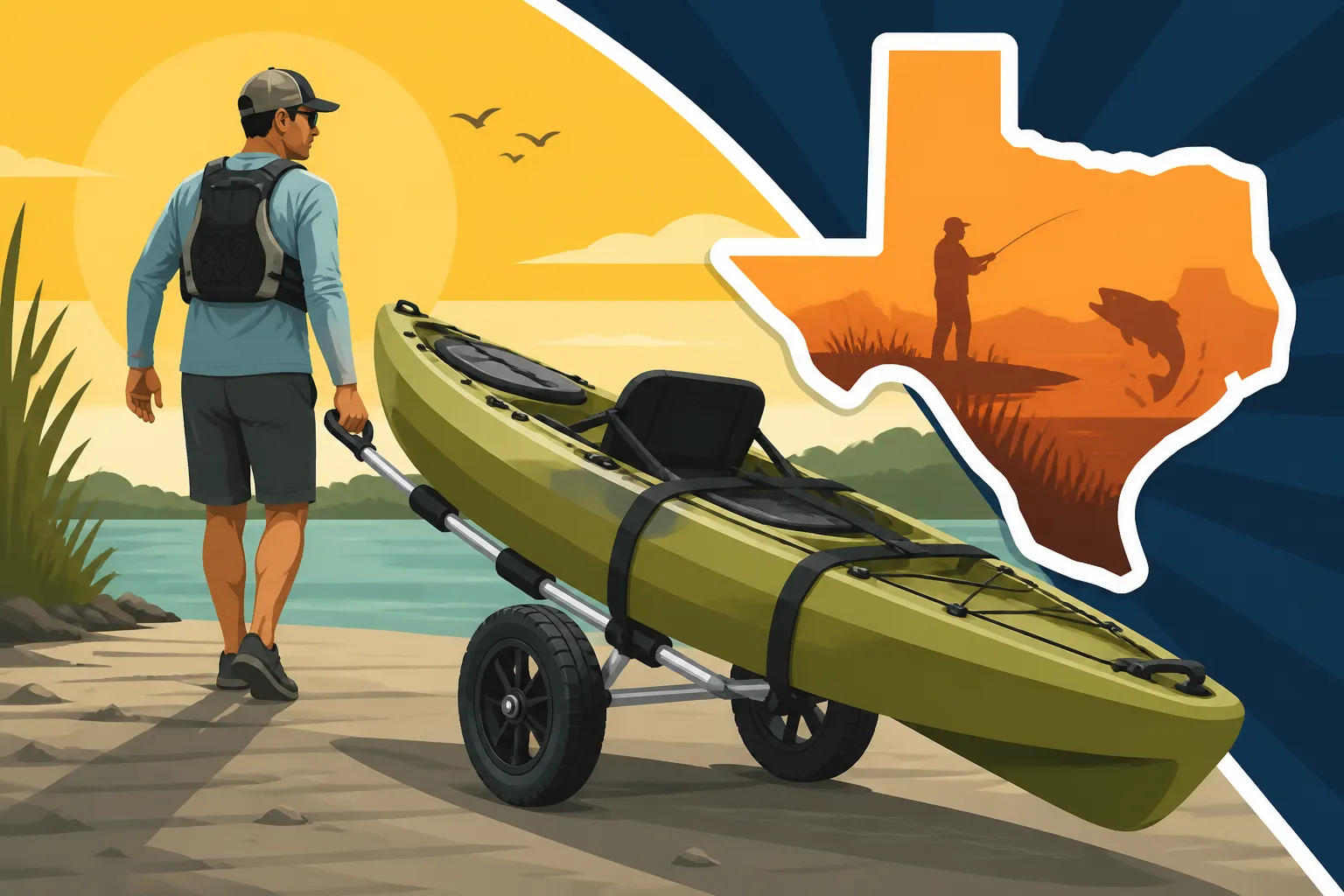
Strap or bunk carts, sometimes called "universal" carts, cradle your kayak on a frame, typically with padded bunks, and secure it with straps. They don't rely on scupper holes, making them far more adaptable.
Pros:
- Universal Compatibility: This is their greatest strength. They work with almost any kayak, whether it's a sit-on-top, sit-in, tandem, or even a canoe. If your kayak doesn't have scupper holes, or if they're oddly spaced, a strap cart is your go-to.
- Better Weight Distribution: Because the kayak rests on bunks or pads, the weight is distributed over a larger surface area of the hull, reducing stress points. This can be a huge benefit for heavier fishing kayaks or those made of less rigid materials.
- Hull Protection: The padded bunks protect your hull from abrasions and scratches during transport, which is a big deal when you've invested good money in your vessel.
Cons:
- Strapping Time: It takes a little longer to load and unload a kayak on a strap cart because you need to properly position and secure the straps. While not a huge delay, it's more than simply dropping it onto scupper posts.
- Bulkier Storage: Some strap carts can be a bit bulkier than their scupper counterparts, though many still fold down for storage. You'll need to check the dimensions if storage in a kayak hatch is critical.
- Secure Fastening is Key: You absolutely must ensure the kayak is securely strapped down. A loose strap on uneven terrain can lead to your kayak shifting or even falling off, which is a scenario no one wants to experience.
Many Texas anglers, especially those with larger, heavier fishing kayaks or those who swap between different kayak models, find the versatility and hull protection of a quality strap/bunk cart to be invaluable.
End-of-Kayaking Carts (Wheel-in-the-Sand Designs)
While less common as a primary kayak cart for all terrains, these designs deserve a mention, especially for those who primarily launch from soft, sandy beaches along the Texas coast. These carts typically feature much larger, often balloon-style, tires and are designed to attach to the stern (rear) of your kayak, allowing you to lift the bow (front) and pull it like a wheelbarrow.
Pros:
- Superior Sand Performance: The large, wide balloon tires excel on soft sand, effectively floating over the surface rather than digging in, which is a common problem for smaller, harder wheels. This is a lifesaver on places like Mustang Island or Bolivar Peninsula.
- Maneuverability: With only the stern on wheels, you have great control over steering from the bow.
Cons:
- Limited Versatility: While great for sand, these carts aren't always ideal for longer hauls over harder surfaces or rocky terrain, as the large tires can be cumbersome.
- Requires More Upper Body Strength: You're still bearing a good portion of the kayak's weight by holding the bow, so it's not entirely hands-free. This might still lead to some fatigue compared to a fully supported mid-ship cart.
- Bulkier: Those big balloon tires, while effective, make these carts less compact for storage in a kayak.
If your primary fishing grounds are sandy coastal beaches, an end-of-kayak cart with large wheels might be the niche solution you're looking for. However, for general-purpose Texas fishing across various terrains, a scupper or strap cart placed near the center of gravity is usually more practical.
Beyond the Basics: Crucial Features for Your Kayak Cart
Choosing the right type of kayak cart is just the first step. To ensure it truly enhances your solo fishing experience in Texas, you need to dig into the details and consider several key features. These elements will determine how well your cart performs on different terrains, how long it lasts, and how convenient it is to use.
Wheel Type and Terrain Suitability
The wheels are arguably the most important part of any kayak cart, directly impacting its performance on the diverse Texas landscape.
- Pneumatic (Air-Filled) Tires: These are your most common and versatile choice. They offer good shock absorption, making for a smoother ride over uneven ground, gravel, or roots. They also provide decent traction. However, they can go flat (always carry a small pump or patch kit!), and smaller pneumatic tires can still sink into soft sand. Look for larger diameter pneumatic tires for better performance on varied terrain.
- Solid/Hard Plastic Wheels: These are typically found on more budget-friendly carts. Their main advantage is that they can never go flat. They are excellent on paved surfaces, hard-packed dirt, and boat ramps. However, they offer no shock absorption, making for a bumpy ride on rough terrain, and they perform poorly on soft sand, often digging in deeply and requiring significant effort.
- Balloon Tires (Beach Wheels): As mentioned earlier, these are the kings of soft sand. Their extra-wide, low-pressure design allows them to roll over sand without sinking. If you frequently launch from the Texas coast, these are a game-changer. The downside is they are generally larger, heavier, and less efficient on hard surfaces, and can be quite a bit more expensive.
Consider where you fish most often. If it's mostly paved ramps and firm dirt trails around lakes like Lake Fork or Sam Rayburn, solid or standard pneumatic tires might suffice. But if you're frequently heading to sandy spots on the Gulf Coast or along the Red River, investing in a cart with larger pneumatic or dedicated balloon tires will save your back and sanity.
Durability and Materials
Texas weather, especially the coastal salty air and intense summer heat, can be brutal on gear. The materials and construction of your kayak cart directly impact its lifespan.
- Corrosion Resistance: This is paramount for saltwater anglers. Look for frames made of marine-grade aluminum, stainless steel, or high-quality, UV-resistant plastic. Steel frames, unless properly coated, will rust quickly when exposed to saltwater. Even if you fish freshwater, a durable, weather-resistant frame will last longer. Rinse your cart thoroughly with fresh water after every saltwater outing.
- Weight Capacity: Your fishing kayak, fully loaded with tackle, rods, and a cooler, can easily weigh over 100 pounds. Ensure the cart you choose has a weight capacity that comfortably exceeds your kayak's fully rigged weight. Skimping here can lead to bent frames or broken axles.
- Construction Quality: Examine welds, pivot points, and fasteners. Are they robust? Do components fit together snugly? A well-built cart will have strong joints and reliable hardware, ensuring it can handle the stresses of repeated use over rough ground. Brands like Wilderness Systems or Malone are often known for their robust construction, available through retailers like Bass Pro Shops or online at Amazon.
Ease of Assembly, Storage, and Portability
For a solo angler, convenience is key. A cart that's a hassle to assemble or store will quickly get left at home.
- Quick Breakdown/Assembly: Look for designs that allow for tool-free assembly and disassembly. Carts with quick-release pins for wheels or folding frames are ideal. You want to be able to set it up and pack it away efficiently.
- Compact Size: Can the cart be broken down small enough to fit inside your kayak's hatch, or at least in a small space in your vehicle? This is especially important if you plan to paddle to a new spot and then portage your kayak over land. If it's too bulky to carry with you, its utility is significantly reduced once you're on the water.
- Lightweight: While durability is important, a lightweight cart is easier to carry, both from your vehicle to the launch and if you need to portage it during a trip. High-quality aluminum frames often strike a good balance between strength and low weight.
Securing Your Kayak: Straps and Bunks
No matter the cart type, keeping your kayak safely secured is non-negotiable.
- Quality Straps: If using a strap-style cart, the included straps should be robust, long enough for your kayak, and easy to use. Cam-buckle straps are generally preferred over ratchet straps for kayaks, as ratchets can overtighten and potentially damage the hull. Look for straps with UV resistance to prevent degradation from sun exposure.
- Padded Bunks/Supports: Whether it's a strap cart or a scupper cart, ensure there's adequate padding where your kayak makes contact with the cart. This prevents scratches, dents, and ensures the weight is distributed evenly without causing friction points. Dense foam or rubber padding is ideal.
- Stability: A good cart will hold your kayak securely without it rocking excessively, even on uneven ground. Some carts feature kickstands or wider bases to prevent tipping while you're loading or unloading, which is a huge benefit when you're working alone. This stability prevents those frustrating moments where your kayak wants to roll off the cart just as you're trying to secure a strap.
Choosing Your Champion: Recommendations for Texas Kayak Anglers
Alright, let's talk about putting it all together and some potential options that might just become your trusty sidekick on those solo Texas fishing trips. Remember, the "best" cart is truly the one that best suits your specific kayak, your primary fishing locations, and your budget.
Top Picks for Freshwater Lakes and Rivers
When you're navigating the freshwater lakes and rivers of Texas – places like Lake Conroe, the Trinity River, or the vast Sam Rayburn Reservoir – you're likely to encounter a mix of terrains. Think paved ramps, gravel paths, grassy banks, and maybe a few muddy spots. For these environments, versatility and robustness are key.
- Mid-ship Scupper Carts (for compatible kayaks): If your sit-on-top kayak has strong, appropriately sized scupper holes, a robust scupper cart can be incredibly efficient. Look for models with larger diameter pneumatic tires (8-10 inches) that can handle varied surfaces. These are often compact and quick to deploy. Brands like Malone or C-Tug (which can sometimes be found at larger outdoor retailers like Bass Pro Shops or online through Amazon) offer excellent scupper cart options. The C-Tug, for example, is famous for its nearly indestructible, non-corroding construction and pneumatic tires that perform well across many terrains, even if it uses straps over scupper holes in a unique way.
- Universal Strap/Bunk Carts: For those with sit-in kayaks, or heavier sit-on-tops where scupper hole integrity is a concern, a well-padded strap cart is an excellent choice. Seek out carts with adjustable bunks and sturdy pneumatic tires. These carts offer superior hull protection and weight distribution. Many quality models from companies like Wilderness Systems or Yakima are available and offer a great blend of durability and ease of use. The adjustable bunks are a real blessing when you're trying to get a perfect fit on an oddly shaped fishing kayak.
When considering these options, pay close attention to the cart's ground clearance. You don't want the kayak's keel dragging on the ground if you hit a dip or a rise on an uneven trail.
Top Picks for Texas Coastal and Beach Launches
Ah, the Texas coast! From South Padre Island to Galveston, the lure of redfish, speckled trout, and flounder is strong. But the soft, sometimes unforgiving sand, can be a real pain to traverse with a standard kayak cart. For these adventures, specialized wheels are almost non-negotiable.
- Carts with Large Balloon Tires: This is where balloon tires truly shine. Carts specifically designed for beach use will typically feature 10-12 inch (or larger) low-pressure, wide tires. These distribute the weight of your kayak over a much larger surface area, allowing it to glide over soft sand with minimal effort. While they might be bulkier and a bit slower on pavement, their performance on sand makes them worth the trade-off if beach launches are your norm. You'll often find these specialized carts from brands like Wheeleez or even generic options on Amazon that focus entirely on sand performance.
- Heavy-Duty Strap Carts with Large Pneumatic Tires: If you want a bit more versatility than pure balloon tires but still need good sand performance, some heavy-duty strap carts come equipped with very large (12+ inch) pneumatic tires. While not quite as effortless as dedicated balloon wheels on the softest sand, they are a significant improvement over smaller wheels and can transition better to harder surfaces found near some coastal launch points. These often offer the best compromise for anglers who might fish both brackish bayou systems and sandy gulf beaches. Look for models made from corrosion-resistant materials, as saltwater exposure is guaranteed.
For coastal anglers, the ability to break down the cart and secure it to the kayak for offshore paddling (if you launch from the beach and head out into the surf) is another consideration. Some of the larger beach carts might not fit easily, so consider a cart that can be strapped to the deck or secured in a cargo area.
Budget-Friendly and Premium Options
Just like kayaks themselves, kayak carts run the gamut in price. You definitely get what you pay for in terms of materials, durability, and specialized features.
- Budget-Friendly (Under a certain amount): You can often find basic kayak carts with hard plastic wheels or smaller pneumatic tires at major sporting goods stores or online. These are typically fine for occasional use on paved or very hard-packed surfaces. They might require more effort on rough terrain and may not last as long in harsh conditions (especially saltwater) without extra care. Look for simple strap-style carts that offer decent weight capacity. Just manage your expectations; they'll get the job done for short, easy hauls but won't offer the same smooth ride or longevity as higher-end models.
- Mid-Range (A reasonable step up): In this category, you'll start seeing carts with better quality pneumatic tires, more robust aluminum frames, and thoughtful features like folding kickstands or quick-release wheels. Many excellent scupper carts and universal strap carts from reputable brands fall into this range. These are often the sweet spot for many Texas anglers, offering a good balance of performance, durability, and value. You'll find a wide selection at retailers like Bass Pro Shops and online.
- Premium (Investing in the best): These are the workhorses built for frequent, heavy use and challenging conditions. Think marine-grade materials, large-diameter balloon tires or top-tier pneumatic tires, and advanced designs that maximize stability and ease of use. Carts from brands like C-Tug or Wheeleez are often in this category. They might represent a more significant initial investment, but they pay for themselves in reduced frustration, prolonged lifespan, and superior performance, especially for the dedicated solo angler who values reliability above all else. When you’re fishing a tournament or simply want zero hassle getting your gear to the water, these premium options truly stand out.
No matter your budget, always prioritize the right wheel type for your primary fishing environment and ensure the cart's weight capacity exceeds your kayak's fully loaded weight. A cheap cart that breaks down or can't handle your terrain is no bargain at all. For more on getting your vessel ready, check out Texas Boat Registration Requirements or Texas Boat Title and Renewal Rules.
Here's a quick comparison of common kayak cart features:
| Cart Type | Wheel Type Focus | Ideal Texas Terrain | Pros | Cons | Typical Price Range |
|---|---|---|---|---|---|
| Scupper Cart | Pneumatic (8-10 inch) | Paved ramps, hard dirt, gravel trails | Simple, secure, compact | Scupper compatibility issues, potential damage | Mid-range |
| Strap/Bunk Cart | Pneumatic (8-10 inch) | Versatile: ramps, dirt, moderate sand, rocks | Universal fit, good hull protection | Slower to load, can be bulkier | Budget to Mid-range |
| Beach/Balloon Tire | Balloon (10-12+ inch) | Soft sand beaches, very loose soil | Superior sand performance, floats easily | Bulky, less efficient on hard surfaces, pricier | Mid-range to Premium |
| Heavy-Duty Universal | Large Pneumatic (12+ inch) | Varied: some sand, rough terrain, rocky shores | Strong, good capacity, decent all-rounder | Still not as good as balloon tires on softest sand | Mid-range to Premium |
| Basic (Entry-level) | Solid/Small Pneumatic | Paved ramps, very firm ground | Affordable | Poor on sand/rough terrain, less durable | Budget |
Before you head out, make sure you're up to speed on the local rules. You can find more information about Texas Fishing License Requirements Explained or even Who Doesn't Need a Texas Fishing License if you're unsure. If you're targeting specific fish, understanding limits is key, so check out Texas Fish Bag and Length Limits or even specifics like Texas Largemouth Bass Length Limits. For a deeper dive into techniques, you might find Beginner Fishing Techniques for Texas Anglers or How to Fish a Texas Reservoir in the Heat helpful. And if you're exploring the coastal waters, don't forget Texas Saltwater Endorsement Explained to ensure you're fully legal. Even exploring nearby waters like Lake Texoma Fishing License Rules has its own unique considerations. Sometimes it's nice to just throw a line in at Free Shoreline Fishing at Texas State Parks.
Disclaimer
This article is for general informational purposes only and does not constitute professional advice. Laws, prices and regulations vary by location and change over time. Consult a qualified professional for guidance on your specific situation.