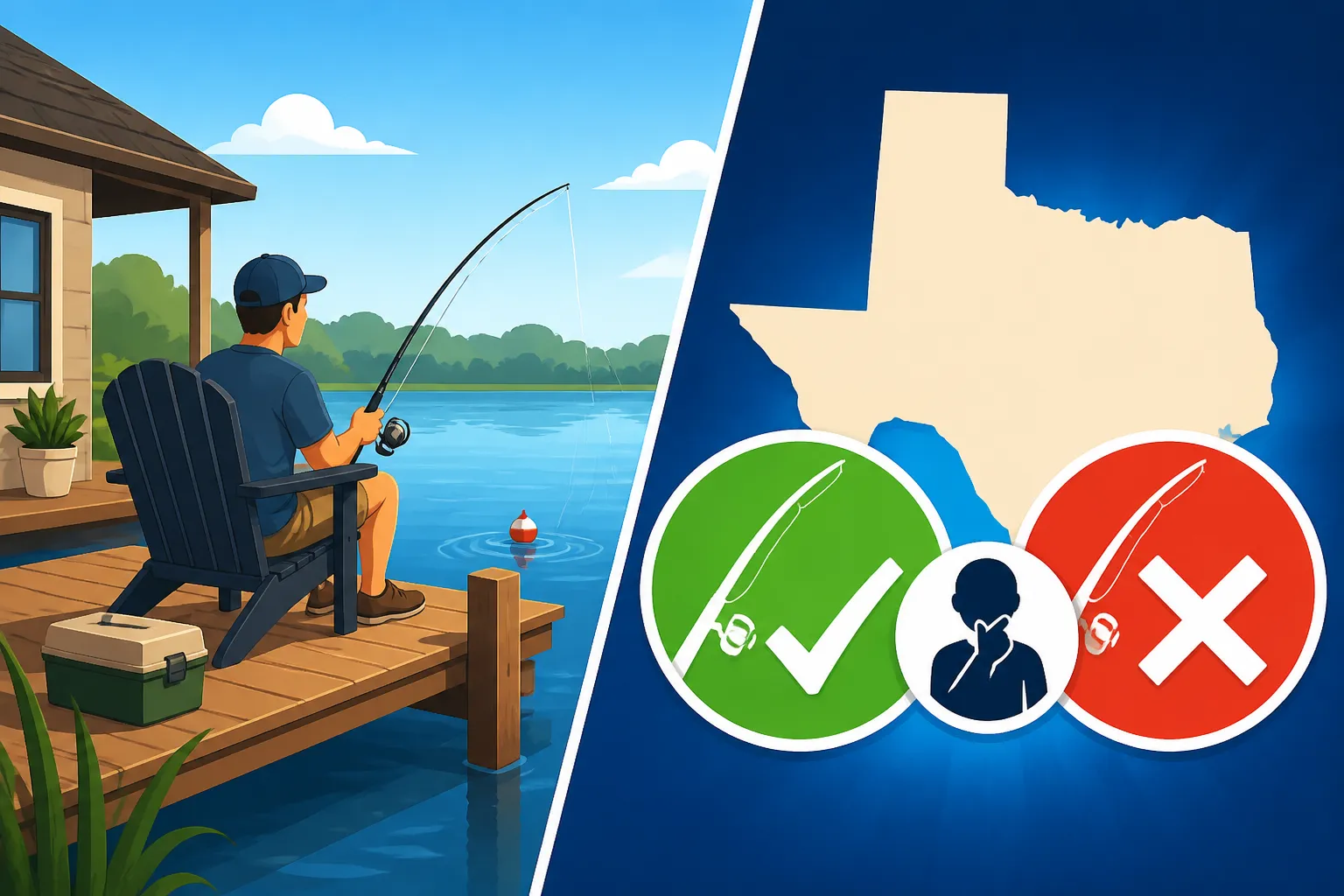
Do you need a Texas fishing license to fish from your own dock
It’s a common scenario, isn't it? You’ve invested in that beautiful waterfront property, perhaps on Lake Travis or Galveston Bay, and naturally, you want to enjoy your private dock. You grab your favorite rod and reel, step onto your own pier, and think, "Finally, a peaceful fishing session without all the fuss." But then a little voice in the back of your head whispers, "Do I still need a Texas fishing license, even from my own dock?" It's a question many Texans ponder, and it gets confusing fast. This guide is here to untangle that very specific, sometimes frustrating, licensing dilemma and make sure you're clear on the rules.
The Broad Strokes: When a Texas Fishing License is Generally Required
Let's start with the basics, because understanding the general rule helps clarify the exceptions. In Texas, if you are 17 years of age or older and you're fishing in public waters, a fishing license is almost always required. This isn't just some arbitrary rule; it's how the Texas Parks and Wildlife Department (TPWD) manages and conserves our state's incredible fisheries. The funds generated from license sales go directly back into stocking programs, habitat restoration, law enforcement, and educational initiatives, ensuring that future generations can enjoy the same fantastic fishing opportunities we do.
When we talk about "public waters" in Texas, we're discussing any natural waterway, lake, reservoir, bay, or stretch of the Gulf of Mexico that isn't entirely enclosed and privately owned. This encompasses pretty much every major body of water you can think of: Lake Fork, Sam Rayburn Reservoir, the Guadalupe River, Corpus Christi Bay, and the vast expanse of the Texas coast. Whether you're casting from a state park pier, a fancy bass boat, or simply wading in the surf, if that water is considered public, you're expected to have your license in hand (or on your phone!). For a complete overview of what you'll need, check out our guide on Texas Fishing License Requirements Explained.
Texas offers various types of licenses to suit different fishing preferences. You can get a freshwater-only license if you stick to inland lakes and rivers, a saltwater-only license for coastal excursions, or an all-water license if you like to dabble in both. Each comes with its own set of rules regarding endorsements, especially for saltwater fishing, where a Texas Saltwater Endorsement Explained is often needed. It's really designed to cover all the bases, ensuring that whatever type of angling you're passionate about, there's a license that fits.
Fishing from Your Private Dock: Public Water, Public Rules
Now, let's get right to the heart of the matter: fishing from your own dock. This is where a significant misunderstanding often arises. Many property owners assume that because the dock is on their land or extends from their property, the fishing rules somehow change. Unfortunately, that's rarely the case. If your dock is situated on a lake, river, or bay that is considered public water, then any fish you catch from that dock are swimming in, and are considered part of, the public fishery. Therefore, a Texas fishing license is required.
Think about it this way: your dock might be private property, an extension of your home, but the water itself isn't yours. You don't own the fish swimming under your pier on Lake Conroe any more than someone fishing from a public boat ramp nearby does. The same goes for properties lining Galveston Bay or any of the state's large reservoirs. Even if your dock is the most luxurious, custom-built structure on the water, the moment your line hits that public water, you're subject to the same regulations as any other angler. This includes abiding by all Texas Freshwater Fishing Regulations or Texas Saltwater Fishing Regulations, such as daily bag and length limits for various species.
This situation can feel a bit counterintuitive, especially if you've invested heavily in your waterfront property. You might feel like you should have some special exemption. However, the conservation model relies on uniform application of rules across public waters to be effective. If every dock owner on Lake Livingston or Toledo Bend Reservoir were exempt, it would create massive loopholes in conservation efforts and make enforcement nearly impossible. So, while your dock is a wonderful private amenity, the fishing opportunities it provides are intrinsically linked to the public resource.
The True Private Water Exemption: When a License is NOT Needed
So, when doesn't one need a Texas fishing license from private property? This is a very specific and often misunderstood exemption. You do not need a Texas fishing license to fish from your own dock or property if the body of water is wholly contained within private property and has no public access or connection to public waterways.
Let's break that down:
- Wholly Contained: This means the entire pond or lake must be exclusively on your private land, or on the private land of an association or group that owns it collectively. It cannot be fed by a public stream or river that originates outside the property, nor can it drain into one.
- No Public Access: There should be no public roads, easements, or other means by which the general public can legally access the water body for any purpose, including fishing.
- No Connection to Public Waterways: This is crucial. If your private pond connects even intermittently to a public creek, river, or lake, then those waters become "public waters" under Texas law, and a license would be required. This means even if a stream flows through your land and feeds into your pond, if that stream eventually connects to a public river, your pond might be considered public access.
Examples of truly private waters might include a small, man-made stock pond on a ranch that is fed only by rainfall or a well, and has no outflow to a public creek. Or a subdivision pond that is completely isolated, managed by a homeowners association, and has no inlet or outlet connected to larger water systems. These situations are relatively rare for properties that typically feature "docks" on larger, well-known bodies of water. For a deeper dive into this specific nuance, you can explore Do you need a license to fish on private property in Texas?.
It's vital to be absolutely certain your water body meets all these criteria before assuming you're exempt. If there's any doubt, it's always safer and wiser to obtain a license. A quick check with TPWD or a local game warden can clarify ambiguous situations, ensuring you don't inadvertently break the law.
| Scenario | Water Body Type | License Required? | Explanation |
|---|---|---|---|
| Fishing from a dock on Lake Travis | Public Lake/Reservoir | Yes | Dock is on private land, but water is public. |
| Fishing from a pier on Galveston Bay | Public Bay/Estuary | Yes | Pier is private, but bay water is public. |
| Fishing from a dock on a private pond that drains into a public creek | Semi-Private/Public | Yes | Pond connects to public waterways, making it public for fishing purposes. |
| Fishing from a stock pond entirely on your ranch, no public access/connection | Wholly Private Pond | No | Water body is completely isolated and privately owned. |
| Kids under 17 fishing from any dock on public water | Public Water | No | Age exemption applies to public waters. |
| Disabled Veteran fishing from a dock on Lake Fork | Public Lake/Reservoir | No | Specific exemption applies to public waters. |
Important Exemptions and Staying Legal
While the "private dock on public water" rule might seem strict, it's part of a broader framework of regulations designed to protect our natural resources. However, Texas does offer several exemptions to the general fishing license requirement that apply regardless of whether you're on a public or private dock extending into public water.
The most common exemption is for age:
- Youth Exemption: Anyone under 17 years of age is not required to have a fishing license in Texas. This is fantastic news for families, encouraging kids to get out on the water and develop a love for fishing without an extra barrier. So, if your little ones are casting from your dock into Lake Ray Roberts, they're good to go without a license! Our Texas Youth Fishing License Rules guide offers more specifics.
- Senior Exemption: Residents born before January 1, 1931, are also exempt from needing a fishing license. While this is a smaller group now, it's a long-standing provision.
Beyond age, there are other significant exemptions:
- Disabled Veterans: Texas offers a generous exemption for resident disabled veterans. If you are a Texas resident and a veteran with a service-connected disability of 50% or more, or if you've lost the use of a lower extremity, you are eligible for a free fishing license. This is a small token of gratitude for their service. Detailed requirements can be found in our Texas Disabled Veteran Fishing License Rules article.
- Intellectually Disabled Anglers: An intellectually disabled person who is fishing under the immediate supervision of a licensed angler is also exempt.
- Free Fishing Day: Texas typically has one Free Fishing Day each year, usually in early June. On this day, anyone can fish in public waters without a license. It's a fantastic opportunity to try out a new spot or introduce someone to fishing without the upfront cost of a license. Remember, though, that all other regulations, like bag and length limits, still apply. Learn more about the date and specific rules in Texas Free Fishing Day.
Even with these exemptions, it's crucial to always carry proof of your eligibility if you fall into one of these categories. For instance, disabled veterans should carry their proof of disability, and those fishing on Free Fishing Day should still be aware of all other fishing regulations. A game warden can always ask for identification. Speaking of carrying your license, you absolutely should have it with you, either physically or digitally on your phone. See our article Do you have to carry your Texas fishing license while fishing? for more information on acceptable forms.
Navigating the Rules and Avoiding Penalties
Understanding these nuances is the first step to enjoying your dockside fishing legally. The last thing any angler wants is a run-in with a game warden, especially when you thought you were doing everything right. Ignorance of the law is generally not considered an excuse, so it's on us to stay informed.
If you are caught fishing without the required license in Texas, even from your own dock on public water, the consequences can range from a citation and fine to potential court costs. Fines can vary depending on the specific violation and the county, but they can easily run into hundreds of dollars, plus administrative fees. It's a far more expensive proposition than simply buying a license upfront. Our guide on Fine for fishing without a license in Texas details the potential repercussions. Beyond the financial hit, it can also be a significant hassle, taking time out of your day for court appearances and paperwork.
So, how do you ensure you're always compliant?
- Buy a License: If there's any doubt about your water body being truly private, or if you don't fall under a specific exemption, just get a license. You can purchase them easily online through the TPWD website, by phone, or in person at authorized retailers like sporting goods stores (e.g., Academy Sports + Outdoors) and even many Walmarts across the state. Many anglers also buy supplementary gear like waterproof license holders or specific fishing accessories through online retailers like Amazon to ensure they're prepared.
- Understand Your Water: For dock owners, take the time to understand if your lake, river, or bay is truly public. Most major bodies of water in Texas are public.
- Carry Proof: Always have your license or proof of exemption with you. You can show your license on your phone using the official TPWD Outdoors App, which is incredibly convenient. Find out more about this option in Texas fishing license mobile app explained.
- Stay Updated: Regulations can change, especially regarding bag and length limits or specific seasons. Always consult the current TPWD Outdoor Annual before you head out.
Ultimately, getting a Texas fishing license is a small investment that pays huge dividends, not just in peace of mind, but in contributing to the health and abundance of our state's incredible fisheries. So, grab your license (and maybe a new fishing reel from Amazon for that dock fishing!), and enjoy the incredible angling Texas has to offer, right from your own backyard.
Disclaimer
Please remember that fishing regulations and licensing requirements can change. This guide provides general information based on current Texas Parks and Wildlife Department rules. Always consult the most recent TPWD Outdoor Annual or visit their official website for the most up-to-date and authoritative information before engaging in any fishing activities.