Best swivels for saltwater rigs
There's nothing quite as frustrating as feeling that solid hook-up on a powerful Texas redfish or a hard-fighting speckled trout, only for your line to go slack a few seconds later. You reel in, feeling a knot of disappointment tighten in your chest, and realize it wasn't a missed bite or a bad hookset – it was a tiny, often overlooked piece of terminal tackle that failed. Many times, the culprit is a poor-quality swivel that succumbed to the harsh saltwater environment or simply couldn't handle the strain. This guide will walk you through everything you need to know to choose the best swivels for your saltwater rigs, ensuring that your connection point is as strong and reliable as the rest of your setup when you're targeting those prized catches along the Texas coast.
Why Swivels Are Critical in Saltwater Fishing and Why They Fail
Swivels might seem like minor components, but in the brutal world of saltwater fishing, they play an absolutely crucial role. They are the unsung heroes that prevent frustrating line twist, strengthen connections, and sometimes, are the only thing standing between you and a lost trophy fish. Understanding why they are so important and the common reasons they fail is the first step toward making informed choices for your tackle box.
The Twisting Nemesis: Line Twist
Imagine you're out on Galveston Bay, casting artificial lures for speckled trout, or maybe you're dropping cut bait for redfish that's spinning as it sinks. Every retrieve, every current, and every struggling fish can impart a twist on your fishing line. Over time, this cumulative twisting becomes a serious problem. A twisted line becomes weak, unmanageable, and prone to tangles, leading to frustrating wind knots and premature line breaks. It's a nightmare scenario when you're trying to make a precise cast into a school of feeding fish. Swivels are designed to counteract this. By allowing your line to rotate independently from your leader or lure, a good swivel absorbs and dissipates these twisting forces, keeping your main line straight and strong. Without an effective swivel, you're constantly fighting your line, losing casting distance, and ultimately, risking your entire setup.
Corrosion: The Silent Killer
Saltwater is an incredibly corrosive environment, and it shows no mercy to metals, especially those of lesser quality. A cheap swivel, even if it looks shiny out of the package, can quickly become a rusty, weak link after just a few exposures to the salty air and water of the Texas coast. This isn't just about aesthetics; corrosion eats away at the metal, weakening the swivel's integrity and drastically reducing its breaking strength. A swivel that's rated for 100 pounds might only hold 10 pounds once rust sets in. Furthermore, the process of galvanic corrosion can occur when dissimilar metals are in contact in saltwater, accelerating the degradation. You might have a perfectly good stainless steel hook, but if it's connected to a cheap brass swivel, the weaker metal will quickly suffer. Always rinse your gear thoroughly after every saltwater trip to minimize corrosion, but starting with high-quality, corrosion-resistant swivels is your first line of defense.
Breaking Strength vs. Real-World Strain
When you look at a swivel's packaging, you'll see a breaking strength rating, often expressed in pounds. It's easy to assume that if you're fishing with 20-pound test line, a 30-pound swivel is more than adequate. However, real-world fishing conditions are far more dynamic than a static test. A hard-charging redfish making a powerful run, a quick hookset on a stubborn flounder, or even the sudden shock of a lure snagging on an oyster shell can generate forces far exceeding the line's stated breaking strength in a quick burst. A swivel, being a connection point, is a high-stress area. If the swivel isn't designed with quality materials and robust construction, it can flex, bend, or even pull apart under these intense, momentary loads. It's not just about the static pull; it's about the sudden impact and dynamic stresses that a swivel must withstand, especially when battling a strong fish like a jack crevalle or a large black drum in the bays.
Types of Swivels: Matching the Rig to the Fish
Just like you wouldn't use a tiny crappie jig for a bull redfish, you shouldn't use the wrong type of swivel for your saltwater application. Each style of swivel has its own strengths and weaknesses, making some more suitable for certain techniques and target species along the Texas coast.
Barrel Swivels: The Everyday Workhorse
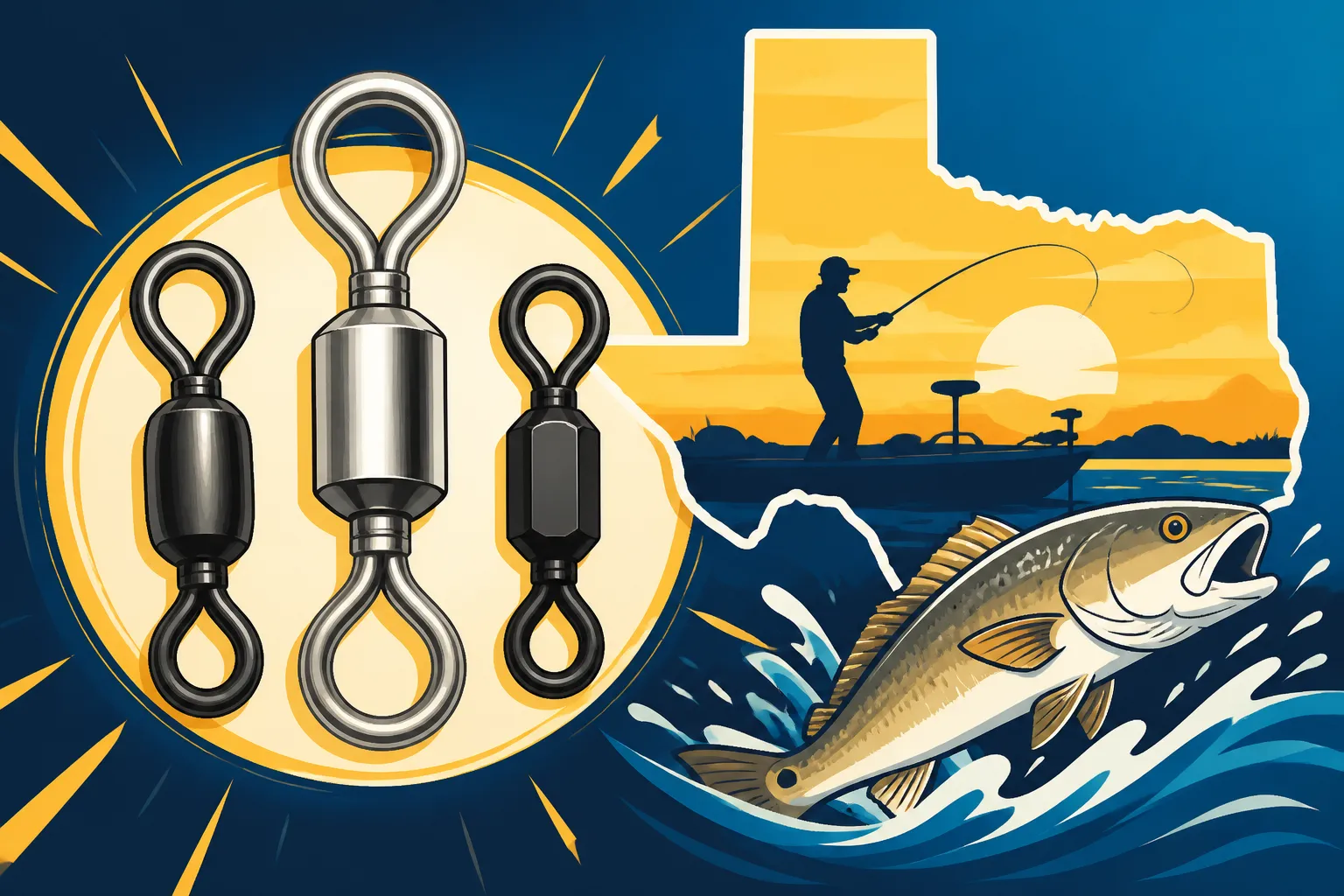
The classic barrel swivel is probably what most anglers picture when they think of a swivel. They consist of two rings connected by a rotating barrel, offering a simple and effective way to reduce line twist. They are relatively inexpensive and widely available, making them a common choice for many freshwater and light saltwater applications. For many general-purpose Texas saltwater rigs, such as a basic bottom rig for catching croaker or a leader for small speckled trout, a good quality barrel swivel can get the job done. They're discreet, don't add much weight, and are easy to tie. However, their anti-twist capabilities are somewhat limited compared to more specialized designs, especially under heavy load or with fast-spinning baits. If you're using heavy lures that spin or targeting fish known for violent headshakes and rolls, a barrel swivel might not be enough to prevent line twist over a long fishing session.
Crane Swivels: Heavy-Duty Reliability
Crane swivels are essentially an upgraded version of the barrel swivel, built with thicker wire, stronger barrels, and generally a more robust construction. They still feature the two rings connected by a barrel, but the components are beefier, allowing them to handle significantly more strain. For anglers targeting larger, harder-fighting fish like bull reds, drum, or even smaller sharks in the surf, crane swivels are a much better choice than standard barrel swivels. They offer increased breaking strength and improved durability, especially against the pulling and tugging of a strong fish. While they still rely on a simple rotating barrel, the heavier construction means they can withstand more abuse before binding up or failing. You'll often find these employed in Texas Saltwater Fishing Techniques where strength is paramount.
Ball-Bearing Swivels: The Ultimate Twist Stopper
When maximum rotation and anti-twist performance are paramount, ball-bearing swivels are the gold standard. Instead of a simple barrel-on-barrel rotation, these swivels incorporate tiny stainless steel ball bearings between the two main components. This design allows for incredibly smooth, almost friction-free rotation, even under heavy load. If you're trolling lures that spin rapidly, jigging heavy metal baits, or using live bait that can twist your line relentlessly, a ball-bearing swivel is an invaluable piece of gear. They are fantastic for situations like slow-trolling for king mackerel offshore or casting large spoons for striped bass in Lake Texoma, where lure action and line integrity are critical. The trade-off is that they are generally larger and significantly more expensive than barrel or crane swivels. However, the investment is often worth it for the peace of mind and superior performance they offer, especially when targeting prized game fish. Brands like Spro and Sampo are well-known for their high-quality ball-bearing swivels, available at stores like Bass Pro Shops or through online retailers such as Amazon.
Snap Swivels and Interlocks: Convenience vs. Compromise
Snap swivels combine a swivel (often a barrel or crane type) with a snap or interlock clip. Their main advantage is convenience: they allow you to quickly change lures, leaders, or rigs without having to re-tie knots. This can be a huge time-saver when the bite is hot, or you're trying to figure out what the fish want. However, this convenience comes with a potential compromise. The snap mechanism itself can be a weak point, sometimes failing under extreme pressure or even opening up unexpectedly if not properly closed. Moreover, the extra bulk of the snap can sometimes deter wary fish or interfere with the natural action of certain lures. For general-purpose fishing where rapid changes are common, such as light tackle fishing for schooling fish, they can be fine. But for targeting trophy fish or in situations where absolute strength and stealth are critical, a direct knot to a high-quality swivel is generally preferred. If you do use snap swivels for saltwater, opt for heavy-duty, corrosion-resistant stainless steel snaps with a strong interlock design to minimize failure points.
Choosing the Right Size and Material for Texas Saltwater
Selecting the right swivel isn't just about the type; it's also about the materials they're made from and their physical size. These factors directly impact durability, strength, and how well they perform in the harsh Texas saltwater environment.
Stainless Steel vs. Brass: Durability and Corrosion Resistance
When it comes to saltwater swivels, material matters immensely. The two most common materials you'll encounter are brass and stainless steel.
-
Brass Swivels: Many standard, inexpensive swivels are made from brass. While brass has decent corrosion resistance in freshwater, it's far less resilient to saltwater. Brass will oxidize and corrode much faster than stainless steel, weakening over time. This can lead to the swivel seizing up and losing its rotation, or worse, breaking under pressure. While often coated with a black or nickel finish to mask the brass, these coatings can chip or wear, exposing the underlying metal to the elements. They are typically fine for very light, occasional use or in situations where quick replacement is expected. However, for any serious saltwater angling along the Texas coast, brass is generally not the preferred choice for critical connection points.
-
Stainless Steel Swivels: This is the material of choice for serious saltwater anglers. Stainless steel offers superior corrosion resistance, meaning your swivels will last much longer and retain their strength in the salty air and water. High-quality stainless steel swivels are built to withstand the elements and the rigors of fighting strong fish. They are more expensive than brass, but the added durability and reliability are well worth the investment, especially when you consider the cost of losing a prized catch due to a cheap swivel failure. When you're fishing for aggressive species like redfish or speckled trout, you want every component of your rig to be able to handle the fight, and stainless steel delivers that confidence.
Sizing Your Swivel: Don't Overlook This Detail
Choosing the correct size of swivel is a balance between strength, stealth, and practicality. A common mistake anglers make is using a swivel that is either too large or too small for their setup.
- Too Large: An oversized swivel can be heavy, affecting the natural presentation of your bait or lure. It can also be very visible, potentially spooking wary fish, especially in clear water conditions often found in the shallower flats of the bay. Furthermore, a large swivel can interfere with knot tying, making it difficult to achieve a strong, compact connection to your leader or main line.
- Too Small: Conversely, a swivel that is too small for your line or target species might not have the adequate breaking strength, even if it's made from quality material. Small rings can also be difficult to tie heavy leader material to, and the knots themselves can be compromised. If the swivel is undersized for the forces it will encounter, it becomes the weak link in your entire setup, leading to break-offs.
A good rule of thumb is to match the swivel's breaking strength closely to your main line and leader strength. If you're fishing 20-pound test line, a swivel rated for 30-50 pounds is a reasonable choice, offering a buffer of strength without being excessively bulky. For heavier setups, like when chasing larger sharks or tarpon, you'd scale up accordingly. Always aim for the smallest, strongest swivel that will adequately handle your line and the fish you're targeting.
Key Features to Look For: Quality Construction
Beyond material and size, there are several other indicators of a high-quality swivel that's built to perform in saltwater:
- Smooth Rotation: The swivel should rotate freely and smoothly, without any binding or grinding. This is especially critical for ball-bearing swivels, where the bearings ensure optimal performance. A stiff or sticky swivel will not effectively prevent line twist.
- Strong Welded Rings: Check the connection points where the swivel's rings meet the barrel. High-quality swivels will have strong, smoothly welded rings that are less likely to open up under pressure. Cheap swivels might have flimsy or poorly joined rings.
- Black Nickel Finish: While stainless steel is inherently corrosion resistant, a black nickel finish can provide an extra layer of protection, reduce glare (which might spook fish), and make the swivel more discreet. Many premium saltwater swivels will feature this finish.
- Reputable Brands: Sticking with well-known, reputable brands in the fishing industry is often a good strategy. Companies that specialize in terminal tackle, especially for saltwater, have a vested interest in producing reliable products. Look for brands often carried by trusted retailers. When stocking up, both Bass Pro Shops and Amazon offer a wide range of quality options for Best leader material for redfish and Texas Saltwater Fishing Techniques.
Here's a quick comparison of common swivel types for saltwater:
| Swivel Type | Pros | Cons | Best Use Cases in Texas Saltwater |
|---|---|---|---|
| Barrel Swivel | Inexpensive, compact, easy to tie, good for light twist. | Limited anti-twist under heavy load, susceptible to binding. | Light tackle for speckled trout, panfish, leader for basic bottom rigs, Free Shoreline Fishing at Texas State Parks general use. |
| Crane Swivel | Stronger than barrel, more durable, better for moderate loads. | Still less anti-twist than ball-bearing, can bind under extreme twist. | General bay fishing for redfish, drum, larger trout, surf fishing with moderate lures, Texas Redfish Fishing Guide applications. |
| Ball-Bearing Swivel | Superior anti-twist, incredibly smooth rotation, high strength. | Most expensive, larger/bulkier, can be overkill for light applications. | Trolling offshore for kingfish, jigging, using fast-spinning lures, live bait fishing for large, hard-fighting species, How to Troll for Striped Bass in Texas. |
| Snap Swivel | Convenient for quick lure changes, saves re-tying. | Snap can be a weak point, added bulk, potential to open unexpectedly. | Situations requiring frequent lure changes, casual fishing, less critical applications. |
Integrating Swivels into Your Saltwater Rigs
Knowing your swivels is one thing, but knowing how to effectively incorporate them into your saltwater fishing rigs is where the rubber meets the road. Placement and purpose are key for maximizing their benefits.
Leader Connections: The Backbone of Your Setup
For most saltwater applications, swivels primarily serve as the critical link between your main fishing line and your leader. Your main line, often braided, is spooled on your reel and is designed for strength and casting distance. Your leader, typically fluorocarbon or monofilament, is a shorter section of line tied to the end of your main line. It's often clearer, more abrasion-resistant, and provides a stealthy connection to your lure or bait. The swivel fits right in between these two.
When connecting your main line to your swivel, use a strong, reliable knot. For braided lines, knots like the Palomar knot or the double Uni knot are excellent choices that retain much of the line's breaking strength. When tying your leader to the other end of the swivel, ensure you're using knots appropriate for the leader material, such as a Uni knot or an improved Clinch knot. The goal is to have every knot as strong as the line itself. A properly tied knot to a quality swivel ensures that the swivel can do its job of preventing twist and absorbing shock without introducing a weak point. This connection is vital whether you're sight-casting for Texas Redfish Slot Limit Explained in the shallows or fishing deeper channels for Texas Blue Catfish Length and Bag Limit.
Trolling Rigs and Live Bait Setups
Certain fishing techniques inherently create more line twist, making the choice of swivel even more crucial.
- Trolling: When you're trolling baits or lures behind a boat, especially for extended periods, even slight imperfections in the lure's action or subtle currents can cause your line to twist. For species like Spanish mackerel or kingfish, which are often caught while trolling spoons or lipped plugs, a ball-bearing swivel is almost mandatory. It allows the lure to spin freely without transferring that rotational energy up your main line. Without it, you'll end up with a severely twisted main line that's a nightmare to manage and drastically weakened.
- Live Bait Fishing: Live baits like shrimp, mullet, or croaker, especially when fished freelined or under a popping cork, can swim erratically and twist your line. A frisky live shrimp doing acrobatics will quickly put kinks in your mono leader and main line. A good swivel allows the bait to move naturally and twist without affecting the integrity of your main line. For a struggling live bait, especially when targeting powerful fish like redfish, a robust crane or ball-bearing swivel will ensure that the constant movement doesn't weaken your connection. Make sure to choose a swivel with a low-profile, dark finish to keep it as inconspicuous as possible around your live bait.
Terminal Tackle for Specific Texas Species
Different species and fishing scenarios along the Texas coast will call for slight variations in your swivel choices.
- Redfish and Black Drum: These powerful bottom feeders are known for their strong runs and headshakes. A strong crane swivel or a heavy-duty ball-bearing swivel is recommended, particularly when using live or cut bait on a Carolina rig or a fish-finder rig. Their sheer power demands a reliable connection point. Consider swivels in the 50-80 pound range for most general redfish applications.
- Speckled Trout: While not as powerful as redfish, speckled trout can still put up a decent fight, and you're often fishing for them with lighter lines and more finesse presentations. A smaller, quality barrel or crane swivel (20-40 pound test) is usually sufficient. When using artificial lures like soft plastics or topwaters that might impart some twist, a smaller ball-bearing swivel can be beneficial without being overly bulky.
- Flounder: Flounder fishing, especially during the fall run, often involves dragging baits or jigs along the bottom. While they aren't known for line-twisting acrobatics, a strong, corrosion-resistant swivel is still important to prevent abrasion and maintain connection integrity, especially if using a spinning lure like a Flounder Killer. A small crane swivel will serve you well here. For more details, check out Texas Flounder Season and Limits.
- Offshore Species: For larger game fish like king mackerel, snapper, or even tuna further offshore, heavy-duty ball-bearing swivels are virtually non-negotiable. These fish are fast, strong, and can generate immense strain on your tackle. Don't skimp on quality when you're 50 miles out in the Gulf.
Ultimately, the best swivel is one that you trust, that matches your line strength, is made from quality, corrosion-resistant materials, and is appropriate for the fish and fishing technique you're employing. Don't let a small, inexpensive piece of hardware be the reason you tell a story about "the one that got away" on your next Texas fishing adventure. Always keep a variety of sizes and types on hand in your tackle box.
Disclaimer
This article is for general informational purposes only and does not constitute professional advice. Laws, prices and regulations vary by location and change over time. Consult a qualified professional for guidance on your specific situation.