Best treble hooks for crankbaits
There's nothing quite as frustrating as feeling that solid strike on your favorite crankbait, fighting the fish for a few tense moments, only to have it throw the hook right at the boat. You reel in, and there it is – a bent hook, a dull point, or perhaps even a completely straightened treble. It's a gut punch, especially when you know it was a good fish. This guide is all about preventing that heartbreak by helping you understand and choose the best treble hooks to upgrade your crankbaits, ensuring those Texas lunkers stay pinned all the way to the net.
Why Upgrading Your Treble Hooks Matters for Crankbaits
When you buy a crankbait off the shelf, the hooks it comes with are often decent enough for casual fishing. But "decent enough" rarely cuts it when you're targeting big, hard-fighting fish in Texas, whether that's a hawg largemouth in Lake Fork or a monster striped bass on Lake Texoma. The stock hooks can be a weak link in your setup, and upgrading them is one of the easiest and most impactful changes you can make to improve your success rate.
The Frustration of Lost Fish and Bent Hooks
We've all been there. You've spent hours casting, finally get that perfect bite, and then disaster strikes. The fish jumps, shakes its head, and the hook gives way. Sometimes it's a completely straightened hook, other times it's a dull point that just didn't penetrate deep enough, or maybe the hook simply opened up. This isn't just bad luck; often, it's a sign that your hooks aren't up to the task. Texas bass and other game fish are powerful, and they know how to use leverage to their advantage. A flimsy hook is no match for a strong jaw and a violent head shake. Losing a personal best or a tournament-winning fish because of a cheap hook can really sour an otherwise great day on the water.
Enhancing Hook-Up Ratios and Landing Success
The primary reason to upgrade your treble hooks is to drastically improve your hook-up ratio and, more importantly, your landing success. Sharper, stronger hooks penetrate deeper and hold better. Imagine a scenario where a fish just "swipes" at your crankbait, barely getting a barb. With a super-sharp, high-quality hook, that minimal contact might be enough to get a solid hold. With a dull, stock hook, it's a missed opportunity. Better hooks mean fewer "short strikes" turning into lost fish and more of those thrilling fights ending with a fish in the boat. This is especially true when fishing for species like Texas Largemouth Bass Fishing Guide or Texas Striped Bass Fishing Guide, known for their aggressive strikes and powerful fights.
Durability and Corrosion Resistance in Texas Waters
Texas presents unique challenges for fishing gear, especially hooks. Our freshwater lakes can have varying water chemistry, and our saltwater environments, like the Gulf Coast bays, are incredibly corrosive. Stock hooks often lack the robust coatings and materials needed to withstand these conditions for long. You might notice rust forming quickly, even after just one or two trips, which dulls the points and weakens the metal. Upgrading to hooks with advanced anti-corrosion finishes means they'll last longer, stay sharper, and maintain their structural integrity, which is vital whether you're chasing redfish in Galveston Bay or casting for bass in the mineral-rich waters of Canyon Lake.
Key Factors in Choosing Treble Hooks for Crankbaits
Selecting the right treble hooks isn't just about grabbing the biggest or sharpest ones you can find. There's a delicate balance to strike, considering your specific crankbait, target species, and fishing conditions. Getting these factors right will make a huge difference in your fishing experience.
Hook Size and Shank Length: Getting the Right Fit
The size of your treble hook is paramount. Too large, and it can interfere with the crankbait's action, cause hooks to tangle, or even scare off finicky fish. Too small, and you might not get enough bite for a solid hookset, especially on larger fish. Generally, you want to match the size of the replacement hooks to the original hooks that came with the crankbait, or go up one size if you feel the stock hooks were too small. Hook sizing can be a bit confusing, with smaller numbers (e.g., #2) indicating larger hooks than larger numbers (e.g., #10).
Shank length also plays a role. Longer shank hooks can be good for fish that often short-strike, but they also increase the chance of hooks tangling with each other or the bait's body. Short shank hooks reduce tangles but might offer less reach. Most standard crankbaits do well with a regular or slightly short shank. If you're unsure, try to find hooks that are the same size as the original, then experiment with different brands or wire gauges. You might even consider a combination of sizes, like a slightly larger hook on the front of the bait for those head-on strikes.
Wire Gauge and Strength: Standard vs. Heavy-Duty
This is where the "strength" factor really comes into play. The wire gauge refers to the thickness of the metal wire used to form the hook.
- Standard Wire (1X, 2X Strong): These are generally what come on most crankbaits. They offer a good balance of penetration and strength for average fishing scenarios and smaller to medium-sized fish. If you're fishing lighter line and targeting less aggressive fish, a 1X or 2X strong hook is usually sufficient. They penetrate easily, requiring less force for a hookset.
- Heavy-Duty Wire (3X, 4X Strong): These hooks are made from thicker wire, making them much stronger and more resistant to bending or straightening. They are ideal for bigger, harder-fighting fish like trophy bass, Texas Alligator Gar Fishing Guide, or saltwater species where sheer power is needed. The trade-off is that heavier wire can slightly reduce penetration due to its thickness, sometimes requiring a bit more force to set the hook. However, once set, they are much more reliable. If you're throwing big crankbaits on heavy braided line in thick cover, 3X or 4X strong hooks are your best friend.
Hook Point Sharpness and Design: Sticking Power
A sharp hook point is non-negotiable. Even the strongest hook is useless if it doesn't penetrate. Look for hooks that are chemically sharpened or laser-sharpened right out of the package. You should be able to lightly touch the point to your thumbnail, and it should stick without sliding. If it slides, it's not sharp enough.
There are a few common hook point designs:
- Conical/Needle Point: This is the most common and often the sharpest, penetrating easily. Great for all-around use.
- Cutting Point: Designed with a triangular or flattened shape on the sides, these points are meant to slice through tougher tissue. They can be very effective but might not penetrate as smoothly as a needle point.
- Modified or Ultra Point: Many brands have proprietary designs that aim to combine the best aspects of both, offering exceptional sharpness and durability.
The barb design is also important. A good barb will hold the fish securely without tearing too large a hole. Some hooks feature smaller, micro-barbs for easier penetration and release, which can be useful if you're practicing catch-and-release frequently.
Coatings and Finish: Protecting Against the Elements
The finish on your treble hooks protects them from corrosion and can even influence their visibility to fish.
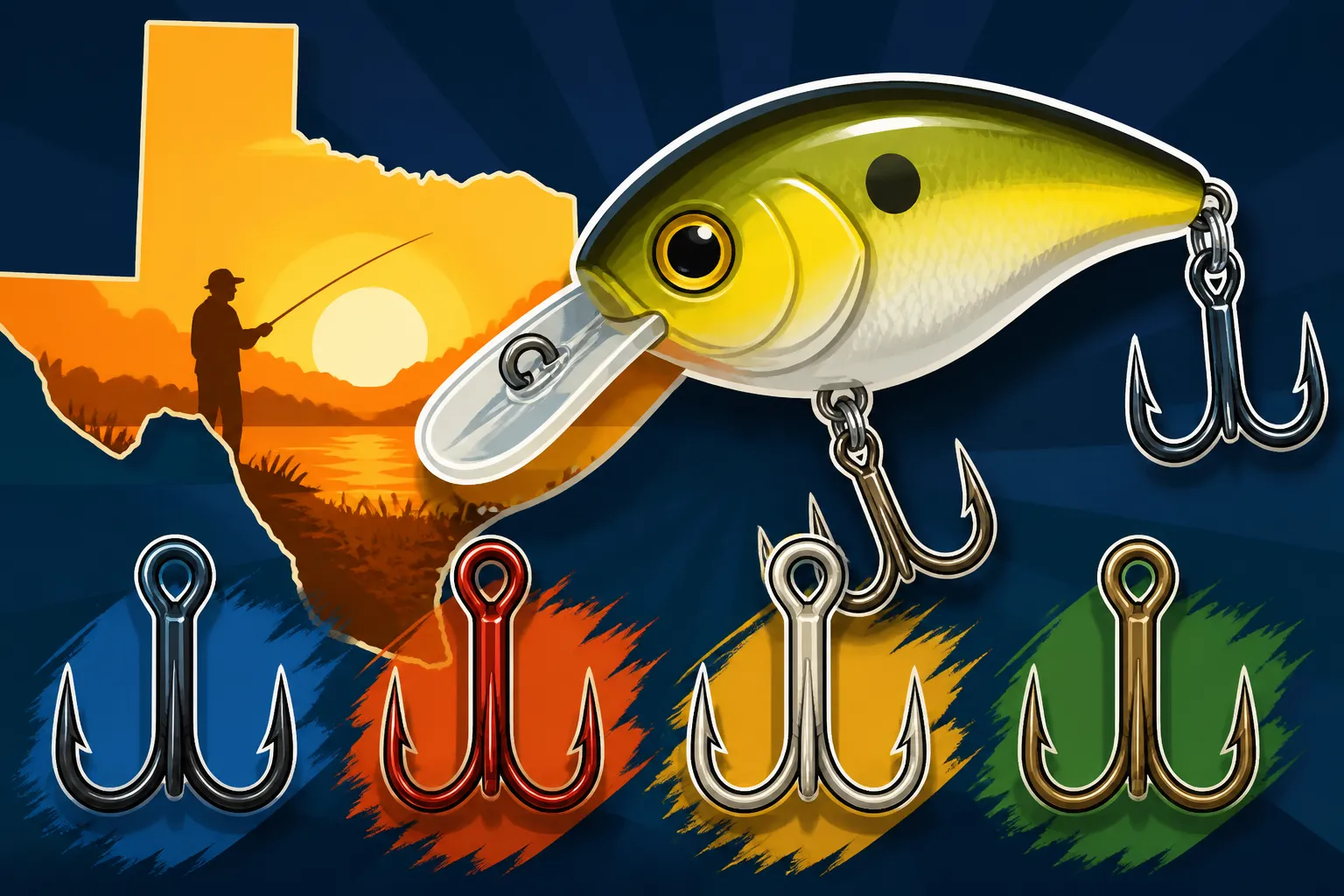
- Nickel/Black Nickel: A very common and effective coating that provides good corrosion resistance in freshwater. Black nickel also has the advantage of being less reflective, which some anglers prefer, especially in clear water or when fish are skittish. Many hooks from brands like Gamakatsu and Owner use these finishes.
- Tin/Saltwater Specific Coatings: For saltwater fishing, tin is an excellent choice, offering superior resistance to the corrosive effects of salt. Many brands offer hooks specifically designed for saltwater use, often labeled as "saltwater grade" or "tin-coated." If you're fishing the Texas Gulf Coast Fishing Spots, these are a must.
- Red Hooks: Some anglers swear by red hooks, believing they mimic injured baitfish or hide better due to the color disappearing quickly in the water column. While the science on this is debated, many quality hooks come in red if you want to experiment.
Consider your primary fishing environment. If you're exclusively fishing freshwater, nickel is fine. If you split your time or venture into saltwater, invest in specialized saltwater hooks for durability.
Popular Treble Hook Brands and Types for Texas Anglers
When it comes to upgrading your treble hooks, you'll quickly discover a world of options from various reputable brands. Each often brings its own twist to design, materials, and sharpening processes. Investing in quality here is truly worthwhile. You'll find a wide selection at places like Bass Pro Shops or online retailers like Amazon.
Standard Round Bend Trebles: The Workhorse
The standard round bend treble hook is exactly what it sounds like: a classic, time-tested design. These hooks typically feature a more uniform curve from the shank to the point. They are incredibly versatile and work well with almost any crankbait you can imagine, from small finesse baits to larger diving plugs.
- Pros: Excellent all-around performance, good penetration, and widely available in various sizes and wire gauges. They tend to be very efficient at hooking fish that strike directly.
- Cons: May not offer the same leverage or "bite" as some specialized designs, especially for fish that just lightly nip at the bait.
- Key Brands: Companies like Gamakatsu, Owner, and VMC offer excellent standard round bend trebles. Their products are known for superior sharpness right out of the pack and consistent quality. Many Texas anglers rely on these hooks for their everyday crankbait fishing.
EWG (Extra Wide Gap) Trebles: For Better Bite
EWG treble hooks are designed with a wider gap between the hook point and the shank, similar to their single hook counterparts often used for Texas rigging soft plastics. This wider gap means there's more "bite" for the hook to grab onto the fish's mouth, especially when a fish engulfs the bait.
- Pros: Can provide better hook-up ratios on fish that bite aggressively or when fish are swallowing the bait deeply. The extra gap allows for more material to get between the hook point and shank. They are particularly effective when fishing crankbaits with bulkier bodies.
- Cons: The wider gap can sometimes lead to more snags in heavy cover due to the increased exposed area. They may also slightly alter the action of very small or light crankbaits if the size isn't matched perfectly.
- Key Brands: VMC's Bladed Hybrid Treble Hooks often incorporate an extra-wide gap concept, and Owner's ST-36 series can also offer a generous gap. These hooks are popular for targeting species like Texas Largemouth Bass Fishing Guide that have thick, bony mouths.
Specialized Hooks: Finesse and Heavy Cover Options
Beyond the standard and EWG designs, there are hooks tailored for specific situations:
- Finesse Trebles: These are often made with lighter wire (1X or less) and super-sharp points to maximize penetration with minimal effort. They are perfect for small, light crankbaits where you don't want to weigh down the lure or inhibit its delicate action. They excel in clear water and for spooky fish, but you need to pair them with lighter lines and a softer touch during the fight to avoid bending them out.
- Heavy Cover Trebles: On the other end of the spectrum are hooks specifically designed for fishing around thick brush, submerged timber, or rocky bottoms. These often feature an inward-curving point (like a "sickle" or "short-shank") to reduce snags while maintaining a strong hookset. They are typically 2X or 3X strong wire. While not as common for crankbaits as jigs or worms, some anglers adapt them for specific, snag-prone crankbait applications.
- Inline Single Hooks: While not trebles, some anglers are switching to inline single hooks on their crankbaits, especially for saltwater or heavy cover. These hooks can offer better penetration, reduce snags, and are often less damaging to fish, making catch-and-release easier. However, they drastically change the crankbait's action and hooking dynamics, so they require experimentation.
Where to Find Quality Treble Hooks
You don't have to look far to find excellent treble hooks. Most major sporting goods stores, like Bass Pro Shops, will have a dedicated section for hooks from various manufacturers. They'll have options from Gamakatsu, Owner, VMC, Mustad, and more. When browsing in person, you can physically inspect the sharpness and feel the wire gauge.
Online retailers like Amazon also offer a vast selection, often with competitive pricing and the convenience of home delivery. Just be sure to read reviews and confirm the exact size and specifications before ordering. It’s a good idea to buy a few different types and sizes to test which ones work best with your specific crankbaits and fishing style. Don't forget that many local Texas tackle shops also carry a curated selection that's often suited for regional fishing conditions.
Practical Tips for Swapping and Maintaining Your Treble Hooks
Swapping out your crankbait's treble hooks is a simple task that can have a huge impact. It doesn't require specialized skills, just a few basic tools and a bit of patience. Maintaining them afterwards will ensure they perform at their best for many trips to come.
The Right Tools for the Job
Before you start, gather your tools. Having the right equipment makes the process much smoother and safer.
- Split Ring Pliers: These are essential. They have a small, angled tip designed specifically to open the split rings on your lures without damaging them or your fingers. Don't try to use standard pliers or fingernails – you'll just frustrate yourself and potentially bend the split rings out of shape. Look for a pair with comfortable grips.
- Replacement Treble Hooks: Have your new hooks ready, making sure they are the correct size and type for the crankbait you're upgrading.
- Hook Sharpener (Optional but Recommended): Even the best hooks can dull over time, especially if they scrape against rocks or timber. A small, fine-grit hook sharpener can keep your new hooks razor-sharp.
- Desiccant or Corrosion Inhibitor (For storage): Especially important for saltwater hooks, these can extend their life.
Step-by-Step Hook Replacement
Swapping hooks is straightforward:
- Identify the Hooks: Determine which hooks you want to replace. Most crankbaits have two or three trebles.
- Open the Split Ring: Using your split ring pliers, insert the small tip into the gap of the split ring that connects the old hook to the lure. Gently squeeze the pliers to open the ring.
- Remove the Old Hook: While holding the split ring open with the pliers, slide the old hook off the ring. Be careful not to let the split ring close entirely, as it can be tricky to reopen.
- Attach the New Hook: Slide the eye of the new treble hook onto the open split ring.
- Close the Split Ring: Rotate the split ring until the new hook is fully on, and the ring closes securely. Give it a gentle tug to make sure it's seated properly.
- Repeat for all Hooks: Go through the same process for every hook you wish to replace on the crankbait.
Always double-check that the hooks are facing the correct direction and not tangled before you put the lure away. Sometimes, hooks can get twisted on the split ring during the swap.
Regular Inspection and Sharpening
Your new, premium hooks aren't a "set it and forget it" solution. Regular maintenance is crucial to keep them performing at their peak.
- Inspect After Every Trip: After each fishing excursion, take a few minutes to inspect all your crankbait hooks. Look for bent points, dull spots, rust, or any signs of damage. If a hook is severely bent or rusted beyond repair, replace it. Don't risk losing a fish because you tried to salvage a compromised hook.
- Check Sharpness: Use the thumbnail test. If a hook slides easily, it needs a touch-up with your hook sharpener. A few light passes on each facet of the point can bring it back to life. Don't over-sharpen and remove too much material.
- Storage: Store your crankbaits in tackle boxes that allow air circulation, especially if they are wet. For saltwater hooks, consider drying them thoroughly and even using a light coating of a corrosion-inhibiting spray if you plan on storing them for an extended period. Many anglers keep a small pack of desiccant silica gel packets in their tackle boxes to absorb moisture, which can be a lifesaver for hooks in our humid Texas climate.
By being proactive with hook maintenance, you'll ensure that every time you tie on that favorite crankbait, you're fishing with the best chance of landing whatever bites. This applies whether you're targeting Texas Crappie Bag Limits with small baits or trying to catch a monster from the Texas Bass Spawning Season Guide period.
Here's a quick comparison of common treble hook characteristics:
| Hook Characteristic | Standard Wire (e.g., 1X) | Heavy Wire (e.g., 3X) | EWG (Extra Wide Gap) | Saltwater Coated |
|---|---|---|---|---|
| Wire Gauge | Thinner | Thicker | Can vary (often 2X) | Can vary |
| Strength | Good, but can bend on big fish | Excellent, very strong | Excellent hold | Enhanced |
| Penetration | Easy, requires less force | Good, might require more force | Good, deep bite | Varies by point type |
| Snag Resistance | Moderate | Moderate | Lower (more exposed) | Moderate |
| Best Use | General purpose, smaller to mid-sized fish | Large, powerful fish, heavy cover | Fish that engulf baits, bulky lures | Marine environments, corrosion resistance |
| Typical Finish | Black Nickel, Bronze | Black Nickel, Bronze | Black Nickel | Tin, Perma Steel |
Disclaimer
This article is for general informational purposes only and does not constitute professional advice. Laws, prices and regulations vary by location and change over time. Consult a qualified professional for guidance on your specific situation.