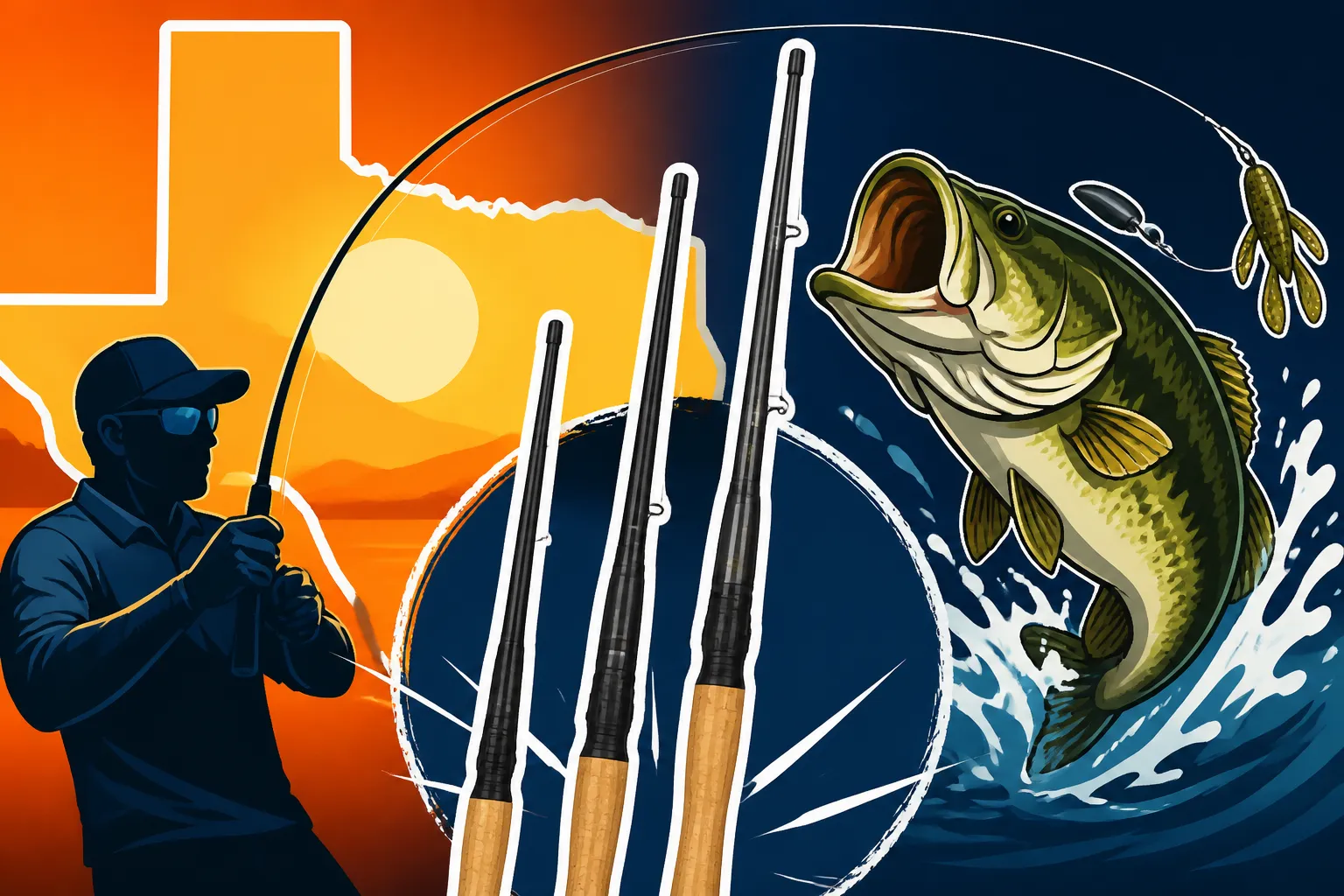
Best rod length for Texas bass fishing
Stepping into a tackle shop, or even just browsing online, can feel like you're staring down an endless aisle of fishing rods, each one seemingly identical yet subtly different. For many Texas bass anglers, one of the first and most confusing choices is rod length. You’re left wondering, "Does an extra six inches really make a difference?" or "Am I using the wrong rod for my favorite lake?" This guide is here to untangle that confusion, helping you understand how rod length impacts your Texas bass fishing success and how to pick the perfect stick for your specific needs and the diverse waters of the Lone Star State.
Understanding Why Rod Length is Crucial for Texas Bass Fishing
It might seem like a minor detail, but the length of your fishing rod plays a monumental role in how effectively you can present a lure, fight a fish, and navigate different fishing environments. In Texas, where we fish everything from vast, open reservoirs like Sam Rayburn to cypress-filled swamps like Caddo Lake, having the right rod length isn't just a preference—it's a tactical advantage. It influences everything from your casting distance and accuracy to the power you can apply and even your leverage against a strong bass trying to bury itself in structure.
A longer rod, for instance, typically offers greater casting distance. Think about trying to reach that submerged hump way out in Lake Fork, or casting across a wide flat in Galveston Bay (though for saltwater, you might be looking at different rods entirely). That extra foot or two on your rod can make all the difference in getting your lure into the strike zone. But that same long rod might become a hindrance when you're trying to pitch a jig into tight spots around boat docks on Lake Conroe, where accuracy and control in close quarters are paramount.
Beyond casting, rod length directly affects your ability to fight a fish. A longer rod creates more leverage, which can be both a blessing and a curse. More leverage means you can move a big bass away from cover quicker, but it can also put more strain on your arms and back. Conversely, a shorter rod gives you more immediate control over the fish, especially when battling it directly under the boat or in heavy vegetation, preventing it from making those last-ditch runs into snags. It’s all about finding that sweet spot for the scenario you expect to encounter.
The Mechanics Behind Rod Length and Performance
To really grasp why rod length matters, let's talk a little about physics and leverage. A fishing rod acts as a lever, and its length directly impacts how it transfers energy. When you cast, a longer rod stores more potential energy during the backcast and releases it with greater velocity, propelling your lure further. This is why surf fishermen use incredibly long rods; they need maximum distance to get baits beyond the breakers. For bass fishing, it means you can cover more water from a single casting position, which is invaluable on expansive lakes.
However, this increased leverage isn't always desirable. In a tight spot, say trying to flip a soft plastic under an overhanging tree limb, a long rod can be cumbersome and reduce your precision. A shorter rod allows for more compact, accurate presentations. The fulcrum point (where you hold the rod) is closer to the tip on a shorter rod, giving you quicker, more direct control over the lure's placement and immediate feedback when a fish bites. It’s a trade-off between power and precision, distance and control.
Impact on Sensitivity and Hooksets
Believe it or not, rod length can also play a role in sensitivity, though it's often overshadowed by rod material and action. A longer rod can sometimes transmit vibrations slightly less efficiently due to the increased length dampening the signal. However, a quality graphite rod, even if long, will still be incredibly sensitive. The real distinction comes in the hookset. With a longer rod, you have more line to take up on a hookset, which can sometimes lead to a less powerful initial hook penetration, especially with very long casts.
Conversely, a shorter rod, especially with a fast action, provides a quicker, more direct hookset. You're simply moving less rod tip distance to achieve the same amount of line pull, allowing for instantaneous power. This is particularly noticeable when fishing lures that require a strong, swift hookset, like a jig or Texas rig in heavy cover. The ability to quickly and firmly drive the hook home is paramount when dealing with the bony mouths of big bass, preventing those frustrating short strikes or lost fish. For more on this, check out How to Fish a Texas Rig for Bass.
Common Rod Lengths for Texas Bass Anglers
When you're looking at rods, you'll generally find them ranging from about 6 feet to over 8 feet. For Texas bass fishing, most anglers will gravitate towards the 6'6" to 7'6" range, with specialized techniques sometimes pushing the boundaries on either end. Each length category has its own strengths and weaknesses, making it better suited for particular techniques and fishing scenarios common across our diverse Texas waters. Understanding these general classifications is the first step in making an informed decision about your next rod.
Imagine fishing for largemouth bass on Lake Fork, a lake renowned for its giant bass and abundant timber. You might need a longer rod for casting crankbaits across open water, but a shorter, beefier rod for punching through matted vegetation. Or picture yourself on a small creek or river in the Hill Country, targeting Guadalupe bass—the Texas state fish. A shorter, more accurate rod would be invaluable for casting in tight quarters with overhanging trees. It's not about one rod for everything, but the right tool for the job.
| Rod Length Range | Primary Texas Bass Fishing Applications | Pros for Texas Anglers | Cons for Texas Anglers |
|---|---|---|---|
| 6'0" – 6'6" | Topwater walking baits, jerkbaits, roll casting in tight cover, skipping under docks, kayak fishing | Excellent accuracy, easy to handle in tight spots (e.g., cypress trees on Caddo Lake), less fatiguing for repetitive casts, great for kayak anglers on Best Kayak Fishing Lakes in Texas. | Limited casting distance, less leverage for fighting big fish in open water, harder to pick up slack line on long casts. |
| 6'8" – 7'2" | Spinnerbaits, chatterbaits, shorter crankbaits, jigs, Texas rigs, smaller swimbaits, most general-purpose bass fishing | Versatile, good balance of casting distance and accuracy, solid hooksetting power, suitable for various Texas lakes and techniques. | Not specialized for extreme distance or very heavy cover, may feel a bit short for sweeping hooksets on long casts. |
| 7'3" – 7'6" | Flipping & pitching, Carolina rigs, longer casting crankbaits (deep divers), heavy jigs, heavier Texas rigs, football jigs, larger swimbaits, frog fishing | Excellent casting distance, superior leverage for fighting big fish, great for quickly moving fish out of heavy cover, covers water effectively. | Can be cumbersome in very tight quarters, less accurate for pinpoint casts in close range, more tiring for all-day repetitive casting. |
| 7'8" + | Swimbait fishing (giant baits), punching heavy mats, deep cranking (specific models), umbrella rigs | Maximum casting distance, ultimate leverage for monster bass and heavy cover, ideal for specialized big-bait techniques. | Very specialized, highly cumbersome in most situations, difficult for transport and storage, can be very fatiguing to cast all day. |
The "All-Rounder" – 6'8" to 7'2"
If you're just starting out or looking for one rod to cover a lot of ground on Texas lakes, a rod in the 6'8" to 7'2" range is often a fantastic choice. This sweet spot offers a remarkable balance between casting distance and accuracy. You can comfortably cast a spinnerbait or chatterbait a good distance, yet still have enough control to accurately pitch a jig to a laydown tree. It's a versatile length that shines in many common Texas bass fishing scenarios.
Think about fishing a typical medium-sized reservoir like Lake Palestine. With a 7-foot medium-heavy rod, you could spend the morning throwing a Texas rig around flooded timber, then switch to a crankbait in the afternoon to target deeper points, all with the same rod. It’s a truly adaptable length that allows you to experiment with various Best Bait and Lures for Texas Fishing without needing a dozen different setups. This is often the first rod length many anglers get when they are beginning to explore the world of bass fishing beyond simple bobber and worm setups.
Reaching Out – 7'3" to 7'6" Rods
When you need to cover serious water or wrestle big bass out of thick cover, rods in the 7'3" to 7'6" range become invaluable. These longer rods excel at launching lures great distances, making them perfect for fishing large crankbaits, Carolina rigs, or covering vast areas with single swimbaits. The extra length provides leverage that helps you control a big fish that's trying to get into the brush pile, pulling it away from danger before it can wrap your line.
Consider fishing the big hydrilla mats on Toledo Bend or Sam Rayburn. A 7'6" heavy-action rod is ideal for pitching a heavy punch rig through that dense vegetation. The length helps you achieve that precise, quiet entry into the mat, and when a giant bass inhales your bait, the leverage allows you to rip it out of the slop before it can tangle you up. Many tournament anglers rely heavily on these longer rods for specific techniques where distance and power are non-negotiable. You’ll often see a wide variety of these rods available at specialty shops like Bass Pro Shops.
Precision and Close Quarters – 6'0" to 6'6" Rods
While longer rods dominate many techniques, there's still a crucial place for shorter rods, especially when precision and maneuvering in tight spots are key. Rods in the 6'0" to 6'6" range are fantastic for skipping lures under boat docks, working topwater walking baits with incredible agility, or making short, accurate roll casts under overhanging trees. They offer superior control and reduce angler fatigue when making countless short casts.
Imagine you're targeting bass under the myriad docks on Lake Travis or working a subtle jerkbait along a rocky bank. A 6'3" or 6'6" medium-action rod gives you the agility to place your lure exactly where you want it without banging your rod tip on the dock structure or getting tangled in trees. They're also a favorite for kayak anglers on small, brushy creeks and rivers, where space is at a premium and long casts are rarely necessary. If you're planning a trip to fish for Guadalupe Bass Texas State Fish Guide in a tight river environment, a shorter rod will likely be your best friend.
Matching Rod Length to Texas Bass Fishing Techniques
The true art of selecting a rod length comes down to matching it with the specific technique you're employing and the type of cover you're fishing. In Texas, our bass habitat is incredibly diverse, from vast open water to dense timber and matted vegetation. A rod that excels at one technique might be a detriment for another. So, let's break down some popular Texas bass fishing techniques and the rod lengths that typically complement them best.
It's tempting to think one rod can do it all, but seasoned Texas anglers know that specialization often leads to more fish in the boat. While a 7-foot medium-heavy might be a good general-purpose choice, you'll feel a significant difference in efficiency and effectiveness when you switch to a 6'6" medium for jerkbaits or a 7'6" heavy for flipping. It's about optimizing your gear to gain every possible advantage, especially when targeting those trophy bass. Many online retailers like Amazon offer detailed descriptions that can help you match rod lengths to techniques.
Flipping and Pitching Rod Lengths
Flipping and pitching are close-quarters combat techniques designed to present a lure quietly and accurately into heavy cover such as boat docks, flooded timber, lily pads, or matted vegetation. These techniques require rods that are long enough to guide the lure effectively but not so long they become unwieldy.
- Optimal Length: 7'0" to 7'6"
- Why it works: The longer length allows you to "reach" into cover, guiding your lure with precision and absorbing some of the impact when you land a fish. For flipping, the extra length provides a good amount of line pick-up on the hookset, allowing you to quickly pull a fish out of heavy cover. For pitching, it helps you make those pendulum-like casts with control. A 7'3" heavy action rod is a staple for many Texas flipping enthusiasts, giving them the power to penetrate thick mats and the leverage to turn a big bass away from snags. If you're tackling dense cover in places like Choke Canyon Reservoir, this length is non-negotiable.
Cranking Rod Lengths (Crankbaits)
Crankbait fishing involves throwing diving plugs that imitate baitfish. The length of the rod for crankbaits depends heavily on the type of crankbait (shallow, medium, or deep diver) and the casting distance required.
- Shallow to Medium Divers (0-12 feet): 6'8" to 7'0"
- Why it works: These rods offer a good balance of casting accuracy for hitting specific targets (like riprap or submerged stumps) and enough length to cast a reasonable distance. A slightly shorter rod can also help impart a bit more action to the crankbait with quick wrist snaps.
- Deep Divers (15+ feet): 7'2" to 7'6"
- Why it works: When you're throwing a deep-diving crankbait, you need maximum casting distance to get the lure down to its target depth and keep it there for a longer period. The longer rod helps launch these heavier baits further and provides the necessary leverage to keep them digging. It also acts as a shock absorber when a big bass slams a deep diver, reducing the chance of pulling the hooks. If you're targeting fish on deep ledges in Canyon Lake, a longer cranking rod is a must.
Topwater and Jerkbait Rod Lengths
Topwater baits like walking baits and poppers, and subsurface jerkbaits, require precise manipulation of the lure to create their erratic, fish-attracting action. The rod length plays a significant role in how easily you can work these baits.
- Optimal Length: 6'3" to 6'9"
- Why it works: Shorter rods are fantastic for working topwater walking baits and jerkbaits because they keep the rod tip closer to the water. This allows you to impart a "walk-the-dog" action or twitch a jerkbait without hitting the water with your rod tip, which can impede the lure's movement. It also reduces wrist fatigue during a day of constant lure manipulation. For anglers who love the explosive strikes of a topwater bite on a calm morning, a shorter rod in this range provides maximum control and crisp action. Check out How to fish topwater lures early in the morning for more tips on these techniques.
Spinnerbait and Chatterbait Rod Lengths
Spinnerbaits and chatterbaits are versatile search baits, often fished around grass, wood, or over open flats. They require a rod that can cast well, handle strikes, and provide enough leverage to pull fish out of cover.
- Optimal Length: 6'9" to 7'2"
- Why it works: This length range provides a great balance of casting distance to cover water, while still offering enough accuracy to hit targets. The medium-heavy power typically associated with these rods, combined with the length, allows for good hooksets and the ability to steer fish away from snags. The rod should have enough tip to allow the lure to load up for casting but enough backbone to handle a strong fish.
Texas Rig and Jig Rod Lengths
The Texas rig and various jigs are bottom-contact baits, requiring sensitivity to detect subtle bites and enough power for solid hooksets, often in cover.
- Optimal Length: 7'0" to 7'4"
- Why it works: Longer rods are beneficial here for several reasons. They provide better casting distance, allowing you to present your bait to distant cover. More importantly, the extra length helps when taking up slack line and driving a powerful hookset, especially crucial when fishing with braided line and a heavy fluorocarbon leader. When a bass picks up a jig or a Texas-rigged worm, you need to feel that subtle "thump" and then deliver a strong, sweeping hookset, and a rod in this range provides the leverage and power for that.
Beyond Length: Other Rod Characteristics to Consider
While rod length is a critical factor, it's really just one piece of the puzzle. To truly optimize your bass fishing setup for Texas waters, you need to consider how length interacts with other rod characteristics. Action, power, and material all play significant roles in the overall performance and feel of a fishing rod. Ignoring these aspects means you're only getting half the story, and potentially selecting a rod that, despite having the "right" length, might not perform as expected.
Think of it like building a house. You wouldn't just pick the length of your walls and ignore the type of wood or foundation. Each component contributes to the overall strength and functionality. The same goes for fishing rods. A 7'0" rod could be perfect for a specific technique, but if it's too heavy-powered for finesse or too slow-action for jigs, you'll struggle. Understanding these combined properties will elevate your game significantly and help you build a truly effective arsenal for the diverse fishing challenges Texas presents. For a broader overview of selecting tackle, consider reading Best Tackle for Texas Bass Fishing.
Rod Action: Fast, Moderate, or Slow?
Rod action refers to where along the blank a rod bends when pressure is applied. This characteristic profoundly affects lure presentation, hookset, and fish fighting.
- Fast Action: These rods bend mostly in the tip section.
- Why it matters: Fast action provides maximum sensitivity and allows for quick, powerful hooksets, making it ideal for single-hook lures like jigs and Texas rigs where you need to drive the hook home quickly. The stiff backbone helps with pulling big bass out of heavy cover. Most bass anglers in Texas rely heavily on fast-action rods.
- Moderate Action (or Medium Action): These rods bend in the top half to third of the blank.
- Why it matters: Moderate action offers more flexibility, which is excellent for treble-hook lures like crankbaits and topwaters. The deeper bend helps to keep fish pinned once hooked, preventing them from tearing free. It also allows for longer, smoother casts, which is a bonus for many reaction baits.
- Slow Action: These rods bend throughout the entire blank.
- Why it matters: While less common in modern bass fishing, slow-action rods are incredibly forgiving. They are sometimes used for very light-line applications or specific finesse techniques where a delicate presentation and a gentle hookset are required. You might find them in more specialized panfish or crappie setups rather than typical bass rigs.
Rod Power: Light, Medium, Heavy?
Rod power (often called "taper" or "weight") refers to the rod's lifting strength or how much pressure it takes to bend the rod blank. It dictates the line weight and lure weight ranges a rod is designed to handle.
- Light Power: Best for ultra-light lures and very light line, typically used for panfish or small trout, not usually for serious bass fishing.
- Medium-Light to Medium Power: Excellent for lighter finesse techniques, smaller topwater baits, small jerkbaits, and situations where lighter line is necessary. Think about fishing clear, pressured lakes where subtle presentations are key.
- Medium-Heavy Power: This is arguably the most versatile power for Texas bass fishing. It handles a wide range of lures—spinnerbaits, chatterbaits, jigs, Texas rigs, mid-sized crankbaits—and provides enough backbone to fight most bass effectively. If you're buying one "all-around" rod, it's often a medium-heavy.
- Heavy to Extra-Heavy Power: Reserved for extreme applications like punching heavy mats, throwing giant swimbaits, or muscling big bass out of dense cover. These rods have immense backbone and are designed for heavy line and big lures. They are essential for targeting true giants, especially on lakes like O.H. Ivie Reservoir.
Rod Material: Graphite, Fiberglass, or Composite?
The material a rod is made from significantly impacts its weight, sensitivity, and durability.
- Graphite: The most common material for bass rods today. Graphite rods are incredibly sensitive, lightweight, and typically have faster actions. This sensitivity is crucial for feeling subtle bites on bottom-contact lures. The downside can be a bit more brittle than fiberglass, making them more prone to snapping if mishandled.
- Fiberglass: Older technology, but still has a place. Fiberglass rods are more flexible, durable, and generally have a slower action. They excel for crankbaits, where their "give" helps absorb the shock of a strike and prevent hooks from tearing out. They are typically less sensitive and heavier than graphite.
- Composite: A blend of graphite and fiberglass. Composite rods aim to offer the best of both worlds—some sensitivity of graphite with some of the forgiving nature of fiberglass. Many modern cranking rods are composites, offering a moderate action that's perfect for treble hooks without sacrificing too much feel. You’ll find a huge selection of rods made from these materials at any major fishing retailer or online, so you can compare options from brands like St. Croix, Shimano, and Lew's.
Practical Considerations for Texas Anglers
Beyond the technical aspects of rod length, there are some very real, practical considerations that Texas bass anglers need to keep in mind when choosing their ideal fishing rods. These factors often boil down to convenience, comfort, and the specific logistics of how and where you fish in our great state. Neglecting these practicalities can lead to frustration, even if you’ve chosen a technically "perfect" rod.
For instance, trying to maneuver an 8-foot swimbait rod through the tight brush along a riverbank is going to be a struggle, no matter how good that rod is for its intended purpose. Or imagine trying to store a fleet of 7'6" rods in a small car or a packed boat locker. Real-world fishing isn't just about what's ideal on paper; it's about what works for you and your fishing adventures across Texas.
Transport and Storage
If you're fishing from a small car, a packed truck, or even just walking along the bank, the sheer length of your rod can become a real headache. A 7'6" flipping stick might be amazing on the water, but if it doesn't fit in your vehicle or constantly snags on trees during bank fishing, it quickly loses its appeal.
- Breaking Down Rods: Many rods are designed to break down into two pieces, making transport and storage significantly easier. While one-piece rods are often preferred by serious anglers for their uninterrupted action and sensitivity, a good two-piece rod can be a perfectly viable option, especially for lengths over 7 feet.
- Rod Sleeves and Cases: Invest in good rod sleeves or a sturdy rod case, especially for longer, more expensive rods. This protects them from damage during transport, whether you're driving to Lake Texoma Fishing Guide or simply moving them from your garage to your boat.
Fishing From Different Platforms
Where you fish from in Texas has a huge bearing on your ideal rod length.
- Bass Boats: If you primarily fish from a spacious bass boat, rod length is less constrained by immediate surroundings. You have room to cast, swing, and store multiple rods of varying lengths. This is where you'll see anglers with specialized rods for every technique, often including several 7'6" or longer rods.
- Kayaks and Canoes: For kayak anglers, particularly on smaller waterways or in dense cover, shorter rods (6'0" to 6'8") are often a blessing. They are easier to maneuver within the confines of a kayak, reduce the chances of hitting obstacles, and make it easier to land a fish close to the boat. This is especially true if you're exploring the quieter coves of Caddo Lake Fishing Guide among the cypress trees.
- Bank Fishing / Piers: When fishing from the bank or a pier, casting distance can be a major advantage. Longer rods (7'0" to 7'6") help you reach deeper water or distant structures that might be inaccessible with a shorter rod. However, if the bank is heavily vegetated with trees or brush, a shorter rod might offer better maneuverability for roll casting. Best Texas Piers for Fishing Without a Boat are often prime spots for using slightly longer rods to get past other anglers or reach further out.
Personal Preference and Physicality
Ultimately, a lot of rod selection comes down to personal preference and what feels comfortable for you.
- Height and Arm Length: Taller anglers with longer arms might find longer rods more comfortable to cast and manage, as the proportions feel more natural. Shorter anglers might prefer slightly shorter rods for easier handling and less fatigue, especially during repetitive casting over a long day on the water.
- Casting Style: Some anglers have a sweeping, powerful casting style that benefits from a longer rod, allowing them to load the blank fully. Others prefer a more compact, wrist-driven cast that might feel more natural with a shorter rod.
- Fatigue: Constantly casting a heavy, extra-long rod can be fatiguing over a full day of fishing, especially if you're making hundreds of casts. For techniques that require constant casting, such as spinnerbait fishing, choosing a slightly shorter and lighter rod within the effective range can make a big difference in comfort and endurance.
Don't be afraid to visit a local tackle shop or a sporting goods store like Bass Pro Shops to physically handle different rod lengths and powers. Mimic a casting motion, feel the balance, and see what feels right in your hands. That tactile experience often trumps any advice you read online.
Disclaimer
This article is for general informational purposes only and does not constitute professional advice. Laws, prices and regulations vary by location and change over time. Consult a qualified professional for guidance on your specific situation.