How to fish deep drop-offs for bass
There's nothing quite as frustrating as hitting your favorite Texas lake only to find the bass have seemingly vanished into thin air. One minute they're smashing topwaters in the shallows, the next it feels like the lake is empty. More often than not, they haven't disappeared; they've just moved to deeper, more comfortable water, especially to those hidden gems known as deep drop-offs. This guide is all about helping you understand why bass gravitate to these underwater ledges and how you can effectively target them, even when the bite is tough.
Why Bass Seek Out Deep Drop-Offs
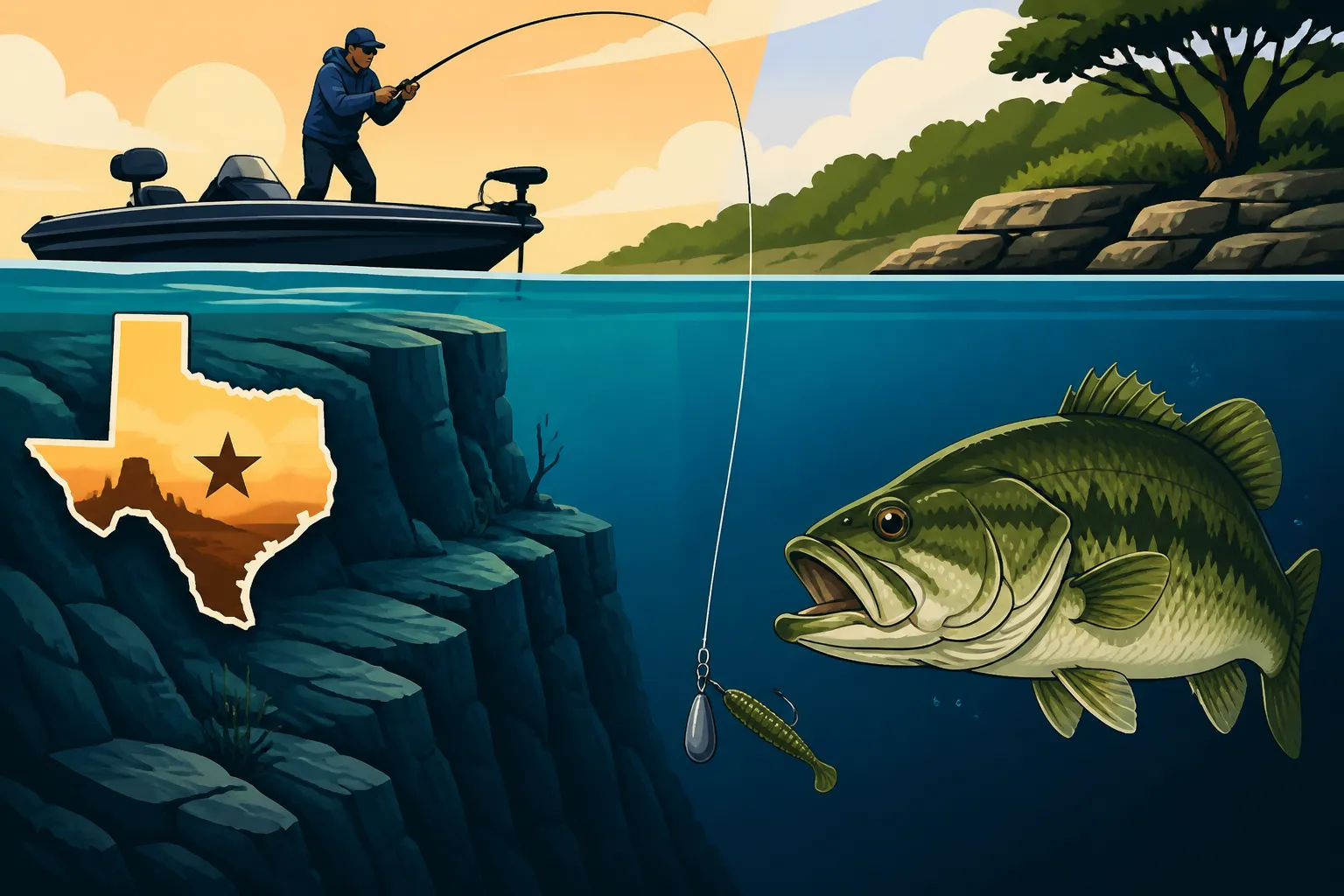
Deep drop-offs are absolute magnets for bass, but it's not always obvious why. These aren't just random underwater features; they represent prime real estate in the aquatic world, offering a combination of comfort, safety, and excellent feeding opportunities for largemouth bass, especially in our vast Texas reservoirs.
Thermal Refuge and Comfort Zones
Imagine a scorching Texas summer day, the kind where the air shimmered over the highway, and the shallow water feels like a warm bath. Just like we seek air conditioning, bass need to escape those extreme temperatures. Deep drop-offs provide that crucial thermal refuge. The water deeper down maintains a more stable, cooler temperature in summer and often a slightly warmer, more stable temperature in winter. This makes these ledges a comfortable hangout spot year-round.
When the water gets really hot, bass will dive down to the thermocline, that invisible layer where the water temperature changes rapidly. A sharp drop-off that cuts through the thermocline allows them to move up and down easily to find their optimal temperature without expending too much energy. In the colder months, when shallow water temperatures plummet, the deeper water off a drop-off might hold a degree or two more warmth, which can make all the difference for cold-blooded fish. Understanding these Texas Bass Spawning Season Guide patterns can also help you predict when fish might start to move deeper after their shallow water rituals.
Ambush Points and Baitfish Highways
Beyond comfort, deep drop-offs are fantastic ambush points. Think of it like a predator lurking at the edge of a cliff, waiting for unsuspecting prey to pass by. Baitfish, whether it's shad, sunfish, or even smaller crappie, often migrate along these underwater contours, using them as highways to move from shallow feeding flats to deeper safety. A bass positioned on a submerged point, a subtle indentation, or a brush pile on the edge of a drop-off has a perfect vantage point to dart out and strike.
These areas also concentrate bait. Wind and current can push baitfish against these underwater structures, making them easier targets. A deep drop-off that extends into a main lake channel, or one that has submerged timber or rock piles along its edge, becomes even more attractive as it provides additional cover for both predator and prey. This makes it a high-percentage area for anglers looking to land some serious fish.
Locating Those Elusive Deep Drop-Offs
You can't catch 'em if you can't find 'em, right? And finding those hidden deep drop-offs, especially on a massive Texas lake, can feel like searching for a needle in a haystack. But thankfully, modern technology and a little bit of old-school map reading can turn you into a deep-water detective.
Interpreting Your Electronics
This is where your boat's electronics truly shine. A good fish finder is your best friend when it comes to locating and understanding deep structure. Don't just look for fish arches; learn to interpret the bottom contours, the hardness of the bottom, and any subtle changes.
- 2D Sonar: This gives you a traditional view of what's directly beneath your boat. Look for sharp changes in the bottom depth. A sudden shift from, say, 10 feet to 25 feet over a short distance indicates a promising drop-off. You'll often see baitfish schools suspended off the ledge, and larger arches (bass) lurking nearby or tight to the bottom. Learning How to Read a Fish Finder for Bass is crucial here.
- Side Imaging/Side Scan: This technology literally lets you "see" to the sides of your boat, revealing contours and structure that you might have missed directly underneath. You can idle over an area and spot a drop-off stretching out to the left or right, identify submerged timber or rock piles along its edge, and even see individual fish relating to that structure before you even pass over them. This is incredibly powerful for efficiently dissecting large areas.
- Down Imaging/Down Scan: This provides a photographic-like view directly below your boat, making it easier to distinguish between different types of structure on the drop-off – a brush pile looks like a brush pile, and a rock pile looks like a rock pile. It helps confirm what your 2D sonar is showing you and gives a clearer picture of the cover bass are holding in.
Practice is key here. Spend time idling over known drop-offs and watching how your different sonar views interpret the same structure. You can often find fantastic deals on advanced fish finders, or even entry-level units perfect for getting started, by checking out fishing gear sections on platforms like Amazon.
Map Reconnaissance
Before you even launch the boat, you should be studying your lake maps. High-definition lake maps, whether on your fish finder's GPS unit, a dedicated mapping app on your tablet, or even old-school paper maps, are invaluable for deep-water fishing.
- Contour Lines: These lines represent changes in depth. When the contour lines are packed tightly together, it indicates a steep drop-off. If they're spread far apart, the bottom is sloping gently. Look for areas where these lines converge or form distinct "fingers" extending into deeper water.
- River Channels and Creek Beds: These are natural highways for fish and often feature pronounced drop-offs along their edges. Bass love to stage on the lip of an old river channel, especially where it bends or where a creek enters.
- Submerged Features: Maps will also often mark old roadbeds, submerged bridges, humps, or rock piles. If these features intersect with a deep drop-off, you've hit a potential jackpot.
Spending an hour with a good map can save you hours of aimless searching on the water. Plot out several potential drop-off spots, then use your electronics to confirm their existence and identify any active fish. For example, knowing How to read lake contour maps for bass fishing can quickly narrow down your search on a massive lake like Toledo Bend or Sam Rayburn.
The Right Tools and Techniques for Deep Drop-Offs
Once you've pinpointed those prime deep drop-offs, you need the right arsenal of baits and techniques to effectively coax those bass into biting. Deep water fishing is a different ballgame than pitching to lily pads; it requires precision, patience, and the right presentation.
Deep Water Rigs
Certain rigs are designed specifically to get down to the fish efficiently and present your bait naturally in deep water.
- Carolina Rig: This is a classic for a reason. A heavy sinker (often 1/2 to 1 oz) is threaded onto your main line, followed by a bead and a swivel. A leader (usually 2-4 feet) is then tied to the swivel, with your hook and soft plastic bait at the end. The sinker drags the bottom, stirring up silt and attracting attention, while your bait floats tantalizingly above, giving it a natural, uninhibited action. This rig is fantastic for covering ground along the edge of a drop-off and presenting a subtle offering. For more detailed tips, check out How to fish a Carolina rig in deep water.
- Drop Shot Rig: This finesse technique is deadly when bass are suspended or are a bit finicky. The hook is tied directly to the main line, leaving a tag end where a specialized drop shot weight is attached. Your bait (usually a small soft plastic) is then nose-hooked or Texas-rigged to the hook, suspending it at a precise depth above the bottom. You can present this rig vertically, keeping your bait right in the strike zone, especially when you've pinpointed fish on your sonar. Learning How to fish a drop shot for bass can significantly improve your catch rates on pressured lakes.
- Ned Rig: While often thought of for shallower finesse, a heavier Ned rig (1/4 to 3/8 oz) can be incredibly effective on deep drop-offs, particularly for smallmouth and spotted bass, but also for picky largemouth. Its mushroom-shaped jig head allows the small soft plastic bait to stand up off the bottom, creating a subtle, irresistible presentation that often triggers bites when nothing else will. If you're looking for a low-profile bait that gets results, a heavier How to fish a Ned rig for bass can be a game-changer.
Lure Selection for Depth and Clarity
Choosing the right lure is about matching the hatch and considering the water depth and clarity.
- Deep Diving Crankbaits: These lures are designed with long bills to quickly reach depths of 15-25+ feet. They're excellent search baits, allowing you to cover water and trigger reaction strikes from active bass. Match your crankbait color to the local baitfish (shad, crawfish) and consider water clarity. For instance, Best crankbait colors for stained Texas lakes might lean towards chartreuse or fire tiger, while clearer lakes might call for more natural baitfish patterns.
- Jigging Spoons: Often overlooked, jigging spoons are fantastic for vertical presentations on deep drop-offs. Drop them directly to the bottom, then snap them up and let them flutter back down. This mimics dying baitfish and can be incredibly effective when bass are schooled up tight.
- Heavy Jigs and Soft Plastics: A 1/2 to 1 oz football head jig or flipping jig paired with a creature bait or craw imitation is a classic for a reason. These baits can be slowly dragged, hopped, or fished with a controlled fall down the ledge. Soft plastic worms, creature baits, and swimbaits rigged on heavy Texas rigs or jig heads are also excellent choices. When considering soft plastics, a wide variety can be found online, and reviewing the Best soft plastics for Texas bass fishing guide can help you build a versatile collection. The darker the water, the darker your jig or plastic color; conversely, in clear water, natural greens and browns or even transparent plastics often perform best. Learning the Best jig colors for clear Texas lakes can make a real difference.
| Lure/Rig Type | Depth Range (approx.) | Best For | Retrieval Style | Key Advantage |
|---|---|---|---|---|
| Deep Crankbait | 10-25+ feet | Covering water, active bass | Steady retrieve, occasional pause | Triggers reaction strikes, finds active fish |
| Carolina Rig | 10-40+ feet | Scattered bass, bottom contact | Slow drag, occasional twitch | Natural bait presentation, covers bottom |
| Drop Shot Rig | 5-50+ feet | Suspended or finicky bass | Vertical shake, minimal movement | Precise depth control, finesse presentation |
| Jigging Spoon | 15-50+ feet | Schooling bass, vertical presentation | Vertical jigging, flutter on fall | Mimics dying baitfish, fast fall |
| Football Head Jig | 10-40+ feet | Bottom hugging bass, crawfish imitation | Slow drag, hop, crawl over structure | Mimics crawfish, good feel for bottom |
| Ned Rig (heavy) | 10-30 feet | Fussy bass, subtle bites, pressured areas | Slow drag, subtle shake, dead stick | Stands up off bottom, subtle presentation |
Mastering the Presentation on Deep Drop-Offs
Having the right gear is only half the battle; knowing how to present your bait effectively on deep drop-offs is what truly separates successful anglers from the rest. It demands attention to detail, precise boat control, and a keen sense of what's happening hundreds of feet away.
Boat Positioning and Control
This is paramount. If you can't stay on the drop-off, you're not going to catch fish.
- Understanding Wind and Current: Texas lakes can be windy, and currents can exist, especially near dam discharge areas or large river systems. You need to account for these forces when positioning your boat. Often, you'll want to approach a drop-off from upwind or up-current, allowing you to drift or use your trolling motor to slowly work down the ledge.
- Trolling Motor Dominance: A strong, reliable trolling motor with GPS capabilities (like spot-lock or anchor mode) is invaluable. It allows you to precisely hold your position on a specific contour or slowly move along the drop-off at a controlled speed. Without it, you'll constantly be fighting the elements, making it nearly impossible to keep your lure in the strike zone for long.
- Parallel vs. Perpendicular: Generally, it's most effective to position your boat so you can fish parallel to the drop-off. This allows you to keep your lure in the optimal depth zone for a longer period. If you try to cast perpendicular, your lure will quickly fall off the edge or pull up into shallower water, limiting its time in the prime strike zone. Consider fishing along the edge, from the deep side up towards the shallower ledge, or vice-versa, depending on how the bass are positioned.
- The "Sweeper" Technique: Sometimes, especially with a Carolina rig or a heavy jig, you'll position your boat just off the deep side of the drop-off and cast onto the shallower flat, then slowly "sweep" your rod, dragging the bait down the face of the drop-off. This imitates baitfish moving from shallow to deep and can be deadly effective.
Detecting Subtle Bites
Fishing deep water often means dealing with subtle bites. You won't always get that bone-jarring strike you feel in shallow water.
- Feel the "Thump": Many deep bites are a soft "thump," a slight pressure, or simply your line going slack or moving sideways inexplicably. A quality rod with good sensitivity is critical. Fluorocarbon line, with its low stretch, also helps transmit those subtle sensations.
- Watch Your Line: Often, the most reliable indicator of a deep bite isn't what you feel, but what you see. Watch your line where it enters the water. Any twitch, jump, or subtle movement to the side that isn't caused by the boat or current can indicate a bite. If you see something unusual, set the hook!
- Patience and Focus: Deep water fishing can be a grind. You might make many casts without a bite, but when you find the fish, it can be fast and furious. Stay focused, pay attention to every tap and tick, and trust your instincts. Remember, the fish you're targeting are often bigger, and well worth the extra effort. Regularly checking a How to Read a Texas Lake Fishing Report can also offer clues on current deep-water bite patterns.
Fishing deep drop-offs in Texas can be incredibly rewarding, especially when the shallow bite shuts down. It takes a combination of technology, patience, and the right techniques, but once you unlock the secrets of these underwater highways, you'll find a whole new world of bass fishing opportunities.
Disclaimer
This article is for general informational purposes only and does not constitute professional advice. Laws, prices and regulations vary by location and change over time. Consult a qualified professional for guidance on your specific situation.