Fly Fishing Techniques for Texas Rivers
For many anglers, the idea of fly fishing in Texas rivers might conjure images of tranquil, crystal-clear streams found elsewhere, leading to a bit of frustration when they realize our dynamic waterways present their own unique challenges. Texas rivers aren't your typical alpine trout streams, but they offer incredible fly fishing opportunities for a diverse range of species, from the feisty Guadalupe bass to eagerly stocked rainbow trout. This guide will walk you through the essential techniques and knowledge you need to successfully navigate and enjoy fly fishing on our beloved Texas rivers.
Understanding Texas River Dynamics for Fly Fishing
Fly fishing in Texas is a fantastic adventure, but it's crucial to understand that our rivers aren't all cut from the same cloth. From the limestone-bottomed spring-fed streams of the Hill Country to the slower, tannin-stained waters of East Texas, each waterway presents its own set of conditions and target species. Without this foundational understanding, you might find yourself casting fruitlessly, wondering why the fish aren't biting.
Diverse River Ecosystems and Their Challenges
Texas boasts an incredible array of river systems, each with distinct characteristics that influence how you approach them with a fly rod. The pristine, cooler waters of the Guadalupe River, particularly below Canyon Lake, are famous for their seasonal rainbow trout stockings. Here, you'll encounter a mix of fast-moving riffles, deeper runs, and calm pools, often with abundant aquatic insect life. Wading can be tricky due to slippery rocks, and currents can be strong, requiring a careful approach and good wading skills. Fly fishing here often mimics traditional cold-water trout tactics, focusing on delicate presentations.
Contrast that with the sprawling Brazos or Colorado Rivers, which can vary wildly in flow and clarity depending on recent rainfall. These rivers are prime hunting grounds for Guadalupe bass, largemouth bass, and various panfish. You might find yourself casting to woody cover, submerged rocks, or along undercut banks. The water can be warmer and often more turbid than Hill Country streams, meaning your fly choices and presentation might shift towards larger, more visible patterns or those that create more vibration. Even smaller, more intimate rivers like the San Marcos or Comal offer unique spring-fed experiences, often clearer and with consistent flows, but sometimes with more fishing pressure.
Reading the Water for Optimal Success
One of the most valuable skills in fly fishing, especially on diverse Texas rivers, is the ability to "read the water." This isn't just about looking for fish, but understanding where fish are likely to hold, feed, and feel safe. Knowing how current, depth, and structure interact will dramatically increase your chances of success.
Look for seams where faster current meets slower water, as fish often wait in the slack water for food to drift by in the faster lane. Riffles, those shallow, choppy areas, are oxygenated and often hold smaller baitfish and insects, making them attractive to feeding fish. Below riffles, you'll often find deeper runs and pools, which offer fish a comfortable holding area with access to food. Any kind of structure—submerged logs, boulders, undercut banks, weed beds—creates ambush points and protection from predators and strong currents. For an in-depth look at where to find fish, check out our guide on Best Places to Fish in Texas.
Essential Gear for Texas Fly Fishing Adventures
Stepping into the world of fly fishing can feel a little overwhelming with all the specialized gear. But for Texas rivers, you can simplify things significantly by focusing on versatility. Having the right tools for the job, tailored to the species and conditions you'll encounter, makes all the difference between a frustrating outing and a truly rewarding one.
Choosing the Right Rod, Reel, and Line
When it comes to your fly rod, versatility is key for Texas rivers. A 4-weight or 5-weight rod is a fantastic all-around choice for many Texas scenarios. It's light enough for presenting delicate dry flies to Guadalupe bass and panfish but still has enough backbone to handle a decent-sized bass or even a stocked rainbow trout. If you're specifically targeting larger bass or venturing into light saltwater situations on coastal rivers, a 6-weight or 7-weight rod will give you more power for casting larger, wind-resistant flies and fighting bigger fish. For purely trout fishing on the Guadalupe, a 3-weight rod can offer a more sporting challenge with delicate presentations. Many anglers find great deals on versatile rods and reels on platforms like Amazon, offering a good balance of quality and affordability.
Matching your reel to your rod weight is crucial for balance. Most modern fly reels are designed to match specific rod weights. For Texas rivers, a reliable large arbor reel is recommended. Large arbor reels retrieve line faster, which is a huge advantage when fighting a strong fish that's running towards you, and they also reduce line memory. When it comes to line, a weight-forward floating line is your bread and butter. It's excellent for nearly all dry fly and nymphing situations. However, if you plan to fish deeper pools or target bass with streamers, having a sinking tip line or even a full sinking line in your kit can be incredibly effective for getting your fly down to where the fish are holding. Remember to check out our broader advice on Best Fishing Rods for Texas Anglers for more general insights.
Must-Have Flies for Texas Species
The beauty of fly fishing lies in imitating what the fish are already eating. For Texas rivers, your fly box should be a mix of common insect patterns, baitfish imitations, and some general attractors.
For trout on rivers like the Guadalupe, you'll want a selection of nymphs (e.g., Pheasant Tail, Hare's Ear, Prince Nymph in sizes #12-18), dry flies (e.g., Elk Hair Caddis, Adams, Parachute Adams in #14-20), and smaller streamers (e.g., Woolly Bugger in olive or black, #8-12). These patterns mimic the abundant aquatic insects and smaller forage fish that trout feed on. If you're planning a trip, be sure to consult our Best Flies for Guadalupe River trout guide for specific recommendations.
When targeting Guadalupe bass and largemouth bass, your flies will generally be larger and more aggressive. Topwater poppers and divers (e.g., Gurgler, Dahlberg Diver) are incredibly exciting for surface strikes, especially during warmer months. Streamers like Clouser Minnows, Deceivers, and larger Woolly Buggers (in white, chartreuse, or olive, #4-8) imitate baitfish, crawfish, and other forage. For subsurface presentations, weighted nymphs or small buggers can also entice bass.
For panfish like bluegill and sunfish, which are found in nearly every Texas river, small poppers, sponge spiders, and small nymphs (e.g., tiny Hare's Ears, various midge patterns in #16-20) are irresistible. Even smaller catfish can be caught on the fly, often on small nymphs or even dry flies if they're actively feeding on the surface during an insect hatch. Building a versatile fly collection doesn't have to break the bank, and many starter fly assortments can be found on Amazon.
Core Fly Casting Techniques for River Conditions
Effective casting is the foundation of successful fly fishing. On Texas rivers, you'll encounter a variety of conditions – from tight, brushy banks that demand precise, short casts to wider open stretches where distance can be an advantage. Mastering a few core casts, and understanding when to use them, will elevate your game significantly.
Mastering Basic Casting for Accuracy and Distance
The overhead cast is the cornerstone of fly fishing. It involves a smooth, controlled back cast and a forward cast, propelling the line and fly towards your target. The key to accuracy and distance lies in a crisp "stop" at the end of both your back and forward casts. Imagine throwing a dart – it’s not about brute force, but about a sharp, controlled acceleration and sudden stop. Practice this motion repeatedly, focusing on a straight line path for your rod tip. On many Texas rivers, particularly those with overhanging trees or tight corridors, you won't always have room for a full overhead cast.
This is where the roll cast becomes your best friend. The roll cast is ideal for situations where there's limited backcasting room. It uses the water's surface to load the rod, creating a D-loop behind you before propelling the line forward. To execute it, raise your rod tip, let the line settle in a D-shape behind you on the water, and then make a smooth, accelerating forward stroke, stopping crisply at about 10 or 11 o'clock. This cast is invaluable for getting your fly out from under brush or along tight banks without snagging your back cast. Mastering both these casts will give you the versatility needed for the varied landscapes of Texas rivers.
Specialized Casts for Tricky Situations
Beyond the basics, several specialized casts can help you overcome common challenges on Texas rivers, especially when dealing with currents and difficult fish lies. One of the most critical challenges is drag, which occurs when different currents pull on your fly line at varying speeds, causing your fly to move unnaturally. Fish are incredibly sensitive to this, and an unnaturally drifting fly is often ignored.
The reach cast (or mend cast) is essential for combating drag. As your fly line is about to land, or immediately after it lands, you "reach" your rod tip upstream or downstream, flipping a curve of slack line into the system. This creates a longer, drag-free drift for your fly by delaying the onset of tension from the current. Similarly, the curve cast allows you to intentionally land your line in a curve, either upstream or downstream, to guide your fly around obstacles or into an eddy without immediately pulling tight. The slack-line cast, which involves wiggling your rod tip during the forward cast to introduce slack into the line, is another excellent technique for achieving longer drag-free drifts, particularly when nymphing in complex currents. These casts might seem advanced, but with practice, they become second nature and are indispensable for fooling wary fish in challenging river environments.
Effective Strategies for Targeting Texas Game Fish
Texas rivers are brimming with diverse game fish that can be targeted on the fly. From the iconic Guadalupe bass to seasonal trout and abundant panfish, each species requires a slightly different approach, a keen understanding of their habitat, and the right fly presentation to entice a strike.
Fly Fishing for Guadalupe Bass and Other Black Bass
The Guadalupe bass, Texas's state fish, is a prized catch for fly anglers. These feisty fish thrive in the clear, rocky streams of the Hill Country, but you can find them in many other Texas rivers too. They love holding in current breaks, behind boulders, in riffles, and along undercut banks where they can ambush prey. When targeting "Guads" and other black bass like largemouth, focus your casts to these high-probability areas. A well-placed popper or diver fished near structure can elicit explosive topwater strikes, especially during early mornings and late evenings or on overcast days.
For subsurface action, streamers like Clouser Minnows or Woolly Buggers, stripped erratically to imitate a fleeing baitfish or crawfish, are incredibly effective. Look for areas with current and oxygenated water, as these fish are often more active there. Vary your retrieve speed until you find what triggers a bite. They're often aggressive, so don't be afraid to make a little commotion with your fly. If you want to dive deeper into these native treasures, check out our Guadalupe Bass Texas State Fish Guide and our general Texas Largemouth Bass Fishing Guide.
Chasing Rainbow Trout in Stocked Rivers
While not native, rainbow trout are a massive draw for Texas fly anglers, thanks to the Texas Parks and Wildlife Department's seasonal stockings, primarily in the Guadalupe River below Canyon Lake. These stockings usually begin in late fall and continue through early spring, providing a fantastic cold-water fishery. The key to success here is understanding trout behavior in these often pressured environments.
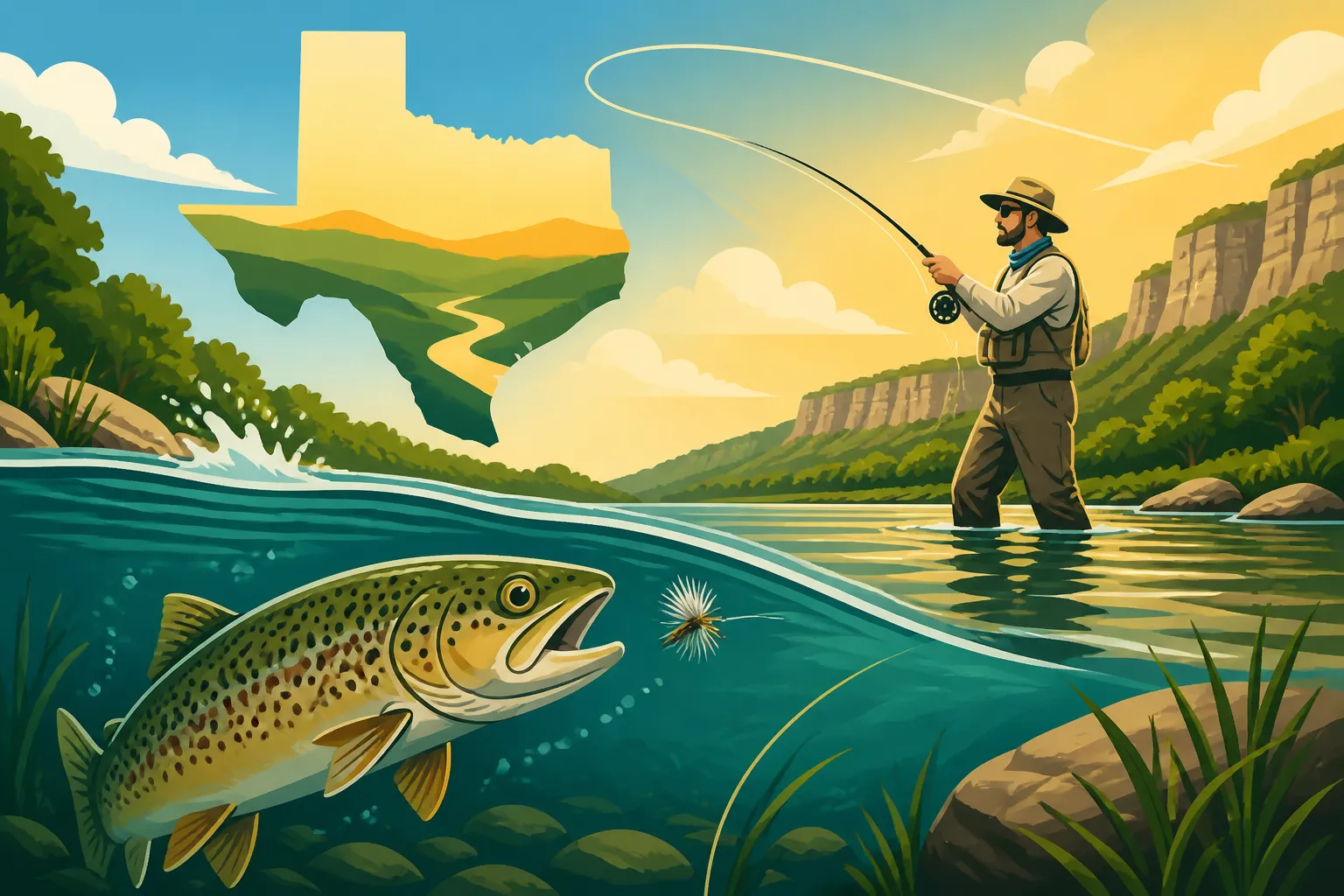
When the water is cold, trout are often lethargic and will cling to the bottom. Nymphing is incredibly effective during these times. Use an indicator rig with split shot to get your nymphs down to the strike zone, varying your depth until you find where the fish are holding. Effective nymphs include Pheasant Tail, Hare's Ear, and various midge patterns. During warmer periods or when insects are hatching, dry fly fishing can be phenomenal. Look for rising fish and try to match the size and profile of the natural insects. A delicate presentation is crucial for these often wary fish. For everything you need to know about these seasonal fisheries, including specific flies, consider reading our Guadalupe River Trout Fishing Guide and How to fish for stocked trout in winter. You might also find our article on When does Texas stock rainbow trout helpful for planning your trip.
Pursuing Panfish and Catfish on the Fly
Don't overlook the abundance of panfish (bluegill, sunfish, crappie) and even smaller catfish in Texas rivers. These species offer fantastic opportunities for fly anglers, especially beginners or those looking for consistent action. Panfish are often eager biters and can be found in almost any slow-moving water, around submerged vegetation, logs, or shaded banks.
Small poppers, sponge spiders, or tiny wet flies and nymphs are irresistible to them. A 3-weight or 4-weight rod is perfect for these light tackle fights. Casting to visible structure or along lily pad edges can result in quick, fun catches. As for catfish, while not a primary fly species, smaller channel cats will readily take flies if presented correctly. Try fishing small Woolly Buggers or weighted nymphs near deeper holes or current seams. They might not be acrobatic, but a decent-sized cat on a light fly rod is a surprising thrill. Our Texas Crappie Fishing Guide and Texas Catfish Species Guide can give you more insights into these often-underestimated game fish.
Navigating and Wading Texas Rivers Safely
Exploring Texas rivers on foot with a fly rod is an incredibly immersive experience, but it comes with responsibilities and safety considerations. Our rivers can be unpredictable, with varying depths, currents, and bottom compositions. Being prepared and respectful of the environment ensures a safe and enjoyable outing for everyone.
Essential Wading Safety and Equipment
Wading in Texas rivers, especially the rocky bottoms of the Hill Country or the slick, muddy beds found elsewhere, requires the right gear and a healthy dose of caution. Wading boots with felt or rubber soles designed for traction on slippery rocks are paramount. Many anglers also use studded soles for extra grip. Never wade in regular sneakers or sandals, as the risk of slipping and injury is too high. A wading staff is not optional; it's a critical safety tool. It helps you maintain balance, test depth before taking a step, and feel for unstable footing. Even experienced waders can be caught off guard by a swift current or a deceptively deep hole.
Always be aware of the current, especially after recent rainfall. If the water is too high or moving too fast to wade safely, it's always best to err on the side of caution and stay on the bank or find another spot. Know your limits, and if in doubt, don't go. Carry a small first-aid kit, a whistle, and ideally, a partner when wading in unfamiliar or challenging waters. If you're tackling the cooler waters of the Guadalupe in winter, good quality waders are essential for comfort and safety. Check out our guide on Best Waders for the Guadalupe River in winter for specific recommendations.
River Access and Ethical Angling Practices
Understanding legal access points is vital for fly fishing Texas rivers. While many rivers flow through private land, the state's "open beaches" and navigation laws can provide public access. Generally, if you can access a river from a public road crossing or a state park, you can wade or float within the riverbed. However, always be mindful of private property lines and avoid trespassing onto adjacent banks. Many Texas State Parks offer excellent public fishing opportunities, and some even allow free shoreline fishing without a license.
Ethical angling practices are just as important as knowing where to fish. Always practice "Leave No Trace" principles: pack out everything you pack in, and leave the area cleaner than you found it. Handle fish gently, especially if you plan to release them. Use barbless hooks or crimp down barbs to minimize harm to the fish. Educate yourself on Texas Fish Bag and Length Limits for all species you might encounter, and always carry your valid Texas Fishing License Requirements Explained. Respecting the environment and fellow anglers ensures these beautiful Texas rivers remain vibrant fisheries for generations to come.
Seasonal Considerations for Texas Fly Fishing
Texas's diverse climate means that fly fishing isn't just a spring or fall activity. While some seasons certainly offer prime opportunities, understanding how to adapt your techniques and target species to the ever-changing weather patterns can ensure you have a productive outing year-round. Don't let the thought of extreme heat or a chilly spell deter you; there's always something to catch.
Spring and Fall: Prime Time Action
Ah, spring and fall in Texas – these are often considered the sweet spots for fly fishing, and for good reason! In spring, after the last cold fronts have passed and water temperatures begin to rise steadily, fish become incredibly active. This is when species like largemouth and Guadalupe bass move into shallower waters for their spawn, becoming more aggressive and territorial. Streamers and topwater flies can be incredibly effective during this period. Insect hatches also become more prevalent, providing excellent dry fly opportunities for panfish and, if present, trout. The weather is generally pleasant, making for comfortable wading and casting.
Fall brings cooler temperatures, often after a long, hot summer, which revitalizes both fish and anglers. Water temperatures begin to drop, signaling many species to feed heavily in preparation for winter. This is a fantastic time for aggressive streamer fishing for bass and panfish. Additionally, fall marks the beginning of the rainbow trout stocking season on the Guadalupe River, offering some of the best cold-water fly fishing experiences. The vibrant foliage along riverbanks also adds a beautiful backdrop to your angling adventure. For many, these shoulder seasons are the absolute best time of year to fish in Texas, offering both comfort and prolific action.
Summer and Winter: Adapting to Extremes
While spring and fall might be ideal, Texas rivers still offer fantastic fly fishing opportunities during the more extreme seasons of summer and winter, provided you're willing to adapt. Summers in Texas can be brutally hot, and water temperatures can soar. This doesn't mean you can't fish, but it does mean adjusting your strategy. Focus your efforts on the cooler parts of the day – early mornings, late evenings, and even night fishing can be incredibly productive for bass and catfish when the water is cooler. Look for shaded areas, deeper pools, or areas with good current and oxygen flow, as fish will seek refuge in these spots. Larger, more robust flies, especially those that create a strong profile or movement, can still draw strikes. Our guide on How to Fish in Hot Texas Summers offers more in-depth tips for staying safe and successful when the mercury rises.
Winters can range from mild to surprisingly cold, especially in North Texas or the Hill Country. For trout anglers on the Guadalupe, winter is peak season, and cold water means active trout that are eager to feed on nymphs. Don't be afraid to bundle up and embrace the chill! For native warm-water species like bass and panfish, activity will slow down significantly. However, they still need to eat. Focus on slower retrieves with smaller, subtler flies in deeper, calmer pools. Fish will often concentrate in these areas. While the number of bites might decrease, the quality of fish caught can still be excellent. Remember, even in winter, a sunny day can bring fish into shallower, sun-warmed areas for a brief feeding window.
Disclaimer
Fishing and outdoor activities carry inherent risks. Always prioritize your safety by being aware of weather conditions, water levels, and local regulations. The information provided in this guide is for informational purposes only, and individuals should exercise their own judgment and consult official sources for the most current rules and safety guidelines before engaging in any fishing activities.