Best lure colors for stained water
It's happened to all of us: you get to your favorite fishing spot, full of anticipation, only to find the water isn't its usual clear self. Instead, it's murky, stained, or downright muddy after a heavy rain or due to an unexpected algae bloom. That initial excitement can quickly turn into frustration as you wonder, "What on earth do I throw now?" Fishing in stained water is a unique challenge, making traditional lure colors feel useless because fish just can't see them. This comprehensive guide is here to walk you through the best lure colors and strategies for stained water, helping you turn those challenging conditions into successful fishing trips across Texas.
Understanding Stained Water in Texas Lakes and Rivers
Before we dive into specific colors, it’s really helpful to understand why water gets stained in the first place and what that means for the fish living in it. Texas is a huge state, and our waters can vary wildly from crystal clear springs to perpetually muddy river systems. Knowing the difference can make all the difference in your lure choice.
What Makes Water "Stained"?
Water clarity is affected by a whole host of environmental factors, and in Texas, we see a lot of them. It's not just one thing, but often a combination that turns our favorite fishing holes murky.
One of the most common culprits is runoff from rain. Imagine a big thunderstorm rolling through, dumping inches of rain on parched ground. All that water flows into creeks, rivers, and eventually lakes, carrying with it silt, clay, and organic debris. This makes the water look like chocolate milk, especially in river systems like the Trinity River Fishing Guide. Post-rain, you’ll notice this kind of staining in many of our reservoirs.
Then there are algae blooms. These can turn water a pea-soup green or even brownish-green, especially during the warmer months when nutrient levels are high and the sun is intense. Lakes like Lake Fork or Sam Rayburn Reservoir Fishing Guide can experience these, and while they might not look as "dirty" as muddy water, they severely reduce visibility.
Another common type of staining, particularly prevalent in East Texas, is caused by tannins. These are natural organic compounds released from decaying vegetation, like leaves, cypress trees, and wood. This gives the water a dark, tea-stained appearance, common in places like Caddo Lake Fishing Guide. This type of water, while dark, can still have surprising clarity underneath, unlike true muddy water.
Finally, some lakes just naturally have silty or clay bottoms that are easily stirred up by wind, boat traffic, or even just fish activity, leading to a perpetually stained appearance. It's not always "dirty," but it's rarely crystal clear.
How Stained Water Affects Fish Behavior and Vision
Think about trying to find something in a dimly lit room compared to a brightly lit one. That's essentially what fish are dealing with in stained water. Their primary sense of sight is severely hampered.
In clear water, bass, crappie, and other game fish often rely on their keen eyesight to ambush prey. They can spot a baitfish from a distance or track a crawfish scuttling along the bottom. But when the water turns murky, that visual advantage disappears. Fish become much more reliant on their other senses: their lateral line, which detects vibrations and pressure changes in the water, and their sense of smell and taste.
This change in sensory reliance often dictates their behavior. Fish might move closer to cover – docks, submerged trees, brush piles – where they can feel more secure and ambush prey from a shorter distance. They might become less active in pursuing fast-moving lures and prefer baits that stay in their strike zone longer or present a strong enough presence (vibration, scent) to be noticed without being seen. They also tend to move slower and feed more cautiously, making your lure choice even more critical.
The Science Behind Lure Color in Stained Water
It might sound fancy, but there’s a real scientific reason why some colors disappear and others pop in murky water. Understanding this can help you pick lures with confidence instead of just guessing.
Light Penetration and Color Visibility
Water isn't just water; it's a filter. And stained water is a very effective filter. Different wavelengths of light penetrate water to different depths. Red light, for example, is absorbed very quickly and practically disappears within a few feet of the surface, even in relatively clear water. Blues and greens penetrate much deeper.
When water is stained with sediment, tannins, or algae, it contains many particles that absorb and scatter light even more aggressively. This means that all colors lose their vibrancy faster, but some fare better than others.
The key here is contrast. In stained water, a fish isn't really seeing a vibrant red or blue as we would in air. Instead, they're seeing a silhouette or a distinct shadow. The goal isn't necessarily to show them a "pretty" color, but to present something that stands out from the background.
Colors that absorb minimal light or reflect ambient light strongly tend to be more visible. This is where bright and fluorescent colors come into play. They don't just reflect light; they glow by converting UV light (which penetrates deeper) into visible light. This is why chartreuse and neon orange can seem to "pop" even in dark water.
Fish Vision in Low Light
It's a common misconception that fish can't see colors in murky water at all. While their ability to discern specific hues is greatly reduced, their eyes are actually quite remarkable and adapted for low-light conditions. Many fish species have a high density of rod cells in their eyes, which are excellent for detecting movement and silhouettes, even when there's not much light.
Think of it like seeing a shadowy figure moving in the dark – you know something is there, even if you can't make out the details or specific colors of their clothes. Fish in stained water primarily detect the presence, size, and movement of an object. The actual "color" is less important than the contrast it creates against the water or sky.
Therefore, when choosing lure colors for stained water, we're essentially trying to achieve two things:
- Maximize visibility: Use colors that either stand out strongly due to their brightness (fluorescents) or create a distinct, easy-to-detect silhouette (dark colors).
- Optimize contrast: Ensure the lure's color creates a strong distinction against the water column, making it easier for the fish's lateral line and low-light vision to pick up its presence.
This understanding will guide us to the best color choices, moving beyond personal preference to scientifically sound strategies.
Top Lure Color Categories for Stained Water in Texas
Now that we understand the "why," let's get into the "what." When the water's murky, certain color categories consistently outperform others. These aren't just old wives' tales; they're backed by how light behaves in water and how fish perceive their environment.
Bright & Fluorescent Colors: Chartreuse, Orange, Firetiger
These are your go-to, attention-grabbing colors for stained water, and for good reason. They are the neon signs of the underwater world.
- Why they work: Bright and fluorescent colors, especially chartreuse, lime green, and certain oranges, have a unique property. They don't just reflect light; they actually absorb UV light (which penetrates deeper into water) and re-emit it as a visible, vibrant color. This gives them an almost "glowing" effect in low-light conditions, making them incredibly visible even when the water looks like coffee. They stand out sharply against the dark background, providing the necessary contrast for fish to detect.
- When to use them: These colors shine brightest in truly muddy or heavily stained water where visibility is less than a foot or two. Think after a major rain event on your favorite lake, or when fishing a perpetually turbid river. They are fantastic for species like bass, catfish, and crappie. If you're targeting crappie hiding deep in brush piles in a stained lake, a chartreuse jig, for instance, can be absolutely deadly. You might find great success with a chartreuse jig on a Best Crappie Jigs for Texas Lakes outing.
- Texas application: On a recent trip to Lake Livingston, after a heavy week of rain, the water was pretty churned up. My buddy was throwing natural colors and getting nothing. I switched to a crankbait with a bright chartreuse belly and immediately started getting bites from hungry bass. The fish weren't seeing the details; they were just seeing that undeniable flash of color. These colors are also excellent for catfish, particularly when paired with strong scents.
Dark & Silhouetted Colors: Black, Junebug, Dark Blue
It might seem counterintuitive to throw a dark lure into dark water, but this category is incredibly effective for a completely different reason: silhouette.
- Why they work: These colors create the strongest possible silhouette against any lighter background, whether it's the sky above or even slightly clearer water closer to the surface. When light levels are extremely low, or when a fish is looking up towards a dimly lit surface, a dark lure presents a solid, unbroken shape that is easy to detect. Think of it like a shadow puppet show – you don't need color to recognize the shape.
- When to use them: Dark colors excel on overcast days, at dawn, dusk, or in really deep, dark, or heavily shaded areas where light penetration is minimal. They are phenomenal for night fishing, where they provide the ultimate contrast against moonlight or even ambient light pollution. For example, if you're trying Night Fishing Techniques for Texas Lakes, a black worm or jig is often a top producer. Bass, crappie, and even catfish will respond well to these.
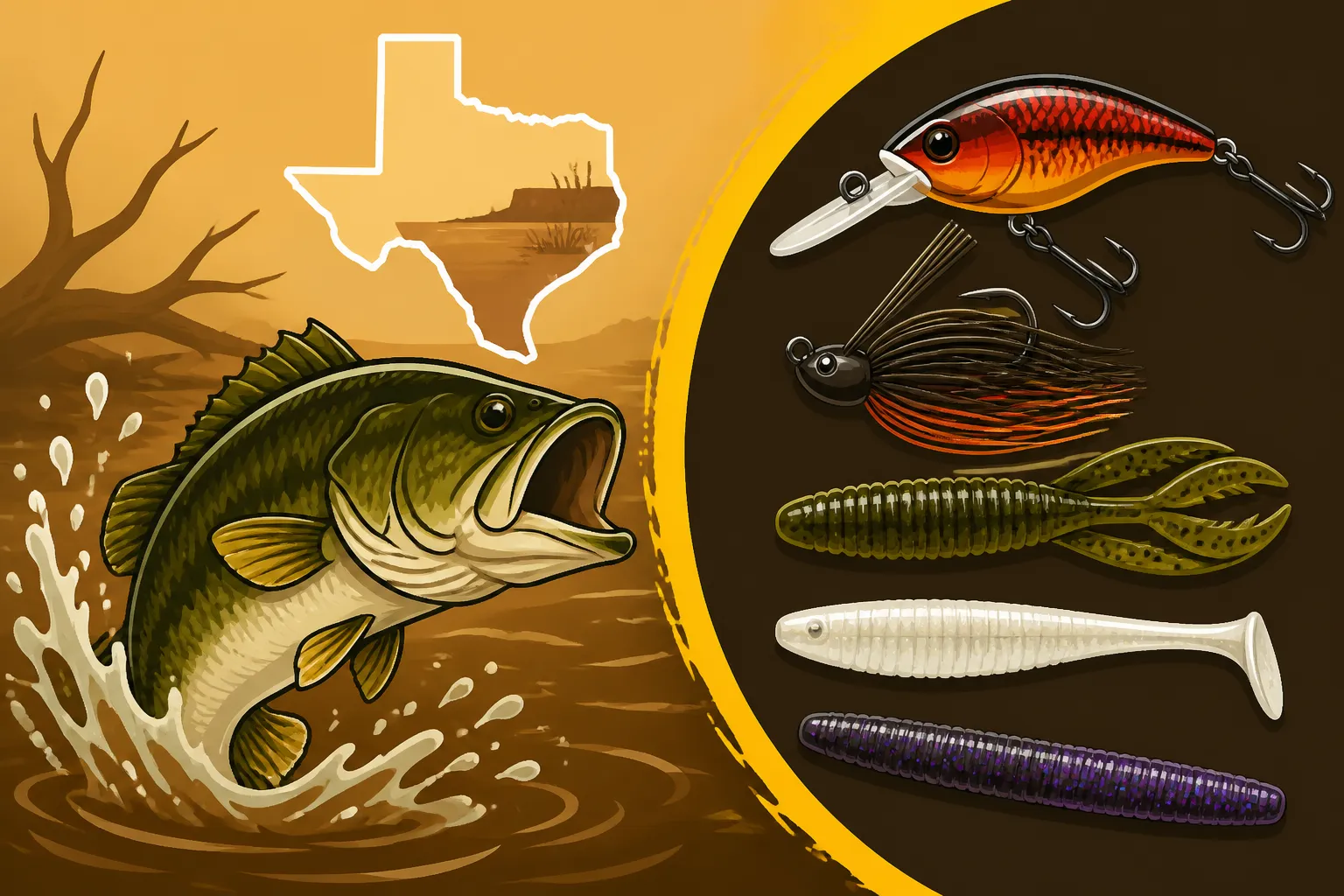
- Texas application: I've had countless successful evenings on Lake Conroe throwing a big, black plastic worm or a junebug jig. As the sun dips below the horizon and the water gets that dusky glow, those dark colors just become so much more visible to the fish from below. They see a clear profile of something moving, and that's often all it takes to trigger a strike. Junebug, a dark purple with green flakes, is a Texas staple for a reason – it creates an excellent silhouette while still having a touch of subtle flash.
Natural-ish with a Twist: Green Pumpkin with Flash, Browns, Reds
This category offers a blend of natural appeal with just enough added visibility to make a difference in moderately stained conditions.
- Why they work: These colors often mimic natural forage like crawfish, bluegill, or baitfish. However, in stained water, a plain green pumpkin might get lost. Adding metallic flakes (like green pumpkin with purple or red flake), laminates (like a brown-orange blend), or even a touch of red (which mimics injured prey) can give them just enough pop to be noticed. The "twist" provides subtle contrast and flash without being overtly unnatural. Red, even though it disappears quickly, can be highly effective in mimicking blood or injured prey if the fish can get close enough to see it.
- When to use them: These are great for water that isn't completely muddy but has a noticeable stain – perhaps a tea-stained clarity from tannins or a light post-front dinginess. They work well when fish are still somewhat relying on sight, but need a little help. Think Texas rigs, Carolina rigs, or jigs where the lure is moving slower and spending more time in the fish's immediate strike zone.
- Texas application: I often reach for a green pumpkin with red flake creature bait or a brown and orange jig when fishing a slightly tannic lake in East Texas. The subtle red or purple flash seems to catch the light just enough to draw attention, while the overall profile still looks like a natural crawfish. On a cloudy day on a lake with a bit of a stain, these colors can be the perfect bridge between vibrant and natural.
By understanding these three main categories and the science behind them, you're already ahead of the game when facing stained water in Texas. It's not about magic; it's about making your lure as detectable as possible to a fish whose primary sense is compromised.
Matching Lure Color to Stained Water Type and Conditions
Not all stained water is created equal. The specific type of murkiness can influence which of our chosen color categories will perform best. What works in a chocolate milk runoff might not be ideal in a tea-stained East Texas lake.
Muddy Water Post-Rain Runoff
This is often the most frustrating type of stained water. Visibility can be measured in inches, and sometimes it feels like zero. This happens frequently in many of our Texas rivers and reservoirs after significant rainfall. When the rivers swell, like the Brazos or Trinity, they carry tons of sediment, turning everything brown.
- Lure Color Strategy: In truly muddy conditions, you need maximum visibility and contrast.
- Bright & Fluorescent: This is where colors like chartreuse, neon green, bright orange, and firetiger absolutely dominate. The goal isn't realism; it's sheer detectability. You want the fish to see something, anything, cutting through that thick murk.
- Dark & Silhouetted: Don't underestimate black or junebug in extremely muddy water. While bright colors help in direct light, a strong, dark silhouette is often what fish pick up against the slightly lighter surface or even ambient light filtering in.
- Beyond Color: In muddy water, vibration and scent become even more crucial. Use lures with a strong thumping action (like a deep-diving crankbait with a wide wobble), rattling features (chatterbaits, lipless cranks), or large profiles that displace a lot of water. Add a strong scent to your soft plastics or jigs to give fish another reason to bite.
- Texas Scenarios: Imagine you're at Lake Ray Roberts after a big rain. The main lake is brown. You'd be throwing a chartreuse squarebill crankbait or a black and blue jig with a rattle to generate attention. The fish might be pushed up shallow, so consider where they'd be able to ambush prey in such low visibility.
Tannic/Tea-Stained Water East Texas
This type of stained water is common in East Texas lakes like Toledo Bend Reservoir Fishing Guide or Caddo Lake, where decaying vegetation releases tannins, giving the water a dark, often reddish-brown hue, much like strong tea. The key difference here is that while it's dark, it can still have surprisingly decent visibility (sometimes 2-3 feet) compared to muddy water.
- Lure Color Strategy: Since there's still some light penetration, you have a bit more flexibility, but contrast is still paramount.
- Fluorescent and Bright: Chartreuse and junebug remain excellent choices. The chartreuse can still glow, and junebug's dark profile with a subtle purple/green flash works well.
- "Natural-ish" with a Twist: Colors like dark green pumpkin with heavy flake (especially purple or red), brown, or even straight dark blue can be very effective. These can mimic crawfish or baitfish that naturally inhabit these dark waters.
- Firetiger patterns can also be surprisingly good, as the bright yellows and oranges cut through the tannin stain, while the dark stripes provide definition.
- Beyond Color: In tannic water, fish can still use their sight somewhat, so lure presentation and profile can be a bit more refined than in muddy water. Scent is still a bonus, but strong vibration might not be as critical as simply getting the lure noticed in the darker water column.
- Texas Scenarios: On a typical day at Toledo Bend with that characteristic tea-stained water, I might start with a junebug senko on a weightless rig or a green pumpkin with blue flake jig worked slowly around cypress trees. If that's not getting bites, I'd switch to a chartreuse spinnerbait to cover water and see if a brighter flash triggers a reaction.
Algae Bloom Stained Water
Algae blooms can turn water various shades of green, yellow-green, or even brownish-green, significantly reducing visibility. This is a common occurrence in many Texas lakes during warm summer months, like Lake Conroe or Lake Palestine Fishing Guide.
- Lure Color Strategy: The key here is to choose colors that stand out against the predominant green hue.
- Bright & Contrasting: White, pearl, bright yellow, and chartreuse are excellent for cutting through green algae. White and pearl create a clean, crisp contrast that fish can easily spot.
- Dark & Silhouetted: Again, black or junebug can create a powerful silhouette against a green-tinged sky or water.
- Blue and Green Combinations: Sometimes, a blue and black or blue and chartreuse combination can work well, as blue can contrast effectively with green while maintaining a somewhat natural baitfish look.
- Beyond Color: Algae can deplete oxygen, especially after dark. Fish might be sluggish. Focus on slower presentations and areas with better oxygenation, such as deeper water or areas with slight current or wind chop. Scent is always a good idea.
- Texas Scenarios: If you're on a lake like Lake Travis during a summer algae bloom, you might reach for a white spinnerbait or a pearl swimbait to imitate a shad trying to escape the murk. If the bloom is really dense, a black or junebug worm might be the ticket, worked slowly through likely cover.
By considering the type of stained water you're fishing, you can fine-tune your lure color selection and greatly increase your chances of success. It's all about understanding the environment from a fish's perspective!
Beyond Color: Other Factors for Success in Stained Water
While lure color is crucial, it's not the only piece of the puzzle. In stained water, fish rely heavily on senses other than sight, making these additional factors absolutely vital for getting bites. Focusing on these elements can turn a tough day into a fantastic one, no matter how murky the water.
Vibration and Sound
Imagine walking through a thick fog; you can't see much, but if you hear a distinct sound or feel a vibration, you know something is there. Fish are the same way, especially in stained water. Their lateral line system is an incredibly sensitive organ that detects pressure changes and vibrations in the water. This is how they "feel" their environment and locate prey, even when they can't see it.
- Why it matters: Lures that generate strong vibrations or sounds act like a beacon in murky water. They send out clear signals that fish can pick up from a distance, drawing them in to investigate. Without these cues, your lure might just pass by unnoticed.
- Effective Lures:
- Rattling crankbaits and lipless crankbaits: These are classic choices for stained water. The internal rattles create a commotion, and the wide wobble displaces a lot of water.
- Spinnerbaits and Chatterbaits: The thumping blade of a chatterbait or the spinning blades of a spinnerbait create intense vibration and flash, even if the flash is muted by the water.
- Buzzbaits: For topwater action in stained conditions, a buzzbait's gurgling and splashing disturbance on the surface is impossible to ignore.
- Jigs with rattles: Adding a rattle chamber to your bass jig or crappie jig can significantly increase its detectability.
- Texas Application: Fishing for bass on a windy, stained Lake Palestine? A chrome and blue lipless crankbait with a loud rattle can be just the ticket. Or perhaps on a deep, turbid O.H. Ivie Reservoir Fishing Guide, a big-bladed spinnerbait might be the only way to get a reaction from those giant largemouths. It's about making noise, grabbing attention, and letting the fish "feel" your bait.
Scent and Taste
When sight is limited, other senses take over. For fish, that often means smell and taste. Many species, especially catfish and some bass, have highly developed chemoreception (smell and taste) that they use to locate food.
- Why it matters: Adding scent to your lures provides an irresistible attractant that fish can detect from a distance. Once they get close, if they mouth the bait, the taste can convince them to hold on longer, giving you more time to set the hook. This is particularly vital when fish are hesitant to commit due to low visibility.
- Application:
- Scented Soft Plastics: Many soft plastic baits come pre-impregnated with salt, garlic, or other fish attractants. Look for brands like Berkley's PowerBait or Yum's Dinger series.
- Scent Sprays and Dips: You can buy external scent sprays, gels, or dips to apply to any of your lures – soft plastics, jigs, even crankbaits. Popular scents include garlic, crawfish, shad, and anise.
- Live Bait: Of course, live bait like worms, minnows, or cut bait (especially for catfish) naturally provides powerful scent trails. If you're trying to figure out Best Catfish Bait for Texas Lakes, scent is king.
- Texas Application: If I'm fishing a stained pond in a city park or a muddy river for channel catfish, dousing my worm or chicken liver with a strong scent like "stink bait" or garlic spray is a non-negotiable. For bass, adding a dab of crawfish-scented gel to a junebug jig can be the difference between a curious sniff and a committed strike. It's about giving them every reason to bite, even if they can't fully see what they're biting.
Lure Size and Profile
In stained water, not only is color less visible, but the entire lure can appear smaller and less distinct. This is where playing with size and profile comes in.
- Why it matters: A larger, bulkier lure presents a more prominent silhouette and displaces more water, making it easier for fish to detect through their lateral line. It's simply harder to miss a big, dark object moving through the murk than a small, subtle one.
- Application:
- Upsize your baits: If you'd normally throw a 4-inch worm in clear water, consider a 6- or 7-inch worm in stained conditions. For jigs, go with a bulkier skirt or add a larger trailer.
- Bulky profiles: Lures with broad sides or paddle tails create more water displacement and a larger profile. Think creature baits with flapping appendages or wide-wobbling crankbaits.
- Darker colors on bigger baits: Combining a large, bulky profile with a dark color like black or junebug maximizes the silhouette effect, making your bait impossible to ignore.
- Texas Application: When the water on Lake Fork is stained after a big rain, I'm not reaching for finesse baits. Instead, I'm throwing a big, black and blue jig with a large craw trailer, or a substantial creature bait on a Texas rig. The goal is to make my presence known. Those trophy bass might be hiding deep in the submerged timber, and a big, thumping, scented bait is what's going to draw them out.
By integrating these "beyond color" strategies with your chosen lure colors, you'll be well-equipped to tackle even the most challenging stained water conditions Texas throws your way. It's about understanding how fish adapt and then adapting your approach to meet them where they are.
| Water Type | Visibility (Approx.) | Primary Lure Colors (High Contrast) | Secondary Lure Colors (Silhouettes) | Key Additional Factors |
|---|---|---|---|---|
| Muddy (Post-Rain Runoff) | 0-1 foot | Chartreuse, Neon Green, Bright Orange | Black, Junebug | Strong vibration, Heavy scent, Large profile |
| Tannic (Tea-Stained) | 1-3 feet | Chartreuse, Junebug, Firetiger | Dark Green Pumpkin w/ flake, Dark Blue | Moderate vibration, Scent, Natural profile |
| Algae Bloom (Green/Brown) | 0.5-2 feet | White, Pearl, Bright Yellow | Black, Junebug | Moderate vibration, Scent, Clear contrast |
| Silty/Naturally Stained | 1-2 feet | Chartreuse, Orange, White | Black, Junebug, Dark Green Pumpkin | Consistent vibration, Scent, Varying profiles |
Disclaimer
This article is for general informational purposes only and does not constitute professional advice. Laws, prices and regulations vary by location and change over time. Consult a qualified professional for guidance on your specific situation.