Best Fish Finders for Texas Lakes
One of the most common frustrations for anglers hitting the vast and diverse waters of Texas is staring at a seemingly empty expanse and wondering, "Where in the world are the fish?" It's disheartening to spend hours casting blindly, feeling like you're just guessing where the best spots might be. This guide is dedicated to pulling back that watery curtain, explaining how modern fish finders can transform your fishing experience on Texas lakes, helping you locate structure, cover, and, most importantly, the fish you're after, turning those frustrating guesses into confident casts.
Why a Fish Finder is a Game Changer for Texas Anglers
Texas lakes are incredibly diverse, from the shallow, stump-filled waters of East Texas to the deep, clear reservoirs of the Hill Country. Without a clear picture of what's beneath the surface, you're essentially fishing blind. A quality fish finder isn't just a fancy gadget; it's a vital tool that gives you X-ray vision into the underwater world, dramatically increasing your chances of success.
Overcoming the Challenges of Texas Lakes
Think about the sheer size and variety of our Texas lakes. You've got giants like Lake Fork, Sam Rayburn, and Toledo Bend, where covering water efficiently is key to finding those trophy bass. Then there are the deep, rocky havens like Canyon Lake or Lake Travis, where fish might hold tight to ledges and submerged cliffs. Fishing these bodies of water effectively without knowing the contours, the drop-offs, the brush piles, or even individual submerged trees is incredibly challenging. A fish finder instantly cuts down the guesswork, showing you exactly where those prime fish-holding areas are. It can help you differentiate between barren bottoms and productive structure, saving you countless hours of unproductive casting.
Many anglers arrive at a new lake, or even a familiar one, and spend precious time searching for promising spots. A fish finder allows you to scan vast areas quickly, identifying humps, creek channels, old roadbeds, and submerged timber that would otherwise remain hidden. This capability is particularly crucial on heavily pressured lakes where fish are wary and tend to congregate around specific, often subtle, structural elements. It also helps you understand how fish relate to these structures, whether they're suspended over deep water or hugging the bottom in cover.
The Technology Behind the Magic
At its core, a fish finder works by sending sound waves (sonar pulses) into the water and then listening for the echoes that bounce back. These echoes are processed and displayed on a screen, creating a visual representation of what's below your boat. Different types of sonar — traditional 2D, DownScan, SideScan, and CHIRP — provide varying levels of detail and coverage, each serving a unique purpose. The beauty of modern units is their ability to combine these technologies, giving you a comprehensive view. For example, you might use SideScan to scout wide areas for submerged timber and then switch to DownScan to get a photographic-like detail of a specific brush pile you've identified, seeing individual fish hiding within it.
The advancements in transducer technology and processing power mean that today's fish finders can resolve incredibly fine details, distinguishing between a single fish and a submerged branch, or even identifying different species by their unique sonar signatures. This is a far cry from the blurry, ambiguous blobs of older units. These technological leaps also mean that even entry-level units offer capabilities that were once exclusive to high-end professional models, making them accessible to a wider range of anglers.
More Than Just Finding Fish
While the name suggests their primary purpose, fish finders are invaluable for much more than just locating individual fish. They are indispensable for understanding the entire underwater ecosystem. You can use them to identify changes in bottom composition, from soft mud to hard rock, which can be critical for certain species. They reveal thermoclines, which are layers of water at different temperatures, often where fish will suspend during warmer months. You can map out weed lines, locate bait balls, and track your boat's movement over productive areas.
For anglers keen on targeting specific species, knowing the structure is paramount. Bass might be holding tight to a submerged point or a creek channel bend, while crappie could be schooling around brush piles. Catfish often lurk in deeper holes or along river channels. A fish finder allows you to pinpoint these specific habitats. Furthermore, integrating GPS and mapping capabilities means you can mark these hotspots, save them, and return to them with precision, building a digital log of your most productive spots. This is especially helpful on vast lakes where features can look indistinguishable on the surface.
Understanding Fish Finder Technologies
Navigating the world of fish finder technology can feel a bit like learning a new language. You hear terms like 2D, DownScan, SideScan, and CHIRP, and it can be overwhelming. But don't worry, once you break it down, it's actually quite intuitive. Each technology offers a unique perspective, and understanding them helps you choose the best unit for your specific Texas fishing needs.
Sonar Basics: 2D, DownScan, and SideScan
Let's start with the fundamentals.
-
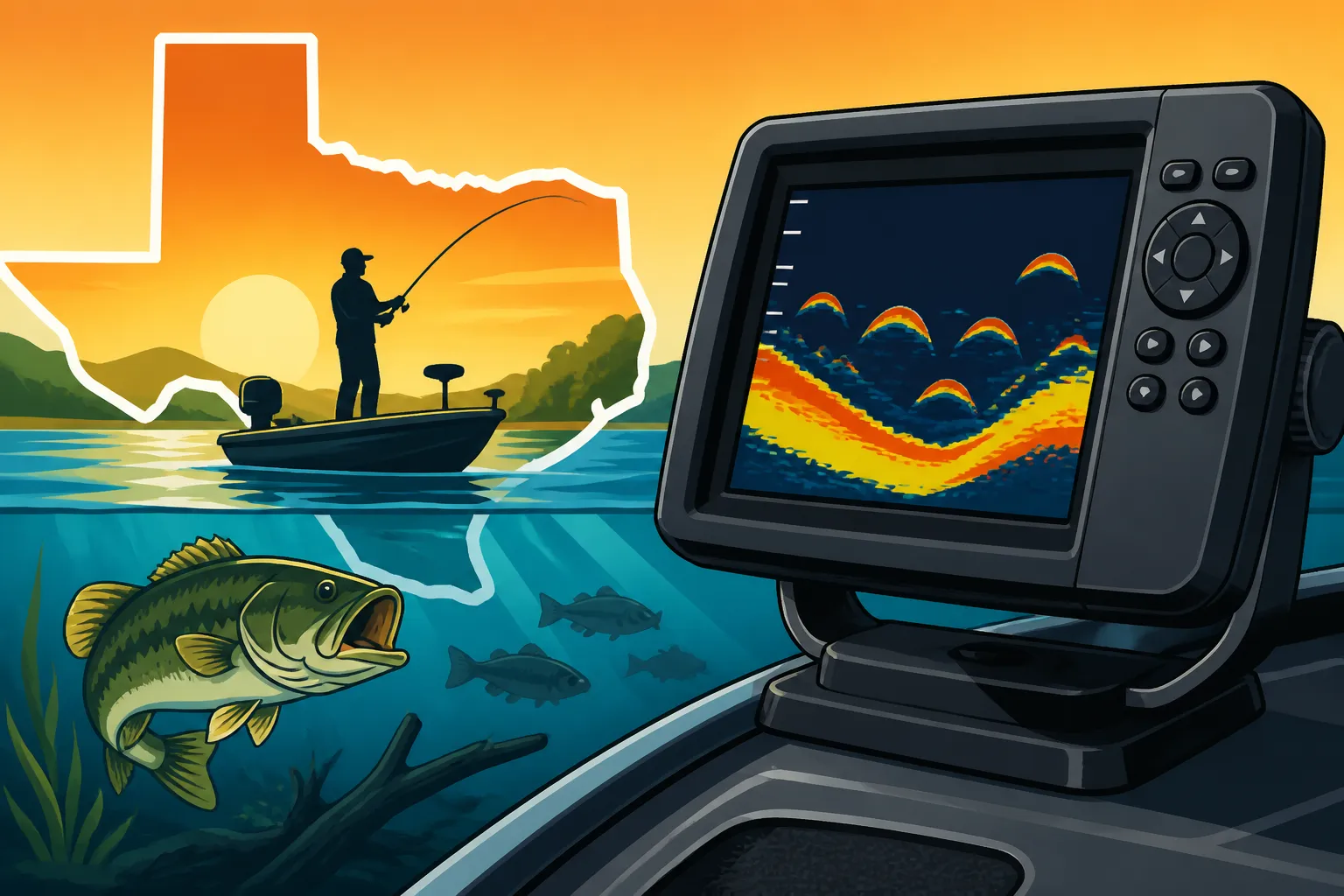
2D Sonar (Traditional Sonar): This is the classic "fish arch" display that most people recognize. It sends a cone-shaped beam straight down, and when the sound waves hit fish or structure, they bounce back, creating echoes. Fish appear as arches because they move through the cone. The wider the cone, the more area it covers, but with less detail. Narrower cones offer more detail but cover less area. This is great for showing depth, hard bottom vs. soft bottom, and general fish presence directly beneath the boat. It's the bread and butter for many anglers.
-
DownScan Imaging (or DownVu/ClearVu): Imagine if you could take a photograph of the bottom directly beneath your boat. That's essentially what DownScan does. Instead of a cone, it uses very narrow, high-frequency beams that provide picture-like detail of structure, baitfish, and game fish directly below. You can see individual tree limbs, rock piles, and even the shadows of fish relating to that structure. It’s fantastic for really dissecting what's directly underneath you, giving you an almost photographic quality rendering.
-
SideScan Imaging (or SideVu/StructureScan): Now, imagine that same photographic view, but extending out to the sides of your boat. SideScan does exactly that, sending beams out horizontally to cover a much wider area. This is a scouting tool par excellence. You can quickly scan large flats, channel edges, or shorelines for hidden brush piles, rock formations, or even submerged vehicles that might be holding fish. When you find something interesting off to the side, you can then turn your boat and use DownScan or 2D to investigate it directly. This technology is a game-changer for finding Best fishing spots accessible without a boat in Texas or even just new spots from your boat.
CHIRP Sonar: Clarity and Target Separation
CHIRP stands for Compressed High-Intensity Radiated Pulse. While traditional sonar sends out a single frequency pulse, CHIRP sends a continuous sweep of frequencies (from low to high) within each pulse. Why does this matter?
The result is significantly better target separation and much clearer, crisper images. With CHIRP, you can often distinguish individual fish in a bait ball, or tell the difference between a fish suspended near a tree limb versus being part of the limb itself. The increased detail makes it easier to identify fish at greater depths and in noisy water conditions.
Many modern fish finders, especially those from reputable brands like Lowrance or Humminbird, integrate CHIRP into their 2D, DownScan, and SideScan technologies, enhancing the clarity across the board. This is particularly valuable when you're trying to pick out a trophy bass from a school of smaller fish.
GPS, Mapping, and Waypointing: Navigating the Waters
A fish finder isn't just for seeing what's below your boat; it's also crucial for knowing where you are and where you want to go. That's where integrated GPS, mapping, and waypointing come into play.
- GPS (Global Positioning System): This allows your unit to track your boat's precise location on the water, showing your movement on a digital map. It's essential for navigation, especially on large, unfamiliar Texas lakes.
- Mapping: Many fish finders come pre-loaded with detailed lake maps, showing contours, depths, navigation markers, and even submerged features. These maps are invaluable for understanding the layout of the lake and identifying potential fishing hot spots before you even get there. Some units allow you to create your own custom maps as you idle over new areas, building a personalized, highly detailed chart of your favorite spots.
- Waypointing: This feature lets you mark specific locations with a digital "pin" on your map. Found a brush pile holding fish? Mark it! Caught a big bass off a submerged hump? Mark it! These waypoints are stored in your unit's memory, allowing you to return to those exact spots with precision whenever you want. This is how you build a library of productive fishing locations over time, turning random luck into consistent success. For serious anglers looking for Best electronics for Texas reservoir fishing, integrated GPS and mapping are non-negotiable features.
Key Features to Look for in a Texas Lake Fish Finder
Choosing the "best" fish finder isn't about picking the most expensive one; it's about finding the unit that best suits your fishing style, the types of Texas lakes you frequent, and your budget. There are several key features that deserve your close attention when making this important decision.
Screen Size and Resolution: Seeing Clearly Under the Sun
Imagine trying to read a tiny text message in bright sunlight. That's what a small, low-resolution screen can feel like on the water. For a fish finder, a larger screen with high resolution is a huge advantage.
- Screen Size: Measured diagonally, screen sizes can range from small 3-5 inch units perfect for kayaks or jon boats, up to massive 12-16 inch displays ideal for larger bass boats. On bigger screens, you can often split the display to show multiple sonar views (e.g., 2D, DownScan, and SideScan) simultaneously, along with your map, without everything looking cramped. This multi-pane view is especially useful when you're actively scouting and fishing at the same time.
- Resolution: This refers to the number of pixels on the screen (e.g., 800×480, 1024×768). Higher resolution means a clearer, more detailed image. You'll be able to distinguish fish arches better, see finer details in DownScan images, and read your maps with more precision. On a sunny Texas afternoon, a bright, high-resolution display makes all the difference in quickly interpreting what your sonar is showing you. Units with higher pixel counts might cost more, but the enhanced clarity is often worth the investment, particularly for Best fish finder for deep Texas reservoirs where every detail counts.
Transducer Power and Frequencies: Reaching the Depths
The transducer is the unsung hero of your fish finder, sending and receiving the sonar pulses. Its power and the frequencies it uses dictate how well your unit performs.
- Power (Watts RMS): More power means the sonar signal can penetrate deeper and provide clearer returns, especially in noisy water or at higher speeds. For deep Texas lakes like Lake Amistad or Canyon Lake, higher power (e.g., 500W RMS or more) is beneficial for reaching those depths and getting clear images. For shallower waters, extremely high power isn't as critical, but it always helps with clarity.
- Frequencies (kHz): Different frequencies offer different benefits:
- Low Frequencies (e.g., 50 kHz): These penetrate deeper and are less susceptible to interference, making them great for deep water. However, they provide less detail.
- High Frequencies (e.g., 200 kHz, 455 kHz, 800 kHz, 1.2 MHz): These provide much finer detail and better target separation but don't penetrate as deep and can be absorbed more quickly. They are excellent for identifying structure and fish in shallower to mid-depth waters, which covers a huge amount of fishing on typical Texas lakes.
- CHIRP Frequencies: As mentioned, CHIRP sweeps a range of frequencies (e.g., Medium CHIRP 83-100 kHz, High CHIRP 150-200 kHz). This combination offers the best of both worlds: good depth penetration with excellent detail and target separation. Many transducers are "dual beam" or "multiple frequency" capable, allowing you to switch between or even simultaneously use different frequencies to get the best view of the water column. When considering a fish finder for general use, a unit that offers a good range of frequencies, ideally with CHIRP, will give you the most versatility.
User Interface and Ease of Use: Getting Started Quickly
You don't want to spend precious fishing time fiddling with complicated menus. A good fish finder should be intuitive and easy to use, even for beginners.
- Intuitive Menus: Look for units with clear, logical menu structures and easily accessible controls. Some brands are known for their user-friendliness right out of the box. Many units feature touchscreens, physical buttons, or a combination of both. Consider which interface you prefer, especially when your hands might be wet or you're wearing gloves.
- Pre-set Modes: Many modern fish finders come with pre-set fishing modes (e.g., "Shallow Water," "Deep Water," "Ice Fishing") that automatically adjust settings for optimal performance in different scenarios. This is a huge help for beginners who aren't yet confident in manually tweaking sonar settings.
- Customization: While ease of use is important, the ability to customize settings as you gain experience is also valuable. You might want to adjust sensitivity, color palettes, scroll speed, or range to fine-tune your display for specific conditions or target species. Brands like Humminbird with their MEGA Imaging or Lowrance with their Active Imaging are generally considered to have excellent, easy-to-use interfaces while still offering deep customization. When you want to learn How to read a fish finder for bass, a user-friendly interface makes the learning curve much smoother.
Top Fish Finder Brands and Their Offerings for Texas Anglers
The market for fish finders is robust, with several major players constantly innovating. Each brand has its strengths, and understanding these can help you narrow down your choices when looking for the perfect unit for your Texas adventures. You'll find a wide array of options at retailers like Bass Pro Shops and Amazon.
Entry-Level Options for the Budget-Conscious
If you're just starting out or primarily fish from a kayak, jon boat, or from the bank, you don't need to break the bank to get valuable sonar capabilities.
- Garmin Striker Series: Garmin offers excellent entry-level units in their Striker series. These often include traditional CHIRP sonar and a built-in GPS plotter, which means you can mark waypoints and navigate, but they typically don't have detailed pre-loaded maps. They're straightforward, reliable, and often offer crisp images for their price point. They are fantastic for anglers who want to know what's directly beneath their boat and mark a few key spots without a lot of bells and whistles. Many of these models are perfect as a Best budget fish finder for beginners.
- Lowrance Hook Reveal Series: The Hook Reveal series from Lowrance is another strong contender. What sets them apart is often the inclusion of FishReveal technology, which overlays detailed CHIRP sonar fish arches onto DownScan images. This makes it much easier to identify fish that might otherwise blend into structure on a traditional DownScan display. They also often come with C-MAP Contour+ mapping, which is a great bonus for pre-loaded lake data.
- Humminbird HELIX 5/7 Series: While some models in the HELIX 5/7 range can get into the mid-tier, the entry-level HELIX units provide solid 2D CHIRP sonar and often have the option to upgrade to Down Imaging or Side Imaging later if the unit supports it. Humminbird's menu system is generally intuitive, and they offer clear displays.
These entry-level units typically range quite a bit in price, but they all offer a significant upgrade over fishing blind. When looking to get one, check out options available through Bass Pro Shops or online retailers like Amazon, where you can often compare features side-by-side.
Mid-Range Performers for Serious Hobbyists
For the angler who spends a good amount of time on the water and wants more advanced features without diving into professional-level pricing, mid-range units hit a sweet spot.
- Lowrance Elite FS Series: The Elite FS (Fishing System) from Lowrance is a powerhouse. It typically combines CHIRP sonar, DownScan, and SideScan imaging with excellent detail, and it's built on a networking platform. This means you can add accessories like a live sonar transducer or connect it to a trolling motor, expanding its capabilities over time. The screen clarity is excellent, and the C-MAP Genesis Live mapping allows you to create your own high-definition contour maps in real-time as you fish. This is invaluable for finding subtle structure on Texas lakes that might not be on pre-loaded maps.
- Humminbird HELIX 8/9/10 Series: Moving up in screen size and features, the HELIX 8, 9, and 10 models offer Humminbird's famed MEGA Down Imaging and MEGA Side Imaging, which operate at incredibly high frequencies (over 1 MHz) to provide near photo-quality images. These units also come with robust GPS charting and mapping features, including Humminbird's AutoChart Live, which lets you map contours and bottom hardness in real-time. The larger screens really make a difference for interpreting the detailed Side Imaging returns.
- Garmin ECHOMAP UHD Series: Garmin's ECHOMAP UHD series offers Ultra High-Definition ClearVü and SideVü scanning sonars, providing excellent clarity. These units are also known for their intuitive interface and include preloaded Garmin Navionics+ charts with integrated detail. They are easily networked and compatible with Garmin's popular Panoptix and LiveScope live-scanning sonar systems, making them a great foundation for future upgrades.
These mid-range units often represent the best value, providing a comprehensive suite of features that will greatly enhance your fishing on lakes like Lake Fork or Sam Rayburn without requiring a professional budget.
High-End Units for the Tournament Pro
If you're a serious tournament angler or simply demand the absolute best technology available, high-end fish finders offer unmatched performance, connectivity, and detail.
- Garmin GPSMAP Series with LiveScope/Panoptix: Garmin's GPSMAP series units are typically large, powerful, and highly networkable. When paired with their revolutionary LiveScope or Panoptix transducers, they offer real-time, live-scanning sonar. This means you can see fish swimming, reacting to your bait, and moving around structure in front, below, or to the sides of your boat, all in real-time. It's like having an underwater camera. This technology has utterly changed tournament fishing, allowing anglers to target individual fish with incredible precision. While the units themselves are robust, the LiveScope transducer is where the magic truly happens.
- Lowrance HDS Live Series: The HDS Live series from Lowrance is their flagship line. These units boast incredibly fast processors, stunning high-definition screens, and support for all of Lowrance's cutting-edge technologies, including Active Imaging, FishReveal, and the ability to integrate with their Ghost Trolling Motor and ActiveTarget live sonar. They offer extensive networking capabilities, allowing you to connect multiple displays, radar, and other accessories. HDS Live units are built for peak performance and reliability, essential for competitive anglers.
- Humminbird APEX/SOLIX Series: Humminbird's APEX and SOLIX series are their top-tier offerings, providing unparalleled screen clarity, processing power, and integration with their MEGA 360 Imaging and MEGA Live Imaging technologies. MEGA 360 allows for a complete, bird's-eye view around your boat, continuously scanning in all directions. MEGA Live provides real-time, live-scanning views similar to Garmin's LiveScope. These units are designed for tournament anglers who need every possible advantage, offering incredibly detailed images and seamless networking across their boats.
These high-end units, especially when combined with live-scanning sonar, are at the forefront of fishing technology and can make a monumental difference when you're targeting those elusive trophy bass or trying to find fish holding tight to How to fish deep drop-offs for bass.
| Feature/Technology | Entry-Level Benefits | Mid-Range Benefits | High-End Benefits |
|---|---|---|---|
| Screen Size | 5-7 inches, basic clarity | 7-10 inches, good clarity, some split-screen | 10-16+ inches, high-res, multi-pane, touchscreen |
| Sonar Types | 2D CHIRP, basic DownScan | 2D CHIRP, DownScan, SideScan (often MEGA/UHD) | All of above + Live Sonar (e.g., LiveScope, ActiveTarget, MEGA Live) |
| Mapping | Basic GPS plotter, waypoint storage | Pre-loaded detailed maps, real-time mapping (e.g., Genesis Live, AutoChart Live) | Advanced mapping, highly customizable, satellite overlays, chart sharing |
| Networking | Limited to none | Basic networking (trolling motor, single display) | Full networking (multiple displays, radar, engine data, live sonar) |
| User Interface | Button-driven, simple menus | Intuitive buttons/touch, customizable layouts | Advanced touch/button, highly customizable, quick access to complex features |
| Target Angler | Casual, Kayak, Jon Boat | Serious hobbyist, weekend warrior, smaller tournaments | Tournament pro, guide, tech enthusiast, large boat owner |
| Typical Cost | Check manufacturer/retailer sites | Check manufacturer/retailer sites | Check manufacturer/retailer sites |
Installation and Setup Tips for Your Texas Lake Fish Finder
Getting your new fish finder up and running correctly is just as important as choosing the right unit. A poorly installed transducer or incorrect wiring can lead to frustrating performance issues. Taking your time with the installation will ensure you get the most out of your investment on Texas waters.
Mounting Your Transducer and Display
The transducer is the eyes and ears of your fish finder, so its placement is critical for clear, uninterrupted readings.
- Transducer Placement: For boats with outboard motors, the ideal spot is typically on the transom, slightly off-center from the motor, and low enough to be in clean water flow, but not so low that it creates excessive spray or drag. It should be submerged enough to get a clean signal at speed, but not so deep it's prone to striking objects. For kayaks, through-hull or scupper mounts are common, ensuring the transducer is fully submerged. Take care to avoid mounting it near anything that might create turbulence, such as strakes or rivets, as this can lead to "dirty" readings (noise on your screen). Some anglers opt for trolling motor mounted transducers, which provide excellent images, especially with SideScan, as the transducer can be steered independently of the main motor.
- Display Mounting: Your fish finder display needs to be mounted securely in a location that's easily visible from your typical fishing position, yet protected from direct impact. Consider glare from the sun – a good swivel mount can allow you to adjust the screen angle for optimal viewing throughout the day. Ensure all cables are neatly routed and secured, protecting them from snags and damage, and preventing clutter in your cockpit. On a bass boat, you'll often see multiple displays, so planning the layout beforehand is key.
Powering Your Unit: Batteries and Wiring
A consistent, clean power supply is essential for optimal fish finder performance.
- Dedicated Power Source: It's highly recommended to wire your fish finder directly to a dedicated battery or to the main battery terminals, bypassing switches or accessory panels if possible. This minimizes electrical interference from other electronics on your boat (like bilge pumps, aerators, or trolling motors) that can show up as "noise" on your sonar screen.
- Proper Gauge Wiring: Use the correct gauge wire recommended by the fish finder manufacturer. Using wire that's too thin can lead to voltage drops, causing your unit to reboot unexpectedly or perform poorly, especially at higher power settings. Always solder and heat-shrink electrical connections for maximum reliability and corrosion resistance, particularly in a humid environment like Texas.
- Fuses: Always install an in-line fuse of the correct amperage between the battery and your fish finder. This protects your unit from power surges and short circuits. Knowing how to set up your power is a crucial aspect of Best electronics for Texas reservoir fishing.
Initial Settings and Calibration
Once everything is installed, a little initial setup will ensure you get the best possible performance.
- Sonar Sensitivity: Start with the "Auto" sensitivity setting, then gradually adjust it. If you see too much clutter (noise) on the screen, reduce the sensitivity. If you're not seeing fish arches or structure clearly, increase it. The goal is to maximize detail without excessive noise.
- Frequency Selection: Experiment with different frequencies based on the depth you're fishing. Use lower frequencies for deeper water and higher frequencies for better detail in shallower areas. If your unit has CHIRP, try enabling it for the best overall clarity.
- Palette and Color Scheme: Most units offer various color palettes. Choose one that provides the best contrast and visibility for your eyes, especially in varying light conditions. Some anglers prefer darker backgrounds for low light, while others prefer brighter ones for intense sun.
- Speed and Scroll Speed: Understand that your sonar image scrolls from right to left, with the right side representing the most current information. Adjust the scroll speed to match your boat speed for a more accurate representation of the bottom. If you're idling, a slower scroll speed is fine; if you're cruising, a faster one is better. Spending some time understanding these basics will dramatically improve How to read a fish finder for bass and all other species.
Maximizing Your Fish Finder's Potential on Texas Lakes
Having a top-notch fish finder is only half the battle; knowing how to use it effectively is where the real magic happens. It's about interpreting the information on the screen and translating it into successful fishing strategies, whether you're chasing bass, crappie, or catfish across the diverse waters of Texas.
Interpreting Your Sonar Display
Learning to read your fish finder is a skill that develops with practice. It’s like learning a new language, but one that directly speaks to fish activity and underwater structure.
- Fish Arches vs. Clutter: On traditional 2D sonar, fish typically appear as arches. A full, strong arch indicates a fish that passed through the entire sonar cone. Shorter or partial arches mean the fish only entered part of the cone. Don't be fooled by random dots or lines, which can be debris, baitfish schools, or even air bubbles. Learn to differentiate these from true fish targets. With DownScan, fish will look more like blobs or distinct targets, often with a shadow indicating their position relative to the bottom or structure. This feature is a game-changer for identifying fish relating to cover.
- Understanding Structure: Your fish finder will show you humps, ledges, creek channels, brush piles, submerged trees, and rock formations. Harder bottoms (rock, gravel) will typically show a thicker, more intense return than softer bottoms (mud, silt). Look for abrupt changes in depth or bottom composition; these are often prime holding areas for fish. For example, knowing How to fish standing timber for bass becomes much easier when you can clearly see the tree on your screen.
- Identifying Baitfish and Predators: Baitfish schools appear as dense clouds or balls on your sonar. When you see larger, distinct arches or targets lurking around these bait balls, you've likely found active predators. This is a critical indicator for locating feeding fish.
Using Waypoints and Custom Maps
Your fish finder's GPS and mapping capabilities are powerful tools for pattern fishing and returning to productive spots.
- Marking Hotspots: Every time you catch a fish, especially if it's a good one, mark that exact spot with a waypoint. This creates a digital breadcrumb trail of your success. Over time, you'll build a comprehensive map of productive areas.
- Saving Structure: Found an isolated brush pile, a subtle hump, or a specific timber line using SideScan? Mark it! Even if you don't catch a fish there immediately, it's a piece of structure that could hold fish at different times or under different conditions. This is invaluable for future trips to the same lake.
- Creating Custom Maps (Genesis Live, AutoChart Live): Many mid- to high-end units allow you to create real-time contour maps as you drive over an area. This is incredibly useful for finding subtle changes in depth or bottom composition that might not be on pre-loaded maps. Imagine discovering a hidden ditch or a small rock pile that nobody else knows about—that's the power of custom mapping. This feature helps refine your approach to How to read lake contour maps for bass fishing in a dynamic way.
- Following Patterns: By marking waypoints for fish catches and identifying the type of structure they were relating to, you can start to develop patterns. For example, if you catch several bass off the northern side of humps in 15 feet of water, you can then target similar areas across the lake.
Seasonal Adjustments and Best Practices
Fish behavior changes dramatically with the seasons and weather, and your fish finder usage should adapt accordingly.
- Summer Heat: During the scorching Texas summers, fish often retreat to deeper, cooler water. Use your fish finder to locate thermoclines, which are layers of water where temperatures change rapidly, as fish will often suspend along these. Focus on deep creek channels, submerged roadbeds, and offshore structure. Knowing How to fish a Texas reservoir in the heat is vital, and your fish finder is your best friend for locating those deeper havens.
- Winter Cold: In winter, fish tend to school up tightly and hold close to vertical structure or deep holes. Your sonar will be crucial for locating these tight schools and presenting your bait directly to them. This is where excellent target separation from CHIRP sonar shines.
- Spring Spawn: During the bass spawn, fish move into shallower water. While you might not rely on deep sonar as much, DownScan and SideScan can still help you identify submerged cover like grass beds or isolated stumps in shallower areas where fish might be nesting or staging.
- Trolling Motor Integration: Many modern fish finders can integrate directly with your trolling motor (like a Lowrance Ghost or Garmin Force). This allows for features like anchor lock, which holds your boat in place over a waypoint, and the ability to control your motor directly from your fish finder screen. This level of integration maximizes efficiency and boat control, freeing you up to focus on fishing.
By consistently using your fish finder, marking your spots, understanding what you see on the screen, and adjusting your approach to the conditions, you'll unlock a new level of fishing success on the diverse and rewarding lakes of Texas.
Disclaimer
This article is for general informational purposes only and does not constitute professional advice. Laws, prices and regulations vary by location and change over time. Consult a qualified professional for guidance on your specific situation.