Best PFD for kayak fishing in summer
The scorching Texas sun combined with the humidity can make a day on the water feel less like a relaxing escape and more like an endurance test. If you're out on your kayak, paddling and casting, the last thing you want is a bulky, suffocating personal flotation device (PFD) that leaves you drenched in sweat and constantly adjusting. Many anglers struggle to find a PFD that offers genuine safety without sacrificing comfort and mobility in our intense summer heat. This guide is here to help you navigate the sea of options and find the absolute best PFD for kayak fishing in the Texas summer, ensuring you stay safe, cool, and agile on the water.
Why Your PFD Choice Matters for Texas Summer Kayak Fishing
When you're out on a Texas lake or bay in the middle of July, the heat isn't just an inconvenience; it's a real factor in your safety and enjoyment. Choosing the right PFD goes far beyond just meeting Texas Boat Safety Equipment Requirements; it's about making a day on the water genuinely comfortable and safe in challenging conditions.
The Unique Challenges of Texas Summer Heat
Texas summers are legendary for their heat and humidity. Imagine this: you've launched your kayak on Lake Fork at dawn, the sun is already bearing down, and by noon, it feels like the air itself is shimmering. Wearing a thick, poorly ventilated PFD in these conditions can quickly lead to discomfort that escalates into genuine risk. The extra insulation traps body heat, accelerates sweating, and increases your chances of dehydration, heat exhaustion, or even heatstroke. You might think, "I'll just take it off if I get too hot," but that's exactly where the danger lies. If you're separated from your kayak for any reason, whether it's a sudden gust of wind, an unexpected wave, or a medical emergency, that unfastened or removed PFD offers no protection. We've all heard stories of sudden summer storms popping up, turning calm waters into choppy nightmares in minutes. A PFD designed for cooler climates simply won't cut it when the mercury is pushing triple digits and the humidity is stifling.
Moreover, the sheer duration of many kayak fishing trips in Texas means prolonged exposure. A quick paddle around a pond is one thing, but a full day of navigating a massive reservoir like Sam Rayburn Reservoir demands gear that can perform hour after hour under relentless sun. A PFD that felt "okay" for the first hour can become an unbearable burden by the fifth, leading to fatigue and reduced concentration, which further compounds safety risks.
Beyond Just Staying Afloat: Comfort and Mobility are Key
While a PFD's primary purpose is buoyancy, for a kayak angler, it needs to do so much more. Think about the actions you perform constantly while fishing from a kayak: paddling, casting, reeling, reaching for tackle, adjusting your seat, or even performing a self-rescue if you capsize. A bulky PFD can severely restrict your range of motion, making these activities tiresome and inefficient. That constant friction under the arms or restriction across the chest isn't just annoying; it can impact your casting distance, your paddle stroke efficiency, and even your ability to properly set the hook.
Consider sight fishing for redfish in a shallow Texas bay. You need to be able to twist, turn, and cast accurately. A PFD that impedes your rotation or snags on your rod is a huge disadvantage. Similarly, if you're battling a big largemouth bass around submerged timber, you need full arm movement to guide the fish to the net. An uncomfortable PFD also has a psychological effect. If it's constantly chafing or making you overheat, your focus shifts from the fishing to the discomfort. This can detract from your enjoyment and, more importantly, distract you from potential hazards or subtle bites. Ultimately, the best PFD is the one you will wear for the entire duration of your trip, and that only happens if it's comfortable and doesn't hinder your fishing.
Understanding PFD Types and Their Suitability for Summer Kayak Fishing
Not all PFDs are created equal, especially when you factor in the specific demands of kayak fishing in Texas summer. There are two main categories you'll encounter, each with its own set of advantages and disadvantages for our hot climate.
Inflatable PFDs: Pros, Cons, and Considerations
Inflatable PFDs have become incredibly popular, especially among anglers, because they offer maximum freedom of movement. These devices are designed to be compact and worn like a small vest or waist pack, only inflating when needed. They come in two main types:
- Manual Inflatables: These require you to manually pull a cord to deploy the CO2 cartridge, which then inflates the bladder. This type is great for experienced swimmers who are comfortable in the water and want full control over when their PFD activates. The benefit is you won't accidentally deploy it if you get splashed or fall in momentarily.
- Automatic Inflatables: These PFDs deploy automatically when submerged in water. They often have a dissolvable bobbin that triggers the CO2 cartridge. This is a fantastic option for those who might be less confident swimmers, or if there's a chance of being knocked unconscious, as it provides immediate flotation without any action required from you.
The pros of inflatable PFDs for Texas summer kayak fishing are significant:
- Minimal Bulk and Maximum Ventilation: This is their standout feature. They are incredibly lightweight and allow for almost unrestricted movement. On a sweltering day, feeling the breeze on your chest and back is a game-changer. You barely know you're wearing one, which drastically reduces the chances of overheating.
- Superior Mobility: With no foam to impede your arms or torso, paddling and casting become effortless. This is crucial for precise lure placement or long-distance casting that Texas waters often demand.
- Compact Storage: When not inflated, they take up very little space, which is always a premium on a kayak.
However, they also come with some cons and important considerations:
- Requires Maintenance and Re-arming: Once deployed, an inflatable PFD needs to be re-armed with a new CO2 cartridge and a fresh dissolvable bobbin (for automatics). This is an ongoing cost and requires diligence to ensure it's always ready. You can often find re-arming kits at retailers like Bass Pro Shops or through online stores like Amazon.
- Not Ideal for Non-Swimmers: While they provide excellent buoyancy when inflated, you need to be a reasonable swimmer to handle the initial moments of falling in before it deploys or you manually activate it. Some regulations may also require you to be a certain age or skill level to wear an inflatable as your primary PFD.
- Care and Storage: They are generally more delicate than foam vests and need to be stored dry to prevent mildew or corrosion of the CO2 cartridge.
- Cost: Inflatables tend to be more expensive upfront than traditional foam vests, and the cost of re-arming kits adds to the long-term expense.
For many experienced kayak anglers, the benefits of minimal bulk and maximum comfort in extreme heat often outweigh the maintenance requirements and higher cost.
Foam Vest PFDs: The Different Styles for Paddling
Traditional foam vest PFDs are what most people picture when they think of a life jacket. They rely on closed-cell foam inserts to provide constant buoyancy. While older, bulkier designs can be a nightmare in the Texas summer, modern foam vests specifically designed for paddling and fishing have come a long way.
You'll want to avoid generic recreational vests, as these often have full backs that ride up against the high-back seats common on fishing kayaks, pushing the PFD into your chin. Instead, look for:
- Fishing-Specific Vests: These are engineered with the angler in mind. Key features include:
- High Back Design: The foam is cut higher on the back or replaced with mesh, allowing it to sit comfortably above your kayak seat, preventing ride-up and improving ventilation.
- Mesh Panels and Open Sides: Many models incorporate large mesh sections on the back, sides, and shoulders to maximize airflow and reduce heat retention.
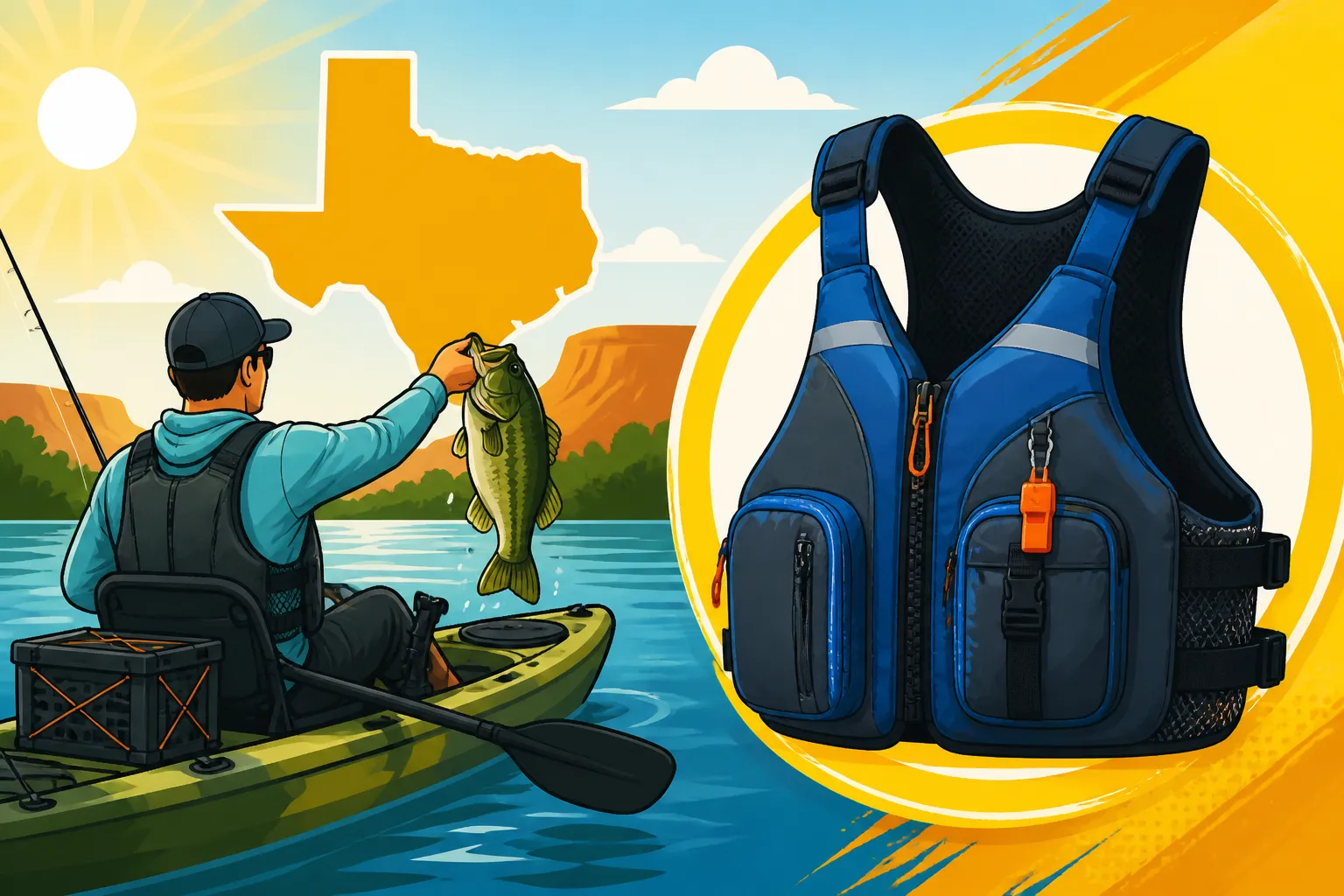
- Strategic Pocket Placement: Pockets are often placed on the front chest area, easily accessible even while seated, perfect for small tackle, pliers, or a whistle.
The pros of foam vest PFDs include:
- Always Buoyant: They provide instant flotation the moment you hit the water, no deployment needed. This makes them excellent for all skill levels, including those who are not strong swimmers.
- Low Maintenance: Simply dry them out after use. No CO2 cartridges to replace.
- Often More Affordable: Initial purchase price is typically lower than inflatables.
- Durable: Generally more robust and less susceptible to damage than inflatables.
The cons of foam vests for summer kayak fishing can be:
- Can Be Hotter: Even with mesh panels and high-back designs, they inherently cover more of your body than an inflatable, potentially trapping more heat.
- Reduced Mobility: While fishing-specific designs improve mobility significantly, they still can't match the unrestricted movement of a deflated inflatable PFD. Casting and paddling may feel slightly more constrained.
- Bulky: Even streamlined versions are bulkier than inflatables, which can sometimes interfere with tight casting motions or reaching into small kayak compartments.
For those who prioritize absolute reliability, minimal ongoing costs, or who are less confident in the water, a well-designed foam fishing vest is an excellent choice for Texas summers, especially if it emphasizes ventilation and a high-back design.
Key Features to Look for in a Summer Kayak Fishing PFD
Choosing the right PFD for those sweltering Texas days comes down to a few critical features that prioritize comfort, safety, and functionality. Don't just grab the first one you see; really scrutinize the design.
Breathability and Ventilation
This is probably the most crucial feature for any PFD used in Texas summer heat. A PFD that traps heat and moisture against your body will quickly make you miserable. Look for designs that actively promote airflow.
- Mesh Backs and Panels: Many top-tier kayak fishing PFDs feature a mesh lower back. This allows air to circulate between your back and the kayak seat, preventing that infamous sweaty back patch. Some designs extend mesh to the side panels or even incorporate ventilated shoulder straps. This isn't just about comfort; reducing excessive sweating helps prevent dehydration, which is a real concern when you're How to stay safe fishing in Texas summer heat.
- Open Sides and Minimalist Designs: PFDs with fewer bulky foam panels, particularly under the arms and along the sides, will offer superior ventilation. Some have adjustable straps that leave large open areas, maximizing air exposure. Think about how much surface area the PFD covers; less coverage generally means better airflow.
- Lightweight, Quick-Drying Fabrics: The outer shell material matters too. Opt for PFDs made from lighter, synthetic fabrics that are designed to shed water and dry quickly. Heavy, absorbent materials will stay wet and cling to your skin, exacerbating discomfort. This is also important if you're planning on Wade Fishing for Redfish in Texas and will be getting in and out of the water frequently.
Storage and Accessibility
Kayak fishing involves a lot of gear in a small space. Your PFD can actually be an extension of your tackle management system, provided it's designed correctly.
- Purpose-Built Pockets: Look for multiple pockets, ideally zippered, placed on the front of the vest. These are invaluable for keeping essential items close at hand, such as a small tackle box with frequently used lures, a pair of pliers, your phone (in a waterproof case!), sunscreen, or a small snack. Pockets with drainage holes are a plus, preventing water from pooling inside.
- Attachment Points (D-rings, Gear Loops): These are small but mighty features. D-rings and gear loops allow you to attach important tools via leashes or retractors. Think about attaching your fishing net, a line cutter, a whistle (often required for safety), or even a small pair of binoculars. Being able to secure these items prevents them from falling overboard and makes them easily accessible when you need them most.
- Tool Holders: Some fishing PFDs incorporate specific sleeves or holsters designed to hold pliers or a knife. This keeps sharp objects safely stowed but ready for immediate use, which is critical when you're unhooking a feisty fish or cutting a tangled line.
Having these storage options on your PFD means less rummaging through your kayak's limited storage and more focus on fishing.
Fit and Adjustability
A well-fitting PFD is paramount for both safety and comfort. A PFD that's too loose can ride up and hinder your ability to breathe or paddle, while one that's too tight will be incredibly uncomfortable and restrictive.
- Snug but Not Restrictive: The PFD should fit snugly around your torso without feeling like it's squeezing you. You should be able to breathe deeply and move your arms freely. It should not ride up over your ears when you lift your arms.
- Multiple Adjustment Points: Look for PFDs with several adjustable straps—typically on the shoulders, sides, and waist. These allow you to customize the fit to your body shape and layering, ensuring it stays put and doesn't chafe.
- High-Back Design for Kayak Seats: As mentioned, if you're opting for a foam vest, a high-back design is critical. This ensures the foam rests above the backrest of your kayak seat, preventing it from bunching up uncomfortably around your neck or pushing you forward. Many Best Kayaks for Texas Fishing have supportive, high-back seats, and a compatible PFD makes a huge difference.
- Sizing: Always check the manufacturer's sizing chart, which typically goes by chest circumference and weight. Don't guess.
A properly fitted PFD won't just keep you safe; it will become a natural extension of your fishing gear, almost forgotten once you start casting.
USCG Approval and Buoyancy Ratings
This is non-negotiable. Any PFD you purchase for use in Texas waters must be U.S. Coast Guard (USCG) approved. This approval signifies that the PFD meets rigorous safety standards and will provide the advertised buoyancy.
- Type III (Flotation Aid): For kayak fishing, you'll almost certainly be looking for a Type III PFD. These are designed for general recreational use and provide at least 15.5 pounds of buoyancy. They are comfortable enough for continuous wear and allow for full mobility, making them perfect for fishing. They are designed for calm inland waters where rescue is likely to be prompt.
- Labeling: Always check the label for the USCG approval stamp and the PFD's type. This information will be clearly printed on the inside of the vest.
- Buoyancy for Inflatables: While most foam vests have inherent buoyancy, inflatable PFDs typically offer more, often 22.5 to 35 pounds when deployed, which is a significant safety margin. Just remember, they only offer this buoyancy after inflation.
Never compromise on USCG approval. It's your assurance that the device will perform when you need it most.
Top Recommendations for Texas Summer Kayak Fishing PFDs
Now that we've covered what makes a PFD suitable for the heat, let's look at the types that excel in these conditions. There are fantastic options in both foam and inflatable categories that prioritize comfort and safety for the dedicated Texas kayak angler.
Lightweight and Ventilated Foam Vests
For those who prefer the simplicity and instant buoyancy of a foam vest, there are excellent models specifically designed for kayak fishing in hot climates. These vests are a far cry from the bulky, stifling PFDs of yesteryear. They integrate clever design elements to maximize airflow and minimize heat retention.
Look for vests that prominently feature large mesh panels, especially across the lower back and sides. A high-back design is also paramount to ensure it doesn't interfere with your kayak seat. Many of these vests will feature thin, soft foam that molds to your body, offering buoyancy without excessive bulk. They often come equipped with angler-specific features like multiple pockets for small tackle boxes, pliers, and other essentials, along with D-rings and lash tabs for attaching tools.
Think about a model with a split front design, which allows for more natural movement and better ventilation across the chest. Brands like NRS and Stohlquist are well-regarded for their paddling-specific PFDs, often incorporating innovative ventilation systems and thoughtful pocket layouts. You might find these specialized vests at outdoor retailers like Bass Pro Shops, where you can try them on and see how they feel with a kayak seat, or browse a wider selection online through sites like Amazon, often with detailed reviews from other kayak anglers.
These vests are a great choice if:
- You want constant, reliable buoyancy without any deployment mechanism.
- You prefer a "set it and forget it" PFD with minimal maintenance.
- You are fishing in areas where immediate flotation is critical, or for those who are less confident swimmers.
- You value the convenience of integrated tackle storage on your PFD.
While they won't be as "invisible" as an inflatable, the best lightweight foam vests come impressively close to maximizing comfort while still providing full flotation in the intense Texas heat.
Manual and Automatic Inflatable PFDs
For the ultimate in comfort and unrestricted movement in the Texas summer, inflatable PFDs are often the preferred choice for many experienced kayak anglers. The feeling of an open chest and back, allowing the breeze to cool you, is simply unmatched by any foam vest.
- Manual Inflatables: These are ideal if you're a strong swimmer and want total control. They typically feature a small CO2 cartridge and a pull-cord. They sit very minimally on your body, often as just a strap around your waist or a small yoke over your shoulders. This means almost zero heat retention and maximum freedom for casting, paddling, and moving around in your kayak.
- Automatic Inflatables: For those who want the peace of mind of automatic deployment, these PFDs inflate upon water immersion. While slightly bulkier than manual versions due to the automatic trigger mechanism, they are still dramatically less intrusive than foam vests. This is an excellent option if you're concerned about unexpected falls or medical emergencies, where you might not be able to manually deploy.
When considering inflatables, pay close attention to the USCG approval (they must be Type V with Type III performance or equivalent), and remember the ongoing cost and necessity of re-arming kits. These kits typically include a new CO2 cylinder and a replacement bobbin (for automatics). It's always a good idea to pick up a spare re-arming kit when you purchase the PFD itself, especially if you're buying it from a place like Bass Pro Shops or Amazon, so you're ready after an accidental deployment or a real emergency.
These PFDs are a great choice if:
- You prioritize absolute freedom of movement for casting, paddling, and managing fish.
- You want minimal body coverage to combat extreme heat and humidity.
- You are a confident swimmer comfortable with the deployment mechanism (manual) or prefer the automatic safety net.
- You are willing to perform regular maintenance and purchase re-arming kits.
Here's a quick comparison of the two main types to help you decide:
| Feature | Foam Vest (Paddling/Fishing Specific) | Inflatable PFD (Manual/Automatic) |
|---|---|---|
| Buoyancy | Always buoyant, instant flotation | Only buoyant after deployment (manual/automatic) |
| Comfort in Heat | Good (with mesh/high-back designs), but covers more area | Excellent, minimal body coverage, maximum airflow |
| Mobility | Very good (designed for paddling), but some restriction | Superior, almost unrestricted movement |
| Maintenance | Low, simple drying | High, requires re-arming kits after deployment |
| Cost (Initial) | Moderate | Higher |
| Best For | All skill levels, those preferring instant flotation, integrated storage | Strong swimmers, maximum comfort, unrestricted movement |
| USCG Type | Type III | Type V (with Type III performance) |
| Key Summer Features | High-back design, mesh panels, open sides, quick-dry fabric | Minimal bulk, air circulation, freedom of movement |
No matter which type you choose, remember that the best PFD is one that fits well, is comfortable enough to wear all day, and meets all safety requirements. Don't let the Texas heat be an excuse to compromise on this essential piece of Texas Boat Safety Equipment Requirements. Getting your Texas Fishing License Requirements Explained is one thing, but staying safe while out on the water is another crucial step for any angler.
Disclaimer
This article is for general informational purposes only and does not constitute professional advice. Laws, prices and regulations vary by location and change over time. Consult a qualified professional for guidance on your specific situation.