How to skip a bait under docks
Texas lakes are dotted with countless boat docks, piers, and marinas, and every seasoned angler knows these structures are absolute magnets for bass, crappie, and even catfish. But getting your bait under those low-hanging planks, into the darkest recesses where the biggest fish lurk, can feel like trying to thread a needle in the dark. If you've ever cast helplessly at a dock, only to have your lure slap the wood or get hung up on a crossbeam, you know the frustration. This comprehensive guide will walk you through the essential technique of "skipping" your bait, transforming those inaccessible spots into your next honey hole.
Why Docks Are Irresistible to Texas Fish
Before we even talk about how to skip, it’s worth understanding why docks are such prime real estate for so many fish species in Texas. It's not just a random hangout spot; these structures provide vital resources that make them irresistible.
Shelter from the Sun and Predators
Imagine a scorching Texas summer day, with the sun beating down on the water. Fish, especially bass, are cold-blooded creatures and don't enjoy direct, intense sunlight any more than we do. Docks provide a dense canopy of shade that offers a cool, dark refuge from the sun's harsh rays. This allows them to conserve energy and stay comfortable. Beyond comfort, these shadows offer excellent camouflage, hiding them from aerial predators like ospreys and eagles, as well as larger fish cruising in open water. They feel safe and secure tucked away under those pilings and planks.
An Abundance of Ambush Points
Docks aren't just flat surfaces; they're complex underwater jungles of pilings, crossbeams, ladders, and even submerged debris like old tires or sunken brush piles that accumulate over time. Each of these elements creates perfect ambush points. A largemouth bass, for instance, is an opportunistic predator that loves to hide in the shadows, waiting for an unsuspecting baitfish or crawfish to swim by. The intricate structure of a dock provides endless nooks and crannies for these predators to lie in wait, making them incredibly effective hunting grounds. You'll often find them tucked against a piling or lurking just outside the darkest pocket.
Consistent Forage Opportunities
It's not just about shelter and ambush; docks are bustling hubs of activity for baitfish and invertebrates. Algae grows on the pilings, attracting small insects and minnows. Spiderwebs and other debris fall from above, attracting smaller creatures. People fishing from docks often drop crumbs or discard bait, which in turn attracts sunfish, minnows, and crawfish – the primary food sources for larger game fish. Additionally, many docks are located near areas where fish naturally spawn, making them important nursery grounds. This consistent availability of food makes docks a reliable buffet for hungry fish, ensuring that if you can get your bait in there, something will likely be looking for a meal. For more insights on what these fish are looking for, check out our guide on Texas Largemouth Bass Fishing Guide.
The Core Skill: Understanding the Bait Skip
Now that we know why fish love docks, let's dive into the critical technique that lets you reach them: skipping. It might sound intimidating, but it's a skill anyone can learn with a bit of practice.
What Exactly is Skipping?
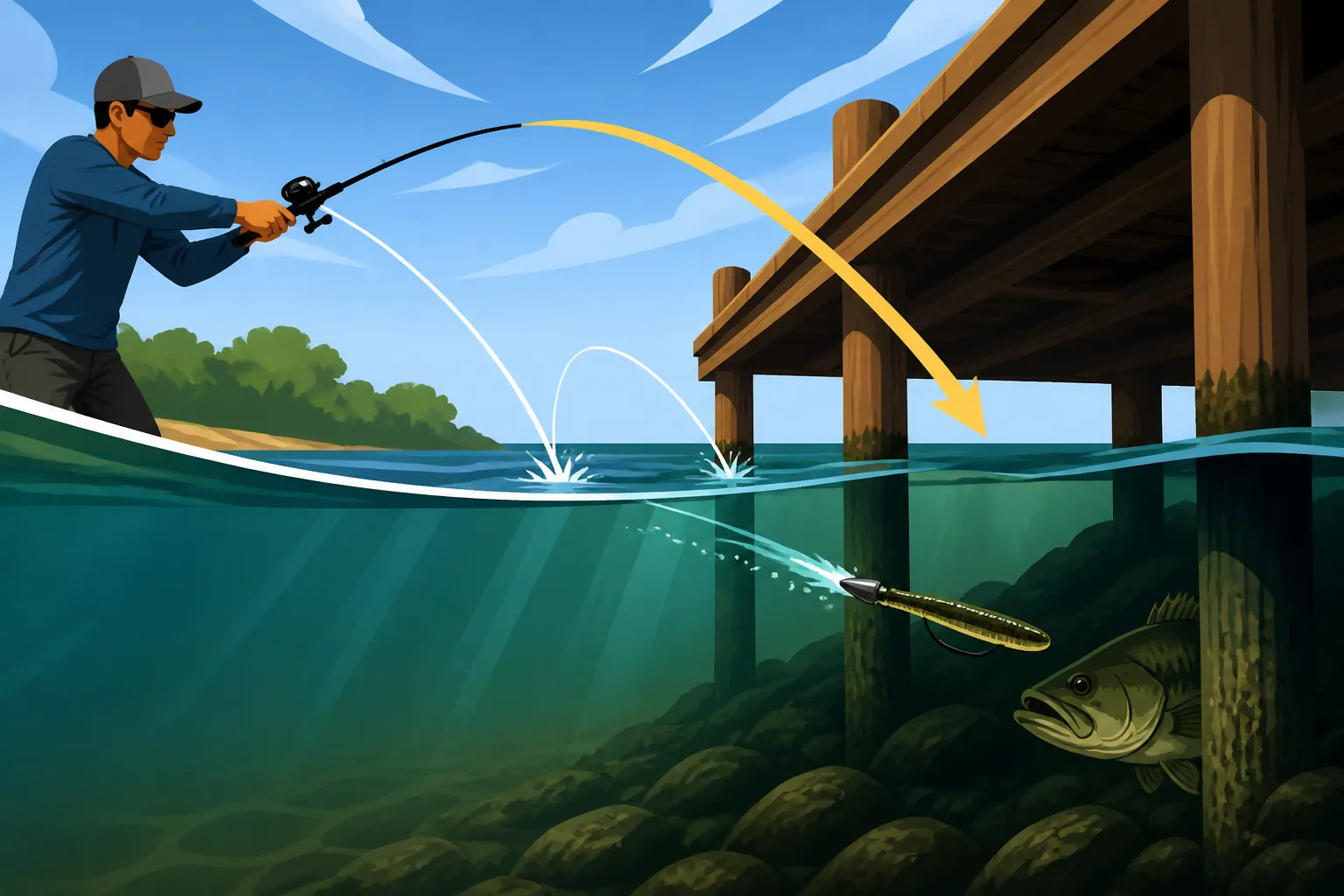
At its heart, skipping a bait is much like skipping a rock across the water. Instead of a high, arcing cast, you're using a low, powerful trajectory that causes your lure to bounce or "skip" several times across the water's surface. The goal is to propel the bait into those tight, low-clearance areas that an overhead or sidearm cast simply can't reach. Think of it as a specialized, precision cast designed to defy gravity and slide your bait exactly where you want it – under a low-hanging boat, beneath a dock deck, or deep into a shadowy opening between pilings. It requires a specific rod angle, a quick wrist flick, and precise thumb control on your reel.
The Physics Behind a Good Skip
The magic of skipping lies in the low angle of approach. When your bait hits the water at a very shallow angle, similar to a flat stone, it generates minimal resistance and transfers much of its forward momentum into horizontal travel across the surface. This "hydroplaning" effect allows the lure to maintain speed and direction, skipping multiple times before finally coming to rest.
Several factors play into a successful skip:
- Angle of Release: The lower the angle, the better the skip. You want your rod tip almost parallel to the water's surface as you release.
- Lure Weight and Shape: Lures that are flat, compact, and dense tend to skip better than bulky, irregularly shaped, or extremely light baits.
- Line Tension: Maintaining slight tension on the line as the bait skips helps guide it and prevents it from veering off course. This is where good thumb control comes into play.
- Water Surface: Calm water is generally easier to skip on, as waves or ripples can disrupt the bait's trajectory and cause it to dig in.
Benefits of Mastering This Technique
Mastering the skip cast offers several significant advantages for anglers fishing around docks and other overhead cover:
- Access to Untouched Water: This is the big one. Skipping allows you to present your lure to fish that rarely see a bait. These are often the biggest, most wary fish that have learned to avoid easy-to-reach areas. By getting into those dark corners, you're fishing where others can't or won't. This can be especially productive when targeting Texas Largemouth Bass Length Limits around private docks.
- Stealthy Presentation: Because the lure is skipping across the surface rather than plunging in with a splash, it creates a much softer, less intrusive entry into the water. This stealth factor is crucial for not spooking fish that are hiding just a few feet away from your entry point. A loud splash can send them scattering, but a gentle skip often goes unnoticed until the bait is right in their face.
- Efficiency: Once you get proficient, skipping can be surprisingly fast and accurate, allowing you to quickly cover multiple dock sections and other tight spots without wasting time on tangled casts.
- Versatility: While primarily known for docks, the skipping technique is also invaluable for fishing under overhanging trees, low bridges, culverts, and any other overhead structure where fish might be hiding.
Assembling Your Skipping Arsenal
Having the right gear isn't just about making the skip easier; it's about making it possible. While you can certainly attempt to skip with any rod and reel, optimizing your setup will dramatically increase your success rate and reduce frustration.
Rods: Shorter, Faster, Stronger
When it comes to skipping, not all rods are created equal. You're looking for a specific combination of attributes to give you the leverage and control needed.
- Length: Shorter rods, typically in the 6'6" to 7'0" range, are often preferred. A shorter rod allows you to get closer to the water's surface for that crucial low angle release and gives you more maneuverability in tight casting spaces that often accompany docks. Too long of a rod can make it difficult to get under low overhangs without hitting the deck above.
- Action: A "fast" or "extra-fast" action rod is key. This means the rod bends mostly in the tip section, providing a quick snap back and excellent sensitivity. This fast tip allows for precise loading and unloading of energy, giving you the whip-like power needed for the skipping motion. It also helps with quick hooksets once a fish bites in close quarters.
- Power: A medium-heavy to heavy power rod is generally recommended. You need enough backbone to handle the force of the cast, drive the hook into a fish that's often quickly moving away from structure, and then pull that fish out from under the dock before it can wrap you around a piling. Many anglers find the "Best Fishing Rods for Texas Anglers" offers several suitable options for this technique.
Reels: The Right Gear Ratio Makes All the Difference
For skipping, a baitcasting reel is almost universally preferred over a spinning reel. While spinning reels can be used, the control and power of a baitcaster make it far more effective.
- Gear Ratio: This is where you might deviate slightly from your everyday bass fishing setup. While high-speed reels (7.1:1 or higher) are great for quickly retrieving line, a slightly slower to mid-range gear ratio (6.X:1 to 7.X:1) can offer more torque, which can be beneficial when fighting a fish that's trying to bury itself in the dock. However, a faster reel also allows you to pick up slack quickly after the bait lands, which is crucial for staying in contact with the lure and detecting subtle bites. Many anglers compromise with a 7.1:1 reel to balance retrieval speed with power.
- Braking System: This is perhaps the most critical feature for a skipping reel. You need a finely tunable braking system (either centrifugal or magnetic, or a combination of both) to prevent backlashes. Skipping puts immense stress on the spool, and without proper braking, you'll spend more time picking out bird's nests than fishing. Practice adjusting your brakes to find the sweet spot that allows for a smooth skip without overrunning the spool. For a deeper dive into reel choices, explore Best Baitcasting Reels for Texas Bass Fishing.
- Spool Tension: Don't underestimate the star drag and spool tension knob. You'll want to adjust the spool tension so there's just enough friction for your lure to fall slowly when the thumb bar is pressed, but not so loose that it free-spools instantly. This initial setting will be refined by your braking system for the actual cast. You can find a wide range of baitcasting reels suitable for skipping on Amazon, making it easy to compare features and read reviews.
Lines: The Unsung Hero of Skipping
The line you choose plays a massive role in how well your bait skips and how effectively you can land fish from under tight cover.
- Fluorocarbon Line: This is often the top choice for skipping. Its low stretch provides excellent sensitivity for detecting subtle bites and superior hook-setting power. Crucially, fluorocarbon is denser than water and sinks, which helps your bait get down quickly once it's under the dock. It's also highly abrasion-resistant, a must-have when your line is constantly rubbing against pilings, barnacles, and rough wood.
- Braided Line: While excellent for sensitivity and strength, braided line has a few downsides for skipping. It floats, which can hinder your bait's descent, and it's notoriously prone to wind knots and backlashes if your reel's braking isn't perfectly dialed in. However, some anglers will use a braided main line with a fluorocarbon leader for maximum sensitivity and strength, mitigating some of the floating issues.
- Monofilament: Generally not recommended for skipping due to its stretchiness, which reduces sensitivity, and its lower abrasion resistance compared to fluoro or braid.
- Pound Test: For most bass skipping scenarios, 12-20 lb fluorocarbon is a good starting point. If you're targeting bigger fish or fishing extremely heavy cover, you might bump up to 25 lb.
Essential Lures for Dock Skipping
Not every lure is designed for skipping. You need baits that are compact, relatively heavy for their size, and have a profile that allows them to slide easily across the water.
| Lure Type | Why It Works for Skipping | Key Considerations |
|---|---|---|
| Soft Plastics (Texas Rig) | Streamlined, weedless, can be weighted internally. | Choose compact baits like Senkos, small creatures, or tubes. Use a light tungsten weight for better skipping. |
| Jigs (Football or Flipping) | Dense, compact, heavy for their size, good weed guard. | Skips exceptionally well. Choose sizes from 3/8 oz to 1/2 oz. Match skirt color to local forage. |
| Bladed Jigs (ChatterBaits) | Unique skipping action, creates vibration and flash. | Requires careful skipping; can sometimes "blow out" on impact. Great for aggressive fish. |
| Crankbaits (Flat-sided) | Some flat-sided, shallow-diving crankbaits can be skipped. | Limited range compared to soft plastics/jigs. Best for slightly higher clearance. Avoid round-bodied crankbaits. |
| Frogs/Toads | Naturally buoyant, designed for surface presentations. | Skips surprisingly well for surface lures. Ideal for very low, tight spots right on the surface. |
Soft plastics rigged on a How to tie a Texas rig or a jig are hands down the most popular and effective choices for skipping under docks. Their weedless nature is invaluable when dealing with the inevitable snags associated with dock fishing. You'll find a fantastic selection of these lures on Amazon, including many of the popular brands used by pro anglers. For more options, check out our guide on Best Soft Plastics for Texas Bass Fishing.
Step-by-Step: Perfecting Your Dock Skipping Cast
Now for the fun part: putting it all together. Skipping is a feel thing, and it will take practice, but following these steps will give you a solid foundation.
Proper Setup and Stance
Your body position and how you hold the rod are critical before you even begin the cast.
- Get Close and Low: Position yourself relatively close to the dock, within easy casting distance (10-25 feet, typically). Get low to the water. Some anglers kneel, others simply crouch. The lower your rod tip can be to the water, the better your skipping angle will be. You want to be able to make your cast almost parallel to the water's surface.
- Rod Position: Hold your rod in your dominant hand, with your thumb firmly on the spool. Extend the rod straight out in front of you, with the tip pointing towards your target. The rod tip should be just inches above the water.
- Lure Placement: Let out enough line so your lure hangs about 6-12 inches from the rod tip. This short lead helps with accuracy and control.
The Low Angle Release
This is the most crucial part of the skip cast. It's not a typical overhead or sidearm cast, but something in between.
- Sidearm Wind-up: Bring your rod back in a low, sidearm motion. Think of it less as "casting" and more like "swinging" or "slingshotting" your bait forward. The rod tip should stay low, almost parallel to the water's surface throughout the entire backswing and forward motion.
- Focus Your Eyes: Pick a specific spot on the water where you want your bait to first contact. This is usually just a few feet in front of the dock, allowing the bait to then skip its way under.
- The Forward Snap: Instead of a full-arm swing, focus on a powerful, accelerating forward snap primarily driven by your wrist and forearm, almost like you're throwing a frisbee underhand, but with the rod. The motion should be smooth and continuous, building speed towards the target.
The Wrist Flick and Thumb Control
These two elements are what separate a good skip from a frustrating splash.
- The "Pop" Release: As your rod reaches the forward point of its arc (still very low to the water), give a sharp, quick flick of your wrist, almost a "pop." This acceleration in the final moment is what propels the bait with the necessary speed.
- Instant Thumb Pressure: Simultaneously with the wrist flick, release your thumb from the spool, but immediately apply light, consistent thumb pressure. This is where your baitcaster's braking system works in conjunction with your thumb. The goal is to let the line unspool just fast enough for the bait to skip, but not so fast that it overruns and causes a backlash. Your thumb acts as a fine-tuning brake, feathering the spool to control the skipping distance and direction. If the bait starts to slow down or dig in, you might slightly reduce thumb pressure; if it's going too fast or threatens to backlash, increase pressure. This precise control is why baitcasters are superior for this technique.
Reading the Retrieve and Setting the Hook
Once your bait has gracefully skipped under the dock, your job isn't over.
- Anticipate the Bite: Fish under docks are often aggressive and will hit the bait as soon as it lands or shortly after it starts to sink. Be ready!
- Maintain Contact: As soon as the bait settles, engage your reel and begin a slow, controlled retrieve. Keep your rod tip slightly elevated and maintain a light, constant tension on the line. This allows you to feel for bites and react quickly. If you're fishing in the low light conditions of dawn or dusk, or even at night, remember that Best lures for night bass fishing often work wonders in these shadowy dock areas.
- Set the Hook Hard: When you feel a bite – which might just be a subtle "thump" or a sudden tightening of the line – set the hook with authority. Often, the fish will be headed straight back into the pilings, so you need to get them turned and moving out into open water quickly. This aggressive hookset and immediate reeling are crucial for pulling fish out of thick cover. Check out our guide on How to Catch Bass Around Boat Docks for more strategies on handling fish in these challenging environments.
Overcoming Skipping Challenges
Skipping can be frustrating at first. Everyone deals with backlashes, snags, and lures that just don't want to skip. Don't worry, these are common hurdles, and they can be overcome.
Taming Backlashes and Birds Nests
The dreaded bird's nest is probably the number one reason anglers give up on skipping. It happens when the spool spins faster than the line is leaving, causing a tangled mess.
- Adjust Your Brakes: This is your first line of defense. Start with your reel's internal or external brakes set relatively high, then gradually reduce them as you gain confidence. It’s better to have a shorter, controlled skip than a long backlash.
- Refine Spool Tension: Make sure your spool tension knob is properly set (lure falls slowly when thumb bar is pressed, but doesn't free-spool). This initial tension helps prevent the spool from overrunning.
- Feather with Your Thumb: Your thumb is the ultimate brake. Learn to "feather" the spool, applying just enough pressure to prevent overruns while allowing the line to flow smoothly. It takes practice to develop this touch.
- Smooth Acceleration: Jerky motions cause backlashes. Focus on a smooth, accelerating swing and release. The power should come from a controlled wrist and forearm snap, not a violent arm swing.
- Practice, Practice, Practice: Seriously. Go to a local pond or even your backyard (if you have the space and a safe target) and practice without a hook. Focus solely on the mechanics until it becomes muscle memory.
Dealing with Snags and Hang-ups
Fishing around docks means fishing around structure, and structure means snags. It’s just part of the game.
- Go Weedless: Always, always use weedless presentations. A How to fish a Texas rig for bass with a buried hook point is your best friend. Jigs with stout weed guards are also excellent.
- Know Your Target: Try to visualize what's under the dock. If you know there are crossbeams or ropes, adjust your skipping distance and trajectory to land just past them, rather than directly into them.
- Don't Overpower: Sometimes a gentler skip is better than a powerful one that drives your bait too deep into immovable structure.
- Rod Angles for Extraction: If you do get snagged, try different rod angles. Point your rod tip directly at the snag and try to pull the lure free with short, sharp snaps. If that doesn't work, try pulling from a different angle. Sometimes, letting the line go slack for a moment can cause the lure to fall off.
- Use a Lure Retriever: Investing in a good lure retriever (often found on Amazon) can save you a lot of money and frustration. These tools can often dislodge expensive lures that would otherwise be lost.
Adjusting for Different Dock Structures
Not all docks are created equal. Some are high and open, others low and cluttered. Your skipping technique needs to adapt.
- High Clearance Docks: These are the easiest. You can use a slightly higher trajectory if needed, and a wider variety of lures might work. Focus on getting the bait far back under the dock.
- Low Clearance Docks: This is where skipping truly shines. You absolutely need that low angle release and precise thumb control. Focus on skipping a compact bait, like a Texas-rigged Senko or a small jig, into the darkest, tightest spots.
- Floating Docks: Often have less submerged structure directly underneath, but the cables and anchor lines can be hazards. These can be easier to skip under as they usually maintain a consistent height above the water.
- Fixed Docks with Pilings: These are common and require accuracy to skip between pilings. Pay attention to any cross-bracing that might be just under the water's surface. When you're dealing with deeper structures around these docks, techniques like those described in How to fish deep structure in Texas reservoirs can also complement your skipping game.
- Marinas with Multiple Boats: The ultimate challenge. You're skipping under boats, between boats, and into very tight pockets. Accuracy is paramount here. Consider using a shorter rod for maximum control. On days with lower water levels, especially during a How to catch bass in a summer drought, more of the dock's structure might be exposed, making skipping both easier and potentially more hazardous for snags.
Disclaimer
This article is for general informational purposes only and does not constitute professional advice. Laws, prices and regulations vary by location and change over time. Consult a qualified professional for guidance on your specific situation.