How to Fish Deep Structure in Texas Reservoirs
Trying to crack the code of deep-water fishing in Texas reservoirs can feel like you're searching for a needle in a haystack, especially when the scorching summer sun drives fish to the cooler, more stable depths. It’s incredibly frustrating to see acres of open water on your sonar and have no idea where the fish are hiding. This comprehensive guide is designed to cut through that confusion, equipping you with the knowledge, gear, and techniques to confidently locate and catch fish that relate to deep structure in Texas's vast and challenging reservoirs.
Understanding Deep Structure in Texas Reservoirs
Texas is home to some truly massive reservoirs, and beneath their vast surfaces lies a hidden world of underwater geography that’s crucial for any serious angler. When we talk about "deep structure," we're not just talking about water depth; we're referring to the contours and features of the lakebed itself that create prime habitat for fish.
What Defines Deep Structure
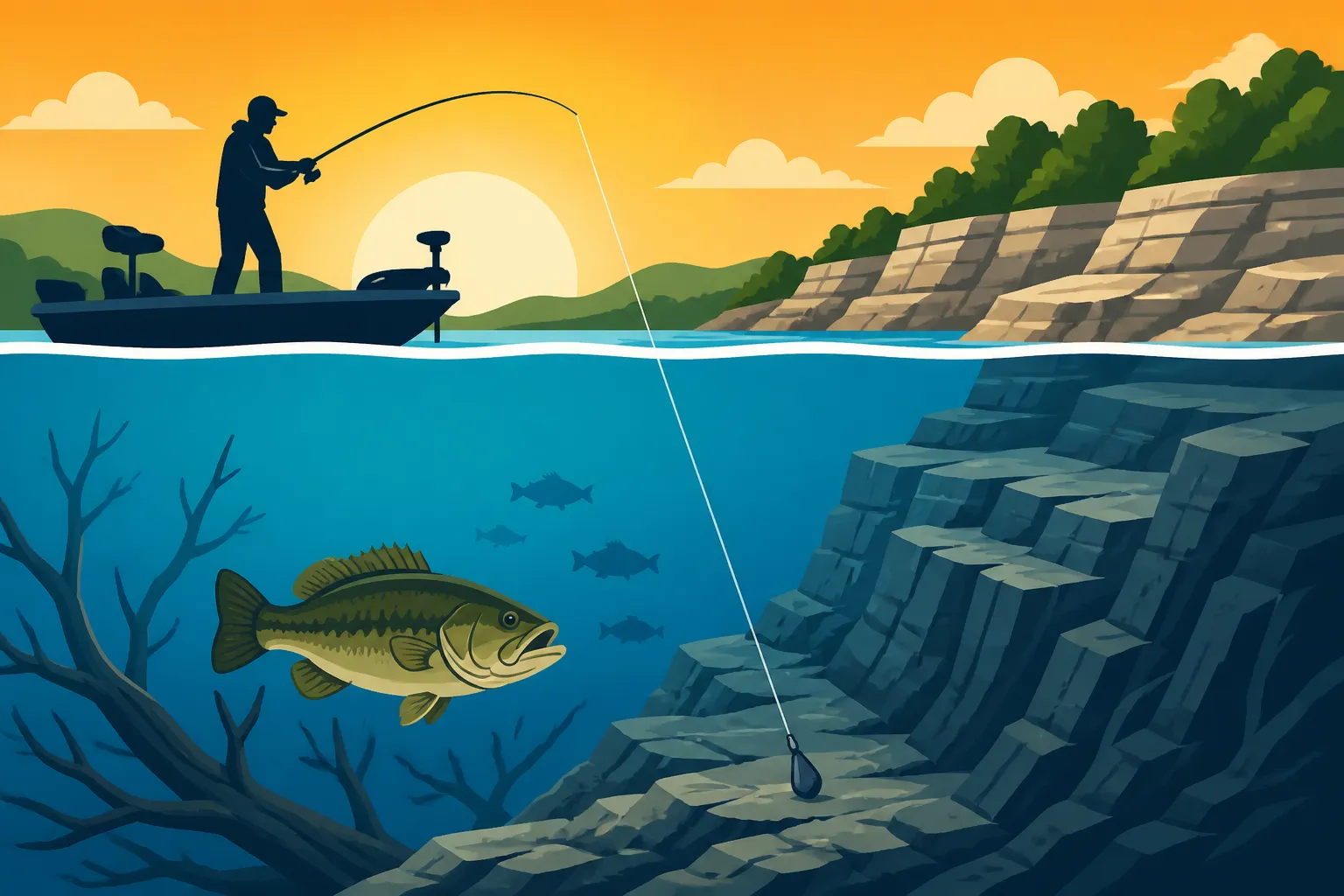
Deep structure encompasses any significant change in the lakebed's topography that provides cover, ambush points, or pathways for fish to travel. Think of it like an underwater landscape, complete with hills, valleys, and forests. This can include natural features like hard bottom transitions, submerged rock piles, natural creek channels that wind through the lake, and sharp breaks or ledges. Man-made structures are equally vital, often being overlooked by less experienced anglers. These might be old roadbeds from before the lake was flooded, the foundations of old houses, bridge pilings, or even entire stands of submerged timber. Each of these features, whether natural or artificial, offers fish protection from predators, a place to ambush prey, and respite from harsh weather conditions or intense sunlight.
For instance, on a reservoir like Lake Fork, famous for its trophy bass, you'll find extensive areas of flooded timber – giant trees that were left standing when the lake was impounded. These submerged forests create incredible vertical structure, drawing baitfish and predator species alike. Similarly, lakes like Sam Rayburn Reservoir have distinct creek channels that provide highways for fish moving between different areas, and identifying where these channels intersect with humps or points can be incredibly productive. Understanding the historical context of these reservoirs, often built on river basins with existing towns and infrastructure, helps you visualize these hidden gems.
Why Fish Relate to Deep Structure
Fish aren't just lounging around in deep water for the fun of it; they're driven by fundamental survival needs: comfort, food, and safety. Deep structure provides all three. One of the most critical factors in Texas reservoirs, especially during the long, hot summers, is the thermocline. This is a layer in the water column where the temperature changes rapidly, essentially creating an invisible ceiling and floor for fish. Above the thermocline, the water can be too warm and lack sufficient oxygen, while below it, oxygen levels can plummet to uninhabitable levels. This means fish often suspend or relate directly to structure within the thermocline or just above it, finding that perfect comfort zone.
Beyond temperature and oxygen, deep structure is a magnet for baitfish. Shad, sunfish, and other forage species will congregate around these underwater features for shelter and food, which in turn draws in larger predatory fish like bass, catfish, and crappie. A hump that tops out at 20 feet of water, surrounded by 40 feet of depth, becomes a buffet line for predators. Furthermore, these structures provide excellent ambush points. A bass sitting on a ledge or at the edge of a brush pile can quickly dart out to snatch an unsuspecting baitfish swimming by. Recognizing these patterns of why fish use certain structures is key to predicting where they'll be. This is particularly true during the Texas Fishing Seasons Month by Month, as fish movements change dramatically with the seasons, often pushing them to deeper, more stable environments during extreme temperatures.
Essential Gear for Deep Water Angling
You wouldn't head into a carpentry project without the right tools, and deep-water fishing in Texas is no different. The gear you choose can make or break your success, especially when trying to feel subtle bites in 30 feet of water or pull a stubborn fish out of dense submerged timber.
Rods, Reels, and Line Choices
When it comes to deep-water fishing, your rod and reel setup needs to be a workhorse. For techniques like deep cranking or working heavy jigs, a longer rod (7' to 7'10") with a medium-heavy to heavy power and a moderate-fast to fast action is generally preferred. The extra length helps with longer casts, which is crucial for getting deep-diving crankbaits down to their maximum depth, and provides more leverage for powerful hook sets over vast distances. A sensitive rod tip is also vital for feeling those subtle "thunks" when your bait hits structure or a fish inhales it.
For reels, a high-speed retrieve ratio (7.1:1 or higher) is often a huge advantage. This allows you to quickly reel in slack line after a long cast, efficiently retrieve your bait to check for grass or debris, and rapidly move from one spot to another. However, for deep cranking, some anglers prefer a slower gear ratio (around 5.0:1 to 6.4:1). This provides more torque to pull large crankbaits through the water and can help you maintain a consistent, slower retrieve speed, which is often crucial for generating bites on deep-diving lures. You can find a wide selection of these specialized rods and reels on platforms like Amazon, offering options for every budget. When considering your setup, remember that Best Fishing Rods for Texas Anglers and Best Fishing Reels for Texas Anglers provide more in-depth insights into making the right choices.
Line choice is perhaps even more critical. Fluorocarbon line is a staple for many deep-water anglers due to its low stretch, high sensitivity, and near invisibility underwater. It allows you to feel the most delicate bites and maintain direct contact with your lure. For situations with heavy cover, like flooded timber or thick brush piles, some anglers opt for braided line, often paired with a fluorocarbon leader. Braid offers exceptional strength and even greater sensitivity with zero stretch, which can be a game-changer when trying to detect subtle bites or differentiate between a fish and a snag. The heavier pound test (15-20 lb for fluoro, 30-65 lb for braid) helps you muscle fish out of cover and retrieve snagged lures.
Electronics are Your Best Friend
In the world of deep structure fishing, sonar and GPS units aren't just tools; they're your eyes beneath the surface. Modern marine electronics have revolutionized how we approach deep water, transforming what used to be guesswork into precision hunting. A quality fish finder with 2D sonar, Down Imaging, and Side Imaging is non-negotiable. 2D sonar helps you identify fish arches and bait balls directly beneath your boat. Down Imaging provides a more photographic, detailed view of what's directly below, allowing you to distinguish between a rock pile and a brush pile, or even see individual fish relating to structure.
Side Imaging is where the magic truly happens for finding deep structure. It allows you to scan wide swaths of the lakebed to either side of your boat, revealing hidden ledges, creek channels, roadbeds, and submerged timber that you might otherwise miss. Imagine being able to see a brush pile 50 feet off to your port side that you just drove over. This ability to quickly identify and understand the layout of complex deep structure is invaluable. Once you find a promising spot, your GPS allows you to mark waypoints precisely, ensuring you can return to that exact spot time and time again. Advanced technologies like live sonar (Garmin LiveScope, Humminbird MEGA Live, Lowrance ActiveTarget) take this a step further, allowing you to see fish and your lure in real-time beneath and around your boat, greatly enhancing your ability to make precise presentations. Learning How to use a fish finder for bass fishing is an essential skill to master these systems.
Must-Have Deep Water Lures and Baits
A diverse arsenal of lures is key to tackling different deep-water scenarios. Each bait type is designed for a specific presentation and depth range.
-
Deep Diving Crankbaits: These are quintessential for covering water quickly and targeting fish on long, sloping points, humps, and creek channel edges. Brands like Strike King, Norman, and Rapala offer models designed to dive 15, 20, even 25+ feet. Matching the dive depth of your crankbait to the structure you're fishing is crucial. Experiment with colors, but natural shad patterns, crawfish patterns, and bright chartreuse variations are reliable starting points in Texas waters.
-
Jigging Spoons: When fish are tightly grouped on a specific piece of structure, or suspended baitfish are key, jigging spoons can be deadly. These heavy, metallic lures (often 1/2 to 1 oz or more) are designed to be dropped directly onto a target and then "ripped" or subtly jigged to mimic dying baitfish. Their flash and erratic fall are irresistible to many deep-water predators. Sizes and weights will vary based on depth and desired fall rate, and you'll find a good selection on sites like Amazon.
-
Carolina Rigs: This rig is a fantastic choice for covering large areas of open-bottom structure, such as main lake points, roadbeds, or offshore humps, especially when the fish are scattered or not actively chasing. It consists of a heavy weight (1/2 to 1 oz or more) slid up the main line, followed by a bead, a swivel, and then a leader (1-4 feet long) tied to a soft plastic bait. The weight drags along the bottom, kicking up sediment, while the bait trails enticingly behind, often mimicking a crawfish or lizard. Mastering How to fish a Texas Carolina rig can significantly boost your deep-water success.
-
Drop Shot Rigs: For a truly finesse approach, especially when fish are lethargic or highly pressured, the drop shot rig is unparalleled. It involves tying your hook directly to your main line with a tag end left below the hook, to which a weight is attached. This allows your soft plastic bait (often a small worm or creature bait) to suspend horizontally at a precise depth above the bottom, keeping it in the strike zone longer. This is ideal for targeting fish that are suspended in brush piles or relating to subtle changes in contour.
-
Football Jigs and Shaky Heads: These are workhorses for probing rocky bottom, shell beds, and hard-bottom humps. Their unique head shapes allow them to crawl over structure without snagging easily. Football jigs, often paired with bulky creature baits, are excellent for imitating crawfish, while shaky heads (typically lighter jig heads with a screw lock keeper) are paired with straight-tail worms for a more subtle, vertical presentation. Heavy Texas rigs, often using a 1/2 to 1 oz tungsten weight, are also essential for punching through thick brush piles with soft plastic creatures or worms. These are often purchased online through retailers such as Amazon. More info on various lure types can be found in our guide to Best Bait and Lures for Texas Fishing.
Locating Fish on Deep Structure
Finding deep structure is one thing; finding the fish on that structure is another. It requires a combination of interpreting your electronics, understanding seasonal patterns, and paying attention to the unique hydrography of each reservoir.
Interpreting Your Sonar and Maps
Modern fishing electronics are incredibly powerful, but they're only as good as your ability to interpret what they're showing you. Start by thoroughly studying your lake's contour maps, whether on your unit's built-in GPS or a dedicated mapping app like Navionics or C-MAP. Look for areas where contour lines pinch together, indicating a sharp drop-off or ledge, or where they form distinct shapes like humps (circles of contour lines) or points (V-shapes extending into deeper water). How to read lake contour maps for bass fishing is a fantastic resource for improving this skill.
Once on the water, use your Side Imaging to locate promising deep structure. Drive slowly over areas you've identified on your map, scanning both sides. When you see a potential brush pile, rock pile, or submerged creek channel, mark it as a waypoint. Then, switch to Down Imaging and 2D sonar to get a more detailed view directly beneath your boat. Look for "bait balls"—dense schools of small fish—as these are primary indicators that predator fish are nearby. Arches or distinct marks near or on the structure itself will indicate larger fish. Don't just look for fish on the very top of a hump; often, they'll be positioned on the sides or in the deeper water adjacent to the structure, ready to ambush. The thermocline will also show up as a distinct line on your 2D sonar, helping you identify the most comfortable depth zone for fish.
Understanding Seasonal Movements
Fish in Texas reservoirs are constantly on the move, primarily influenced by water temperature, forage availability, and spawning instincts. Knowing these seasonal shifts is paramount to deep-water success.
-
Spring: During pre-spawn, fish begin their migration from deep wintering grounds towards shallower spawning flats. They often "stage" on deep points, humps, and creek channel bends adjacent to these spawning areas. These deep structures offer convenient holding areas where they can feed heavily before moving shallow to spawn. They're still active and feeding aggressively in these deeper areas.
-
Summer: This is prime time for deep structure fishing. As surface temperatures soar into the 80s and 90s, fish seek refuge in cooler, oxygen-rich water. This typically means they move offshore to relate to the thermocline and concentrate on deep main lake points, humps, roadbeds, submerged timber, and brush piles. During the How to Fish in Hot Texas Summers, targeting these cooler, more stable environments becomes essential. They'll often school up in these deeper haunts, making them a fantastic target once located.
-
Fall: As water temperatures begin to cool, fish spread out more, often chasing migrating baitfish into shallower creeks and coves. However, deep main lake structures still hold fish, especially larger, more resident individuals who prefer not to follow the masses. You might find fish relating to the same humps and points they used in summer, but they might be higher in the water column or more spread out.
-
Winter: When temperatures drop and stay low, fish once again group up tightly on deep, stable structures. Creek channels, deep breaks, and the deepest brush piles become critical. Fish activity slows significantly, requiring slower presentations, but when you find a winter school on deep structure, the fishing can be exceptional. They will often suspend just off the bottom or bury themselves within cover for warmth and protection.
Leveraging Hydrography and Lake Levels
The unique hydrography of each Texas reservoir, combined with fluctuating lake levels, profoundly impacts where and how fish relate to deep structure. Reservoirs are, by definition, artificial lakes created by damming rivers, and their bottoms often reflect the original riverbed, creek channels, and even land features like old roads, bridges, and homesteads. Understanding the history of the lake you're fishing can give you huge clues. For instance, knowing that a certain lake was formed by flooding a timber-rich area means you should be actively looking for submerged trees and stumps in deeper water.
Currents, even subtle ones, in areas near the main river channel or around bridge pilings can position fish predictably. Wind also plays a role, pushing baitfish and creating "currents" on offshore structures that can concentrate predators on the windy side of a hump or point. Fluctuating lake levels, common in Texas, can either expose or submerge structure, changing access and fish behavior. A brush pile that was in 15 feet of water might now be in 25 feet, or vice-versa. Always check recent lake level reports for the reservoir you plan to fish, as this can drastically alter your deep-water strategy.
Effective Techniques for Deep Structure Fishing
Once you've located promising deep structure and potentially marked some fish on your sonar, it's time to present your lure effectively. This often requires precise boat control and nuanced retrieve techniques.
Deep Diving Crankbait Strategies
Fishing a deep-diving crankbait successfully is all about getting it down to depth and keeping it there, grinding against the structure. First, make the longest cast you possibly can. The longer the cast, the more time your crankbait has to dive and the longer it stays in the strike zone. Once it hits the water, immediately point your rod tip towards the water and crank hard to get it down as fast as possible. You want to feel the lip of the crankbait occasionally "tick" or "grind" against the bottom. This bottom contact is crucial; it stirs up sediment, mimics a fleeing baitfish or crawfish, and often triggers reaction strikes.
Vary your retrieve speed. Sometimes a steady retrieve is best, but often, adding pauses, jerks, or even slight deflections off submerged objects can provoke a bite. If your bait hits a stump or rock, pause for a split second, allowing it to float up slightly, then resume your retrieve. This sudden change in direction or action often mimics a struggling baitfish, drawing strikes. Pay close attention to your rod tip; it will tell you if your bait is digging, deflecting, or if you have a subtle bite. For an even deeper dive, consider a lighter fluorocarbon line, as thinner lines allow the lure to achieve greater depths. Remember that your goal is not just to reel it in, but to work it through the structure.
Vertical Jigging and Drop Shotting
These techniques are all about precision and finesse, perfect for when fish are holding tight to specific, isolated pieces of deep structure or are suspended in the water column.
Vertical Jigging: This is ideal for targeting fish you've identified directly beneath your boat on sonar, whether they're in a brush pile, on a rock pile, or suspended. Use a jigging spoon or a heavy football jig. Position your boat directly over the target (a good trolling motor with a spot-lock feature is invaluable here) and drop your lure straight down. Watch your sonar screen; you should be able to see your lure descending towards the fish. Once it reaches the desired depth, typically just above or right in the middle of the fish, begin your jigging motion. This can range from aggressive rips (lifting the rod tip sharply and letting the lure fall on slack line) to subtle quivers and lifts. The key is to experiment until you find what the fish respond to. Most strikes will occur on the fall, so watch your line carefully for any jumps or twitches.
Drop Shotting: This finesse technique shines when fish are very finicky or heavily pressured. It presents a small, natural-looking bait in a very subtle manner. Again, position your boat directly over or slightly upwind of your target structure. Drop the rig down, allowing the weight to hit the bottom while your soft plastic bait hovers tantalizingly above it. The beauty of the drop shot is that you can impart action to your bait with minimal movement of your rod tip, without moving the weight from the bottom. Gently shake your rod tip, causing the bait to dance. This is particularly effective for reluctant bass, crappie, or even catfish relating to deep brush or rock. Keep your line tight enough to feel the weight on the bottom but loose enough for the bait to move naturally. Often, anglers will get a light "tap" or simply feel extra weight when a fish takes the bait.
Carolina Rig and Heavy Texas Rig
These two rigs are excellent for systematically probing deep structure and enticing bites from less active fish.
Carolina Rig: As mentioned earlier, the Carolina rig is a search tool, allowing you to cover vast areas of deep structure efficiently. It’s perfect for main lake points, roadbeds, ledges, and hard-bottom humps. Cast it out, let it sink to the bottom, and then slowly drag it back using long sweeps of your rod. The weight will tick along the bottom, creating a commotion, while the trailing soft plastic will flutter enticingly. The leader length is critical; a longer leader (3-4 feet) gives the bait more natural movement, while a shorter one (1-2 feet) keeps the bait closer to the weight, which can be better in thicker cover or when fish are less aggressive. Pay close attention to the feel through your line—any difference in resistance, a mushy feel, or a distinct "thump" could indicate a bite. For those looking to master it, our guide on How to fish a Texas Carolina rig offers detailed instructions.
Heavy Texas Rig: This is your go-to rig for punching through thick, deep cover like submerged timber, dense brush piles, or matted vegetation. It’s essentially a standard Texas rig but with a much heavier tungsten weight (3/4 oz to 1.5 oz or more) to ensure it penetrates the cover. Pair it with a stout hook (4/0 or 5/0 EWG or straight shank) and a bulky, compact soft plastic bait like a creature bait or a beaver-style bait. The heavy weight helps the lure fall quickly and straight through the cover, reaching fish that are buried deep within. Once it reaches the bottom, lift and drop it, trying to keep it in the tight confines of the cover. Bites can range from a violent thud to simply feeling "spongy" or "heavy" when you lift. This rig is all about getting your bait into places other lures can't reach and extracting big fish from dense cover. If you want to learn more, check out our guide on How to fish a Texas rig for bass.
Advanced Tips and Common Pitfalls
Mastering deep structure fishing in Texas is a journey, not a destination. It involves continuous learning, adapting, and refining your approach.
Patterning Fish on Deep Structure
Finding fish once is great, but consistently catching them requires developing a "pattern." A pattern is a repeatable set of conditions (depth, structure type, lure, retrieve speed, time of day) under which fish are actively feeding. When you catch a fish on a deep hump in 25 feet of water using a football jig, don't just celebrate—analyze! What kind of structure was it? What was the water temperature? Was there baitfish present? Note everything in a fishing log or your electronics. Then, look for similar areas on your map and replicate your successful presentation. The more data points you collect, the easier it becomes to predict where fish will be and what they'll bite.
Texas reservoirs can be vast, so don't be afraid to run-and-gun. Hit several promising deep spots, make a few casts with different presentations, and if you don't get a bite, move on. The fish might be concentrated on only a few key areas. Once you get a bite, slow down and thoroughly work that area, as deep-water fish often school up. Look for subtleties; maybe they’re not on the top of the hump, but rather on the shaded side, or where a hard bottom transitions to a soft bottom. The smallest details can make the biggest difference in cracking the deep-water code. This constant adaptation and analysis are key to consistently finding Texas Largemouth Bass Fishing Guide hotspots offshore.
Overcoming Deep Water Challenges
Deep water presents unique challenges that can frustrate even seasoned anglers. Wind and boat control are perhaps the biggest culprits. A strong Texas breeze can make it nearly impossible to hold your boat steady over a specific deep brush pile for vertical jigging or drop-shotting. This is where a high-quality trolling motor with a GPS-guided spot-lock feature becomes indispensable. It electronically anchors your boat, allowing you to focus on fishing, not fighting the wind.
Another challenge is line twist and managing deep-water fights. Prolonged deep-water fights can put immense strain on your line, especially with braided line, leading to tangles and knots. Using good quality swivels on rigs like the Carolina rig can mitigate twist. When fighting a fish from deep water, avoid horsing it; pump and reel smoothly to maintain pressure and keep the fish from surging back into cover. Remember, fish brought up from extreme depths can suffer from barotrauma (swim bladder expansion). If you plan to release them, learn how to properly fizz or vent them to increase their survival chances. This requires special care, especially for larger fish.
Finally, hook sets from long distances and in deep water can be tricky. The stretch in fluorocarbon line, while minimal, is still present. You need a powerful, sweeping hook set to drive the hook home. Don't be shy; lean into it! You also need to be aware of the "feel." Bites in deep water can be incredibly subtle—a slight tap, a feeling of extra weight, or your line just feeling "mushy." Any deviation from the normal feel of your lure hitting the bottom warrants a hook set. Many big deep-water fish are lost simply because the angler didn't feel the bite or didn't set the hook hard enough.
Practice and Patience
Let's be real: deep structure fishing isn't something you master in a single outing. It takes practice, patience, and a willingness to learn from every cast. You'll get snagged, you'll miss bites, and you'll spend hours searching without a single fish to show for it. That's part of the process. The reward, however, is immense. There’s nothing quite like the satisfaction of graphing a small school of fish on a hidden hump 30 feet down, dropping a lure on their heads, and feeling that satisfying thud. It's a testament to your understanding of the lake, your electronics, and your technique.
Start by focusing on one or two techniques and one or two types of deep structure. Don't try to learn everything at once. Pick a well-known deep-water lake like Lake Texoma or Lake Whitney, and dedicate time to just idling and looking at your sonar. Practice interpreting those lines and blobs. The more time you put in, the more you'll develop an intuition for what's happening beneath the surface. It’s an incredibly rewarding aspect of fishing, allowing you to target some of the biggest, least pressured fish in Texas reservoirs.
Here's a quick comparison of some popular deep-water lures:
| Lure Type | Primary Use Case | Typical Depth Range | Key Advantages | Best for |
|---|---|---|---|---|
| Deep Diving Crankbait | Covering water, imitating baitfish | 15-30+ feet | Covers large areas, triggers reaction bites | Points, humps, ledges, creek channels |
| Jigging Spoon | Vertical presentation, mimicking dying bait | 15-50+ feet | Highly effective on schooling fish, flash | Tight schools, suspended fish, hard bottoms |
| Carolina Rig | Covering bottom, subtle presentation | 10-40+ feet | Good for scattered fish, sensitive | Roadbeds, shell beds, sparse cover |
| Drop Shot Rig | Finesse, precise presentation | 10-50+ feet | Ideal for finicky fish, stays in strike zone | Brush piles, isolated cover, suspended fish |
| Football Jig | Bottom contact, imitating crawfish | 10-40+ feet | Excellent for rocky bottoms, heavy cover | Rock piles, ledges, hard bottom transitions |
Disclaimer
Please be aware that fishing regulations in Texas can change. Always consult the most current Texas Parks and Wildlife Department (TPWD) Outdoor Annual for specific rules, bag limits, and length restrictions before you head out on the water. This guide is for informational purposes only and does not supersede official regulations.