Texas Channel Catfish Identification Guide
Have you ever reeled in a whiskered beauty from a Texas lake or river, only to find yourself scratching your head, wondering if it's a channel cat, a blue, or even a flathead? It's a common dilemma for many anglers, and getting it right isn't just about bragging rights; it's crucial for understanding regulations and even improving your fishing techniques. This comprehensive guide is here to unravel the mystery, helping you confidently identify the Texas channel catfish so you can fish smarter and stay compliant.
The Distinguishing Features of the Texas Channel Catfish
When you pull a fish from the water, certain features are immediate giveaways, and the channel catfish has several that set it apart. Learning to spot these tells can make you a much more confident angler, whether you're at Lake Fork or a local community pond.
Signature Spots and Body Coloration
One of the most iconic characteristics of the channel catfish, especially the younger ones, is the presence of small, irregular dark spots scattered across its sides. Think of them like freckles on a kid – numerous, varied in size, and sometimes fading as the fish grows older. These spots are a fantastic first indicator, particularly when dealing with fish under a few pounds. However, it's important to note that larger, older channel cats, especially those from muddy waters, often lose these spots and can appear a uniform olive, gray, or even black. Don't let a spot-free larger fish trick you; many mature channel catfish will have little to no spotting, a detail that frequently confuses anglers trying to differentiate them from blue catfish.
The overall body coloration of a Texas channel catfish can vary wildly depending on its environment. Fish caught from clear, rocky rivers or lakes might display a darker, almost bluish-gray hue on their backs, fading to silvery sides and a white belly. Conversely, those living in muddy, nutrient-rich impoundments like Lake Livingston often have a much lighter, almost yellowish-green or olive-brown tint, which serves as excellent camouflage in their surroundings. Understanding this adaptability in color helps you look past superficial differences and focus on more consistent anatomical markers. This variability highlights why relying solely on color can sometimes lead you astray, making other features even more critical for positive identification.
Forked Tail Fin: A Clear Identifier
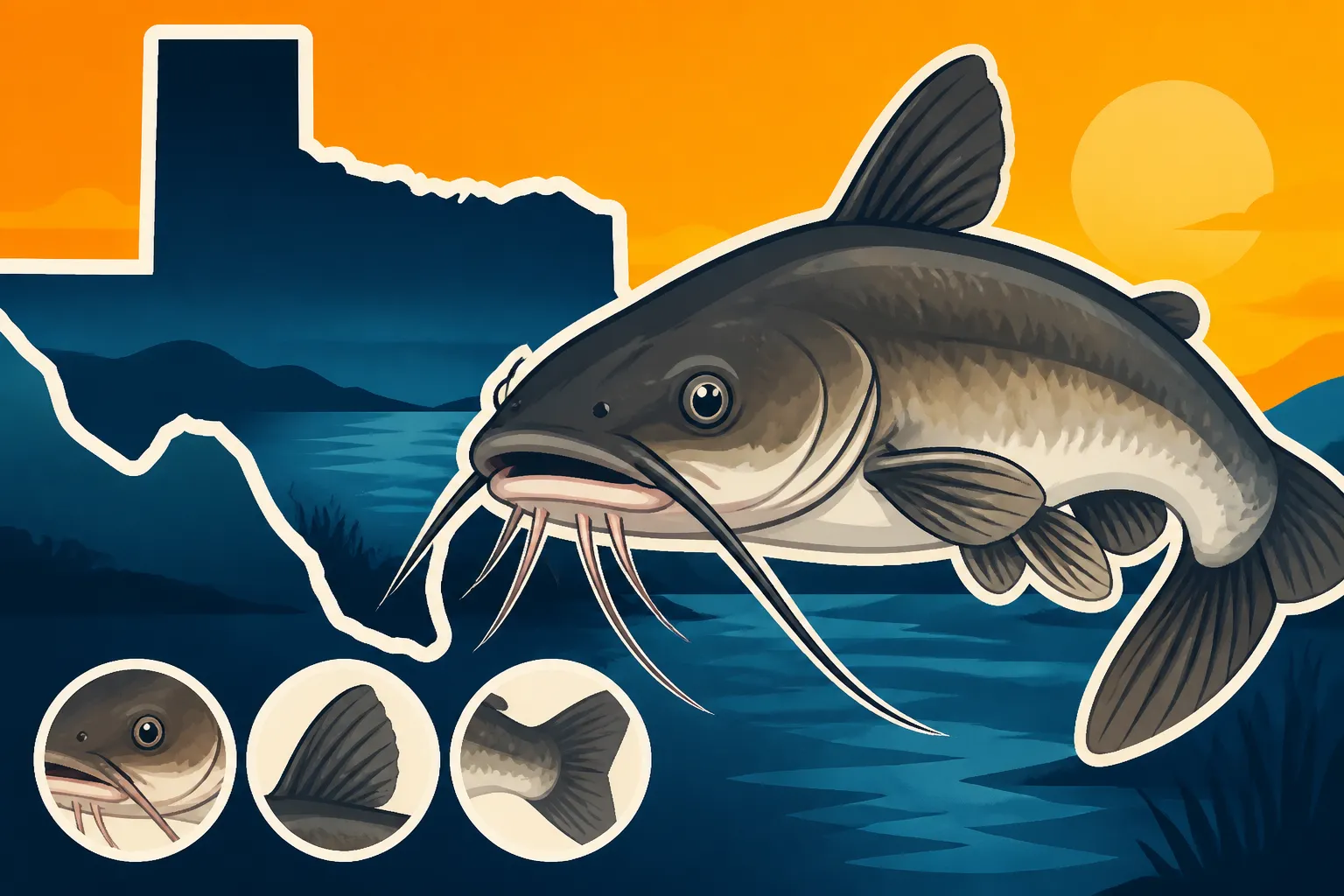
Perhaps the most definitive characteristic of a channel catfish is its deeply forked tail fin. This isn't just a slight indentation; it's a distinct, V-shaped split that makes the tail look like two separate lobes joined at the base. If you can clearly see this deep, pronounced fork, you're almost certainly holding a channel catfish (or possibly a blue catfish, which we'll address in a bit). This feature is consistent across all sizes and ages of channel catfish and is one of the easiest ways to rule out a flathead catfish, which has a distinctively rounded or squared-off tail fin.
The deeply forked tail allows the channel catfish to be a relatively fast and agile swimmer, especially in open water. This contrasts with the more sluggish, bottom-dwelling flathead. When you're making a quick identification on the boat or bank, glance at the tail. If it’s sharply divided, you're on the right track for a channel cat. This visual cue is so reliable that it's often the first thing experienced anglers check when trying to confirm a catfish species, especially when multiple species are known to inhabit the same waters, like those found in many larger Texas reservoirs.
Mouth Shape and Head Profile
Another crucial set of clues lies in the channel catfish's head and mouth. The mouth of a channel catfish is typically subterminal, meaning the upper jaw extends slightly beyond the lower jaw. It's a relatively small, somewhat pointed mouth compared to the cavernous, shovel-like mouth of a large blue catfish or the distinctly protruding lower jaw of a flathead. This mouth structure is adapted for scavenging on the bottom and preying on smaller fish, insects, and crustaceans.
The head itself is moderately sized in proportion to its body, and its profile generally slopes down from the dorsal fin towards the snout in a relatively smooth, gentle curve. It doesn't have the wide, flattened appearance of a flathead catfish's head, which often looks like it's been squashed from above. Nor does it typically possess the extremely broad or pronouncedly humped head you might see on some very large blue catfish. Paying attention to these subtle yet consistent differences in head and mouth structure can greatly aid in your identification efforts, especially when the spots might be absent or other features seem ambiguous.
Fin Characteristics and Barbels (Whiskers)
Beyond the prominent features like spots and tails, a closer look at a channel catfish's fins and, of course, its famous whiskers, provides even more definitive identification markers. These details are consistent across the species and are extremely helpful when you're trying to make a positive ID.
Dorsal and Pectoral Fins: Spines and Serrations
One notable characteristic of the channel catfish's dorsal (top) and pectoral (side) fins is the presence of a single, stout, and very sharp spine at the leading edge of each. These spines are rigid and can deliver a painful poke if you're not careful when handling the fish. This is a common feature among many catfish species, so it's not unique to the channel cat, but knowing it's there prepares you for safe handling. Many anglers find it useful to carry a pair of fish-handling gloves or even a specific de-hooking tool to avoid these sharp defenses, which can be particularly irritating if they break off in your skin.
What is a more specific identifier, though requiring a closer look, are the serrations (like tiny teeth) on the posterior (back) edge of these pectoral fin spines. If you gently run your finger up the back edge of the pectoral spine (be careful!), you might feel a saw-like roughness. While present, these serrations are typically less prominent and fewer in number on a channel catfish than on a blue catfish. They are often described as weak or fine. This is a finer detail, but one that can be crucial in distinguishing between species when other characteristics are ambiguous. Comparing this feature side-by-side with other catfish species, perhaps using a detailed guide you found on Amazon, can help train your eye (and finger!) for future encounters.
The Eight Barbels (Whiskers) of a Channel Catfish
No catfish identification guide would be complete without talking about the iconic barbels, or "whiskers." The Texas channel catfish, like most catfishes, has eight barbels. These aren't just for show; they are packed with chemoreceptors, essentially taste buds that help the fish locate food in murky water or low light conditions. The arrangement is quite specific: you'll find two barbels on the chin (mandibular barbels), two on the snout (maxillary barbels), two near the nostrils (nasal barbels), and two at the corners of the mouth (also maxillary barbels).
These barbels are typically medium to long, generally extending past the gill covers, and are often darker in color, sometimes matching the overall body hue of the fish. While all major Texas catfish species have barbels, their size and coloration can sometimes offer subtle clues. For the channel catfish, their prominent but not overly thick or fleshy appearance is typical. The consistency in the number and general placement of these eight sensory appendages is a hallmark of the species, always there to help you confirm your catch. For more detailed information on all the species you might encounter, check out our Texas Catfish Species Guide.
Size, Shape, and Habitat: Beyond the Finer Details
While specific anatomical features are key for identification, understanding the general size, body shape, and preferred habitat of the channel catfish in Texas can also help you narrow down your catch. These broader characteristics paint a picture of where and how you're likely to encounter these fascinating fish.
General Body Shape and Size Range
The Texas channel catfish typically exhibits a more streamlined and slender body profile compared to its bulkier blue catfish cousins or the stockier, bottom-hugging flathead. They are built for movement, capable of chasing down prey as well as scavenging. While they can grow quite large, especially in well-managed lakes, they generally don't reach the immense sizes that blue catfish can achieve. A channel catfish weighing over 20 pounds is considered a trophy, while blue catfish can easily exceed 50 pounds, with giants pushing past 100 pounds. Most channel cats caught by recreational anglers in Texas fall into the 1 to 10-pound range, making them a fantastic and manageable target for a family fishing trip.
Their growth and overall size are heavily influenced by the availability of food, water quality, and the specific dynamics of the lake or river they inhabit. In smaller ponds or heavily fished areas, you might predominantly find channel cats in the panfish size, perfect for a fish fry. In contrast, massive reservoirs with abundant forage and fewer fishing pressures can produce much larger specimens. Understanding this typical size range can often be a quick indicator, especially if you're pulling in a fish that seems exceptionally large for a channel catfish – it might be time to double-check those blue cat features.
Preferred Habitats in Texas Waters
One of the reasons the channel catfish is such a popular game fish in Texas is its incredible adaptability. You can find them thriving in an incredibly wide range of aquatic environments, from the slow-moving, muddy waters of East Texas rivers to the clearer, rockier bottoms of Hill Country lakes and even many of the stocked community fishing ponds across the state. This versatility means that regardless of where you decide to drop a line in Texas, there's a good chance you'll encounter a channel cat.
They show a preference for areas with some sort of structure that offers cover and ambush points. This could be submerged timber, rock piles, ledges, creek channels, or even brushy shorelines. They are opportunistic feeders, often patrolling these areas for anything edible. While they can tolerate a wide range of water conditions, including slightly brackish water in coastal areas, they generally thrive in warmer, somewhat turbid waters that characterize many Texas lakes and rivers. So, whether you're trying your luck fishing from the bank at a state park or navigating the main lake channels in your boat, knowing where to focus your efforts for channel cats is key. If you're looking for great places to hook into these adaptable fish, check out our guide on Texas Lakes for Family Fishing or explore Texas Rivers for Fishing.
Common Confusions: Channel Catfish vs. Its Cousins
Even for seasoned anglers, differentiating between the various catfish species in Texas can sometimes be a challenge. The three most common species—channel, blue, and flathead—share some characteristics, leading to frequent misidentification. Let's break down the key differences to ensure you know exactly what you've landed.
Channel Catfish vs. Blue Catfish
This is arguably the most common catfish identification challenge in Texas. Both species have deeply forked tails, and larger channel cats can lose their spots, making them look even more like blues. However, there are a few critical differences that, once learned, can help you tell them apart.
The most reliable differentiator between a channel catfish and a blue catfish lies in their anal fin rays. The anal fin is located on the underside of the fish, behind the anus. A channel catfish will typically have 24-29 rays in its anal fin, and the leading edge of this fin will have a rounded appearance. In contrast, a blue catfish will have a higher count, usually 30-35 rays, and its anal fin will have a straighter, more elongated leading edge, sometimes appearing to curve inwards slightly. Counting these rays can be tricky on a squirming fish, but it’s the most definitive method. For fish under a couple of pounds, look for the spots on the channel catfish. While larger channels lose them, juvenile blues rarely have them. Blues also tend to have a more pronounced hump on their back, especially larger specimens, and a broader, more sloped head profile. They can also grow significantly larger than channel cats. For a deep dive into this particular identification challenge, make sure to read our detailed Texas Blue Catfish Identification Guide.
Channel Catfish vs. Flathead Catfish
Distinguishing a channel catfish from a flathead catfish is generally much easier, as their appearances are quite distinct. The most obvious difference is the tail fin: as mentioned, the channel catfish has a deeply forked tail, while the flathead catfish has a rounded or slightly notched tail that is not forked. This single feature is usually enough to make a positive identification instantly.
Beyond the tail, the flathead lives up to its name with a noticeably broad, flattened head, almost shovel-like in appearance, with small eyes. Its lower jaw also protrudes beyond its upper jaw, giving it a distinct "underbite." Channel catfish, conversely, have a more pointed head and the upper jaw extends slightly beyond the lower. Flatheads also typically exhibit a mottled, splotchy brown, yellow, or olive coloration, which provides excellent camouflage against logs and rocky bottoms, their preferred ambush points. They lack the distinct spots seen on smaller channel cats. Given these stark differences, it’s rare for even novice anglers to confuse these two species once they know what to look for. To really get to know this solitary giant, check out our Texas Flathead Catfish Identification Guide.
Why Accurate Identification Matters for Texas Anglers
Understanding the specific type of catfish you've caught isn't just an academic exercise or a way to impress your fishing buddies. It has real-world implications that can affect your fishing experience, your legal standing, and your overall success on the water.
Understanding Bag and Length Limits
This is where accurate identification becomes absolutely critical. The Texas Parks and Wildlife Department (TPWD) sets specific regulations for different fish species, and catfish are no exception. For instance, while channel catfish might have one set of bag and length limits, blue catfish or flathead catfish could have entirely different rules. Misidentifying your catch could lead to unknowingly violating these regulations, which can result in hefty fines, confiscation of your catch, and even suspension of your fishing license. Imagine getting a ticket because you thought your blue cat was a channel cat and kept too many, or kept one that was undersized for its species!
It's your responsibility as an angler to know the rules. Before you even head out to the lake, take a few minutes to review the current TPWD Outdoor Annual or use their mobile app. Knowing the specific characteristics that differentiate a channel catfish from a blue or flathead empowers you to make informed decisions about what you keep and what you release. This not only protects you from legal trouble but also contributes to the sustainable management of Texas's incredible fisheries. You can find all the details you need in our guide to Texas Catfish Bag Limits and Texas Fish Bag and Length Limits.
Improving Your Fishing Strategy
Beyond the legal aspects, accurately identifying channel catfish can significantly enhance your fishing strategy. Each catfish species, while sharing some general preferences, has its own unique behaviors, dietary habits, and preferred habitats. Knowing which species you are targeting allows you to select the most effective baits, lures, and fishing techniques. For example, channel catfish are notorious scavengers, readily taking cut bait, stink baits, and even a variety of natural baits. You can often find great options for these types of baits on Amazon, from pre-made dough balls to specialized catfish attracting oils.
Flathead catfish, on the other hand, are primarily predators and prefer live bait, often shiners or sunfish, presented near woody cover. Blue catfish are also predatory but will readily consume cut bait, and they tend to roam open water areas more than flatheads. If you consistently find yourself catching channel cats in a certain spot with a particular setup, it reinforces that you're in the right place with the right presentation for that species. Conversely, if you're targeting blues but only catching channels, it might be a sign to adjust your location, depth, or bait choice. Our guides on How to Catch Catfish in Texas and Best Catfish Bait for Texas Lakes offer excellent insights into species-specific strategies. Knowing your fish means catching more of what you want and enjoying your time on the water even more.
Practical Tips for On-the-Water Identification
Even with all the knowledge in your head, making a quick and accurate identification when a fish is flopping around can be tough. Here are some practical tips to help you confidently identify that Texas channel catfish right there on the bank or in your boat.
Quick Check List for Channel Catfish
When you've got a catfish in hand and need a rapid ID, run through this mental checklist:
- Tail Fin: Is it deeply forked, like a V? If yes, you're likely holding a channel or a blue cat. If it's rounded or only slightly notched, it's a flathead. This is your number one quick check!
- Body Spots: Are there small, irregular dark spots on the sides? If yes, and the fish isn't massive, it's almost certainly a channel catfish. Remember, large channel cats can lose their spots.
- Head Shape: Is the head moderately sized and somewhat pointed, with the upper jaw slightly overlapping the lower? If it's broad and flat with a protruding lower jaw, it's a flathead. If it's very large and sloped, it leans towards a blue cat.
- Anal Fin: If you're still unsure after the first three, gently spread the anal fin (the fin on the underside behind the vent). Count the rays. A channel cat will have 24-29 rays, while a blue cat will have 30-35. The channel cat's anal fin also tends to have a more rounded edge, while the blue cat's is straighter. This is the most definitive, albeit sometimes challenging, check.
Running through these key indicators quickly will dramatically increase your accuracy and confidence in identifying a channel catfish. Keep a small, waterproof laminated card with these bullet points in your tackle box – it’s a simple but effective tool.
Tools and Resources for Doubtful Cases
Sometimes, despite your best efforts, you'll land a fish that just leaves you stumped. Perhaps it's a hybrid, or a channel cat that doesn't perfectly fit the mold. Don't worry, there are resources available to help.
Firstly, many state parks and local bait shops have laminated fish identification charts. These visual aids, often available for a small fee or even free, can be incredibly helpful for a side-by-side comparison. You can also find comprehensive fish identification guides online or in book format, some of which are sold on Amazon, that offer detailed illustrations and descriptions. Modern technology has also stepped up; there are several smartphone apps dedicated to fish identification, allowing you to snap a picture and get potential matches. While these apps aren't foolproof, they can be a great starting point for identification. When in doubt, it's always best to assume the stricter regulation (e.g., if there's a slot limit, release it) or even release the fish entirely rather than risking a violation. Taking clear photos of the fish from different angles, especially its fins and head, can also allow you to consult with more experienced anglers or online communities later.
| Feature | Channel Catfish | Blue Catfish | Flathead Catfish |
|---|---|---|---|
| Tail Fin | Deeply forked | Deeply forked | Rounded or slightly notched, not forked |
| Spots | Small, irregular spots (esp. on smaller fish); often absent in large adults | Generally absent (uniform slate blue/gray) | Mottled brown/yellow/olive, no distinct spots |
| Anal Fin Rays | 24-29 (rounded fin edge) | 30-35 (straight, elongated fin edge) | 14-17 (shorter, rounded fin) |
| Head Shape | Moderately sized, somewhat pointed | Sloping head, often larger | Broad, distinctly flattened head, wide |
| Jaw Position | Upper jaw slightly longer than lower | Upper jaw slightly longer than lower | Lower jaw protrudes beyond upper (underbite) |
| Size Potential | Typically up to 20 lbs (trophy range) | Can exceed 100 lbs | Can exceed 100 lbs |
Disclaimer
This article is for general informational purposes only and does not constitute professional advice. Laws, prices and regulations vary by location and change over time. Consult a qualified professional for guidance on your specific situation.