Texas largemouth bass minimum length limit
Ah, the mighty largemouth bass! There’s nothing quite like the thrill of a big ol' Texas lunker hitting your line. But let's be real, navigating all the rules and regulations can sometimes feel like trying to untangle a backlash in the dark. One of the biggest head-scratchers for many anglers, whether you’re a seasoned pro or just starting out, is understanding the specific length limits for keeping these prized fish. You don't want to accidentally keep an undersized fish or release a perfectly legal one, so this guide is here to clear up all the confusion around the Texas largemouth bass minimum length limit.
Understanding Texas Largemouth Bass Regulations
Texas Parks and Wildlife Department (TPWD) sets these regulations with one main goal in mind: keeping our fisheries healthy and thriving for generations to come. It’s all about sustainable fishing, ensuring there are plenty of big bass to go around. But what does that mean for you when you're out on the water?
The Statewide Minimum Length Limit
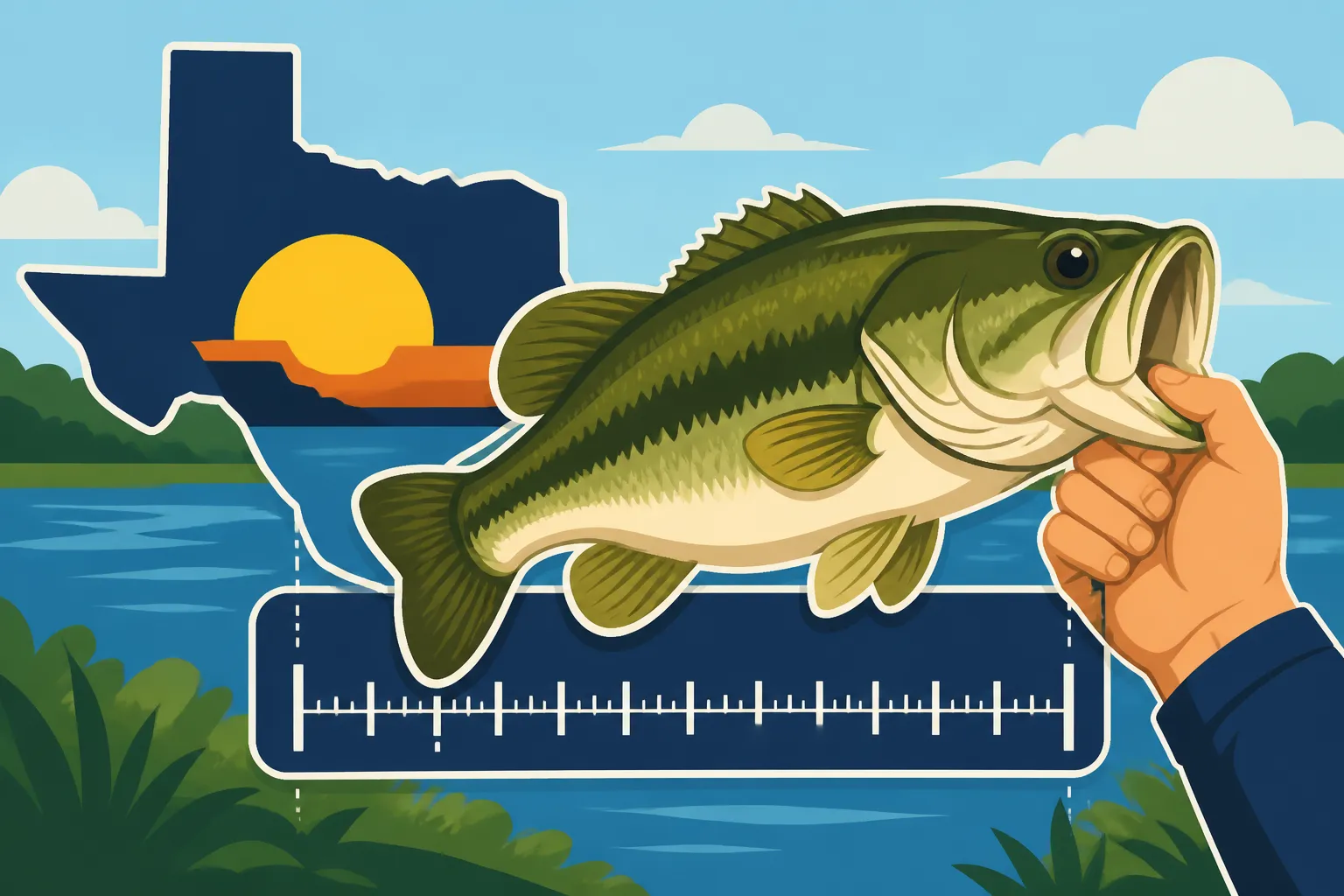
For most public waters across Texas, the standard rule for largemouth bass is a 14-inch minimum length limit. What this means is, if you catch a largemouth bass shorter than 14 inches from the tip of its snout to the tip of its tail (with the tail squeezed together, by the way!), you absolutely have to release it immediately. No exceptions for the statewide rule. It's not just a suggestion; it's the law, and it's there for a very good reason.
Imagine this: You've just cast your favorite lipless crankbait near some submerged timber on Lake Travis, and BAM! a feisty largemouth inhales it. You reel it in, admire its green and bronze hues, and then reach for your bump board. If that fish measures 13.75 inches, even if it looks like a plump little fighter, it has to go back. Releasing those smaller fish allows them to grow bigger and, critically, gives them a chance to spawn, contributing to the next generation of bass. This 14-inch minimum is a cornerstone of responsible bass management. For a broader look at all the rules, check out our guide on Texas Freshwater Fishing Regulations.
Along with the length limit, there's also a daily bag limit, which is often intertwined with length restrictions. For most public waters, the daily bag limit for largemouth bass is five fish, but this is usually in combination with smallmouth, spotted, and Guadalupe bass. So, if you catch three largemouth and two smallmouth, and they all meet the length requirements, you’ve hit your five-fish limit.
Why Length Limits Matter for Conservation
Sometimes, folks might grumble about having to release a perfectly healthy-looking bass because it's just shy of the minimum length. But there's a profound reason behind these seemingly strict rules, and it all boils down to conservation. These minimum length limits, like the 14-inch rule, are designed to protect younger fish, ensuring they have enough time to grow and, most importantly, reach sexual maturity and reproduce.
Think of it like this: a bass that hasn't reached 14 inches might only have had one or two chances to spawn, if any. By letting it go, you're giving it more opportunities to contribute to the gene pool, potentially producing hundreds, if not thousands, of offspring. This is especially vital during the Texas Bass Spawning Season Guide. Without these measures, anglers could quickly deplete the breeding stock, leading to a significant decline in bass populations over time. The larger, more mature fish are crucial for healthy ecosystems, as they often exhibit superior genetics and are more effective at spawning. It's a long-term investment in the future of our incredible Texas fishing heritage, making sure that future generations can enjoy the same thrilling experiences we do today.
Exceptions and Special Regulations: It's Not Always 14 Inches!
Now, here's where things can get a little tricky, and it’s why just knowing the statewide 14-inch minimum isn't quite enough. While that's the general rule, Texas is a vast state with thousands of lakes, rivers, and reservoirs, and many of our most popular bass fishing destinations have their own unique regulations. Ignoring these specific rules can land you in hot water faster than a topwater frog disappears into a lily pad field.
Lake-Specific or Reservoir-Specific Regulations
This is the absolute most critical point for any bass angler in Texas: always, always check the specific regulations for the lake or reservoir you plan to fish before you even wet a line. TPWD has implemented special regulations on many bodies of water to manage their unique fish populations and achieve specific conservation goals. These can include different minimum length limits, slot limits, or even no length limits at all, all while maintaining a 5-bass daily bag limit (unless otherwise specified).
Let’s look at some famous examples:
- Lake Fork: Widely renowned as a trophy bass lake, Lake Fork has a special 16-24 inch slot limit. This means you must immediately release all largemouth bass that are between 16 and 24 inches long. You can keep bass shorter than 16 inches, and you are allowed to keep one bass per day that is 24 inches or longer. This regulation is specifically designed to protect those prime, large breeding bass that make Lake Fork so legendary for producing giants. If you're heading there, definitely check out our Lake Fork Fishing Guide.
- Toledo Bend Reservoir: As a border lake shared with Louisiana, Toledo Bend operates under reciprocal agreements. For largemouth bass, it has a 14-inch minimum length limit, but a more generous 8-bass daily bag limit. This exception to the standard five-bass limit is unique due to its shared waters. Understanding these nuances is crucial, which is why a dedicated guide like our Toledo Bend Reservoir Fishing Guide is so helpful.
- Falcon Lake: Down in South Texas, Falcon Lake has a "no minimum length limit" for largemouth bass, with a 5-bass daily bag limit. This type of regulation is often in place where fisheries biologists determine that population dynamics benefit from harvesting a broader range of sizes, perhaps to reduce competition for food among smaller fish.
These are just a few examples, and there are many more lakes with special regulations – some with 18-inch minimums, others with 16-inch minimums, and various slot limits. The key takeaway is that relying solely on the statewide 14-inch rule can lead to unintended violations. Make it a habit to check the current TPWD Outdoor Annual or their website for the specific body of water you're visiting. You can usually find the most up-to-date information by searching for the lake name and "fishing regulations Texas."
Here's a quick table illustrating how diverse these regulations can be:
| Lake/Body of Water | Largemouth Bass Length Limit | Daily Bag Limit (Largemouth, Smallmouth, Spotted, Guadalupe in aggregate) |
|---|---|---|
| Most Public Waters | 14-inch minimum | 5 |
| Lake Fork | 16-24 inch slot limit; one fish 24 inches or greater allowed. All others 16-24 inches must be released. | 5 |
| Toledo Bend Reservoir | 14-inch minimum | 8 |
| Falcon Lake | No minimum length limit | 5 |
| O.H. Ivie Reservoir | 18-inch minimum | 5 |
| Canyon Lake | 18-inch minimum | 5 |
Slot Limits and How They Work
Slot limits are a fascinating and highly effective conservation tool, but they can be a bit confusing if you’re not familiar with them. Instead of simply saying "no fish under X inches," a slot limit designates a range of fish sizes that must be immediately released. For instance, on Lake Fork, that's the 16-24 inch slot.
Here's why they're used:
- Protecting Prime Spawners: The fish within the slot are often the most reproductively active and genetically valuable fish. By protecting them, TPWD ensures that these strong, healthy breeders stay in the lake to produce more bass, improving the fishery's overall health and genetic diversity.
- Encouraging Growth: Releasing fish within the slot allows them to grow larger, potentially past the upper end of the slot into trophy size.
- Managing Overpopulation of Smaller Fish: Sometimes, if a lake has an overabundance of smaller bass (below the slot), allowing anglers to keep these smaller fish can reduce competition for food, giving the remaining bass a better chance to grow faster and larger. Conversely, allowing anglers to keep fish above a slot limit (like the one fish over 24 inches on Lake Fork) allows for the harvest of older, sometimes less reproductively vigorous fish, or those that have already contributed significantly to the gene pool.
Let's imagine you're fishing on a lake with a 14-18 inch slot limit and a 5-fish daily bag.
- You catch a 13-inch bass: You can keep it (it's below the slot).
- You catch a 15-inch bass: You must release it (it's within the slot).
- You catch a 19-inch bass: You can keep it (it's above the slot).
The exact rules for keeping fish below or above the slot, and how many of each, will vary by lake, so that’s another critical detail to confirm in the official regulations. It requires a bit more thought at the boat, but it's a testament to the scientific management applied to our valuable fisheries.
Practical Tips for Measuring and Handling Bass
Alright, so you know the rules, or at least you know where to find them for your specific lake. Now comes the practical part: actually measuring and handling that beautiful bass you just caught. Doing this correctly not only ensures you comply with the law but also maximizes the fish's chances of survival if you have to release it.
Accurate Measuring Techniques
When a game warden asks to see your catch, or when you're deciding whether a fish goes into the livewell or back into the water, accuracy is paramount. A few tenths of an inch can make all the difference.
Here’s how to measure a largemouth bass accurately:
- Use the Right Tool: The gold standard for measuring fish is a "bump board" or "measuring board." These are rigid boards with a fixed stop at one end. You can find excellent options on Amazon, or at most tackle shops. They’re much more accurate than a flimsy tape measure that can curve and give you an incorrect reading. Make sure your measuring device is easily accessible when you're fishing.
- Lay the Fish Flat: Gently lay the bass on its side on the bump board. The fish should be as flat and straight as possible.
- Close the Mouth: Push the fish's snout firmly against the fixed stop on the board. Make sure its mouth is closed, not gaping open, as this can add extra length to the measurement.
- Squeeze the Tail: Gently squeeze the tail lobes together. The measurement is taken to the longest point of the tail. Don’t try to stretch the fish; just ensure the tail is compressed.
Practice makes perfect! It might feel a bit awkward at first, especially with a lively fish, but with a little practice, you’ll be a pro. Always prioritize the fish's well-being by being quick and gentle throughout the process.
Best Practices for Catch and Release
Even if a fish is legal size, you might choose to release it, especially if you’re fishing for sport or simply want to contribute to the fishery. But for those undersized fish that must be released, proper handling is absolutely crucial for their survival. Texas summers can be brutal, and a poorly handled fish might not make it, even if it swims away.
Here are some golden rules for catch and release:
- Minimize Air Exposure: This is perhaps the most important rule. Keep the fish in the water as much as possible. If you must lift it for a photo or measurement, do so quickly and efficiently. Even a minute out of water can cause significant stress and damage to their gills and internal organs.
- Wet Hands Only: Always wet your hands before touching a fish. Dry hands can remove the fish's protective slime coat, making it vulnerable to disease and infection.
- Support the Fish: When holding a bass, especially a larger one, support its weight horizontally. Avoid holding it vertically by the jaw alone, as this can damage its jaw, spine, and internal organs. Use one hand to grip the lower jaw (if using a lip gripper or thumb), and the other hand to support its belly or tail.
- Use Proper De-Hooking Tools: Carry needle-nose pliers or a dedicated de-hooking tool. These allow for quick and clean hook removal, minimizing damage to the fish and time out of water. Barbless hooks can also make removal easier. You can find some great options for de-hooking tools that fit easily into your Best Tackle Box Setup for Texas Anglers.
- Revive If Necessary: If a fish seems sluggish after being released, gently hold it upright in the water, facing into a mild current if possible, and move it back and forth to force water over its gills. Only release it when it can swim away under its own power. This is especially important during those hot How to Fish in Hot Texas Summers days.
By following these simple practices, you're not just complying with regulations; you're actively participating in the conservation effort and ensuring that those vibrant, healthy bass continue to populate our Texas waters.
Staying Informed and Legal
Fishing in Texas is a fantastic experience, but nothing can sour a great day on the water faster than a visit from a game warden that ends with a citation. Staying informed about the latest regulations isn’t just about avoiding trouble; it’s about being a responsible angler and steward of our natural resources.
Where to Find the Latest Regulations
The Texas Parks and Wildlife Department is your go-to source for all official fishing regulations. Do not rely solely on what your buddy told you, or what you read in an old forum post. Regulations can and do change!
Here’s how to ensure you always have the most current information:
- TPWD Outdoor Annual: This is the official publication for all Texas hunting and fishing regulations. It’s updated annually, usually around September 1st, which is when the new license year begins (and when many regulations can change – learn more about the Texas fishing license year explained: why it ends August 31). You can find the Outdoor Annual in several formats:
- Online: The digital version is always the most current and accessible. Just search for "TPWD Outdoor Annual" on your preferred search engine.
- Mobile App: TPWD offers a fantastic mobile app (available for both iOS and Android) that provides instant access to regulations, allowing you to check limits right on the water. This is incredibly convenient.
- Print Version: You can pick up a physical copy at most retail locations that sell fishing licenses, like Walmart, Academy Sports + Outdoors, or local bait shops.
- TPWD Website: The official TPWD website (tpwd.texas.gov) has a dedicated fishing section where you can search for specific lake regulations, stocking reports, and news updates. It’s a treasure trove of information for any Texas angler.
- Local Signage: Many popular boat ramps and fishing piers will have signs posted detailing the specific regulations for that body of water. While helpful, always cross-reference with the official Outdoor Annual if you have any doubts, as signs can sometimes be outdated.
Make it a habit to glance at the new Outdoor Annual each year when you renew your Texas Fishing License Requirements Explained or pick up your new license. A quick review can save you a lot of grief.
Penalties for Violations
Fishing without the correct license or failing to adhere to length and bag limits are serious offenses in Texas. Game wardens are highly trained peace officers who actively patrol our lakes, rivers, and coastal waters, ensuring everyone is playing by the rules. They’re there to protect our resources, and they take violations seriously.
The consequences for not following regulations can vary depending on the severity and nature of the offense, but generally include:
- Fines: These can range from a couple of hundred dollars to over a thousand dollars, plus court costs.
- Seizure of Fish: Any illegally caught fish will be seized.
- Loss of Fishing Privileges: In more serious or repeat offenses, your fishing license could be suspended or revoked, meaning you wouldn’t be able to legally fish in Texas for a period of time. This can be a really harsh penalty for someone who loves to fish!
- Criminal Charges: In extreme cases, especially involving commercial violations or egregious disregard for conservation laws, criminal charges can be filed.
It's really not worth the risk. A little bit of homework upfront, like understanding the Texas Fish Bag and Length Limits and how to properly How to Get a Texas Fishing License, is a small price to pay for a worry-free day on the water. Knowing the specific rules for your target species, like the largemouth bass, and for the specific water body you're fishing, is part of being a responsible and ethical angler.
Disclaimer
The information provided in this guide is for general informational purposes only and does not constitute legal advice. Fishing regulations are subject to change. Always consult the official Texas Parks and Wildlife Department Outdoor Annual or website for the most current and accurate regulations before fishing.