How to find bass on a new lake
There’s nothing quite like the excitement of hitting a brand-new lake, the shimmering promise of unknown waters stretching out before you. But let’s be real, that excitement often quickly turns into a scramble of confusion and frustration. You pull up, and suddenly you’re faced with miles of shoreline, countless coves, and no idea where to even begin looking for bass. It can feel like trying to find a needle in a haystack, leaving you wondering if you should have just stuck to your home waters. This guide is here to cut through that overwhelm, giving you a clear roadmap to confidently locate bass on any new Texas lake, turning those "lost" feelings into "found" fish.
The Pre-Trip Detective Work: Researching Your New Lake
Before you even launch your boat or cast a line, the most successful anglers are already putting in work. Think of it like being a detective: you gather clues, look for patterns, and build a case before you ever step onto the scene. Skipping this crucial step is a surefire way to spend your day aimlessly cruising and casting into barren water.
Diving into Maps and Satellite Imagery
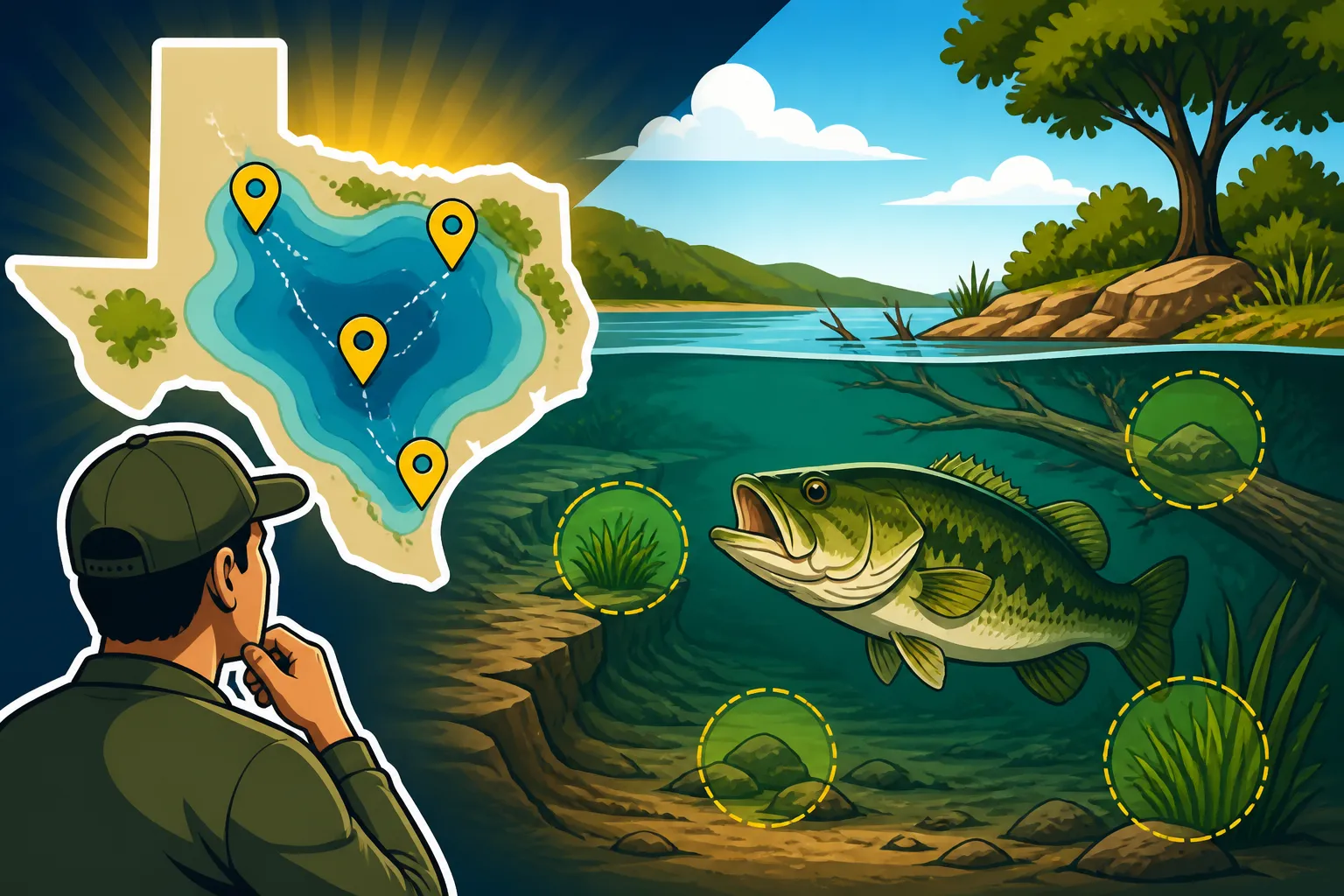
The first and arguably most important tool in your arsenal for a new lake is a good map. We're talking about more than just a simple navigation chart; you need detailed topographical maps that show you the contours, depths, and underwater structure. These maps are like x-rays of the lake bottom, revealing what lies beneath the surface.
When you're poring over these maps, look for key features that scream "bass habitat." Pay close attention to old creek channels that wind through the lake, especially where they intersect with points or humps. These underwater highways are natural travel routes for bass and baitfish. Identifying sharp drops, ledges, and submerged humps can show you where fish might hold at different depths depending on the time of year or day. Points that extend far into the lake are also critical, as they offer bass ambush points and quick access to both shallow and deep water. Many modern fish finders come with incredibly detailed mapping capabilities, but you can also find excellent digital and paper maps online or through various angling apps. Even a quick search on Amazon for "Texas lake maps" can yield some hidden gems.
Complementing your topographical maps with satellite imagery, like what you find on Google Earth, can provide an incredible visual overlay. While you can't see through the water, you can often spot visible cover like standing timber, submerged brush piles (sometimes), large rock outcroppings, boat docks, marinas, and even areas with dense aquatic vegetation near the shoreline. Comparing the satellite view with the contour lines on your topo map helps you connect the dots between visible cover and underwater structure, giving you a much more complete picture of potential bass hangouts. Are there a lot of private docks? Those often have brush piles sunk nearby. Is there a defined creek arm with visible dead trees? That's a strong indicator of submerged timber.
Consulting Online Resources and Fishing Reports
Once you have a good visual understanding of the lake, it's time to tap into the collective wisdom of other anglers. The internet is a goldmine, but you need to know where to look. Start with official sources like the Texas Parks and Wildlife Department (TPWD) website. They often have detailed lake pages with information on fish populations, stocking reports, and general lake characteristics. You might even find specific details in a Texas Largemouth Bass Fishing Guide or articles discussing Texas Largemouth Bass Length Limits that hint at prevalent sizes.
Beyond official sites, delve into local fishing forums, Facebook groups dedicated to Texas fishing, and general angling websites that host fishing reports. When you're sifting through these, look for patterns, not just one-off catches. What areas are consistently mentioned? What bait choices seem to be popular? Are anglers talking about fishing deep structure or shallow cover? While individual fishing reports can be a bit hit-or-miss in terms of real-time accuracy, they often provide valuable historical context. For example, if you consistently see reports from May talking about bass being caught on crankbaits near main lake points, that gives you a starting point for your own trip. Remember, take everything with a grain of salt, but use it to build your initial strategy. Even glancing at old tournaments results or local guide service blogs can offer unexpected insights into productive areas and seasonal patterns. Understanding How to Read a Texas Lake Fishing Report effectively will significantly shorten your learning curve.
Understanding the Lake's Personality: Clarity and Forage
Every lake has its own personality, and two huge factors in understanding it are water clarity and the dominant forage base. These elements dictate how bass feed, where they hold, and what lures they'll respond to.
Water clarity can range from gin-clear to heavily stained or muddy. Bass in clear water often rely more on sight and tend to be more skittish, preferring deeper water or heavy cover. Your lure choices might lean towards natural colors, subtle presentations, and longer casts. Conversely, in stained or muddy water, bass rely more on their lateral line (vibration) and scent. They might hold tighter to cover, and brighter, louder lures that create a lot of displacement could be more effective. Think about how the light penetrates the water – this impacts how deep bass will comfortable hold. You can often find a good selection of specialized lures for varying water clarities on Amazon.
Equally important is knowing what the bass are eating. Is the lake full of threadfin shad, gizzard shad, bluegill, or crawfish? Matching the hatch is a time-honored fishing principle for a reason. If bass are gorging on shad, then shad-imitating crankbaits, swimbaits, and spinnerbaits will likely be productive. If bluegill are abundant, then a square bill crankbait or a bluegill-colored jig might be the ticket. Sometimes, TPWD's lake pages will list the primary forage species, or you can glean this information from fishing reports. Knowing the common forage helps you choose the Best Bait and Lures for Texas Fishing that imitate their natural food sources, increasing your chances of a strike.
On-the-Water Scouting: Your First Hours on the Lake
You’ve done your homework, got your gear ready, and now you’re finally out on the water. The temptation might be to immediately start firing casts at every piece of cover you see, but hold your horses! Your initial hours on a new lake should be less about catching fish and more about gathering real-time intelligence. Think of this as your reconnaissance mission.
The "Scanning" Approach: Covering Water Efficiently
When you first hit the water, resist the urge to drop your trolling motor and meticulously pick apart every single stump. Instead, start by literally scanning the lake. This means moving at a moderate speed, keeping your eyes peeled, and, most importantly, leveraging your boat’s electronics. Your fish finder is your best friend here. Engage your side imaging or 360-degree sonar if you have it; these tools are game-changers for quickly identifying hidden brush piles, rock formations, ledges, and baitfish schools that you'd otherwise never see. Learning How to use a fish finder for bass fishing effectively will dramatically improve your scouting efficiency.
As you scan, you're not just looking for bass; you're looking for life. Are there schools of baitfish suspended in the water column or hugging the bottom? Are you seeing distinct changes in bottom composition, like rock transitioning to mud? Are there noticeable depth changes? Mark anything interesting on your GPS, even if you don't fish it immediately. The goal is to identify a handful of promising areas where you'll slow down and fish more thoroughly later. This systematic approach, especially in larger bodies of water like Lake Fork or Sam Rayburn Reservoir, prevents you from wasting valuable time in unproductive zones.
Focusing on High-Percentage Areas First
Given the vastness of a new lake, you need to prioritize where you spend your fishing time. There are certain types of structures and areas that are almost always high-percentage spots for bass, regardless of the lake. These are your starting points.
- Points: Main lake points or secondary points (points within a coves) are classic bass magnets. They offer easy access to deeper water and often hold baitfish. Start by fishing the sides and the very tip of the point, experimenting with different depths.
- Creek Channels and River Bends: If your map showed old creek or river channels, target their edges and bends. Bass often stage along these features, especially during seasonal migrations. Knowing How to read lake contour maps for bass fishing will highlight these crucial underwater highways.
- Humps and Ridges: Submerged humps or ridges rising from the lake bottom act like underwater islands, attracting baitfish and, consequently, bass. These are often overlooked by anglers who only focus on visible shoreline features.
- Transition Zones: Bass love transitions – where hard bottom meets soft bottom, where clear water meets stained water, or where a flat suddenly drops into deeper water. These edges create natural ambush points.
- Visible Cover: Don't ignore the obvious. Boat docks, especially those with associated brush piles, standing timber, and lily pad fields are always worth a few casts. When fishing around docks, consider how to effectively How to fish around boat docks for bass.
Start your fishing efforts in these obvious, high-probability locations. Even if you don't catch a fish on the first few casts, you're building a mental database of what these areas look like and how bass might be relating to them.
Observing Environmental Clues
The lake itself is constantly giving you clues if you know how to read them. Pay close attention to subtle environmental signals that can lead you to fish.
- Wind: Wind can be your friend. A consistent breeze pushing into a bank or point can concentrate baitfish, creating a buffet for bass. Fish the windy side of structures, as the chop also breaks up the surface, making it harder for bass to see you.
- Current: If the lake has a dam or a significant river inflow/outflow, current can be a major factor. Bass will often position themselves out of the main current, waiting for food to drift by. Look for eddies and slack water areas.
- Water Temperature: Your fish finder often displays water temperature. Pay attention to subtle changes. Even a two-degree difference can sometimes concentrate bass, especially during extreme heat or cold.
- Baitfish Activity: This is one of the most direct clues. Are you seeing baitfish flickering on the surface? Are birds diving into the water? Are there "blow-ups" where something is chasing bait on the surface? Where there's bait, there are usually predators. These visible signs can instantly tell you where to make your next cast. A good pair of polarized sunglasses (you can find quality ones on Amazon) are invaluable for spotting these subtle movements.
Breaking Down the Lake: Developing a Pattern
Once you've done your initial scouting and perhaps even landed a fish or two, the real work of developing a pattern begins. This is where you connect the dots, understanding why you caught a fish in a particular spot and trying to replicate that success elsewhere on the lake.
The "Follow the Forage" Principle
This is one of the most fundamental truths in bass fishing: find the food, and you'll find the bass. Bass are opportunistic predators; their primary goal is to eat and conserve energy.
If you're consistently seeing schools of shad on your electronics in a certain depth range, then bass are likely to be nearby, holding just above, below, or to the side of those schools. Pay attention to the size of the baitfish. If you're marking small shad, then try smaller profile lures. If they're larger gizzard shad, then a big swimbait or a larger crankbait might be more effective. When you catch a bass, check its mouth – sometimes you'll see tails of baitfish sticking out, giving you a direct clue about their latest meal. If you're fishing a lake known for specific forage like the abundant shad in Lake Fork or the diverse ecosystem of Toledo Bend Reservoir, focusing on areas where that forage thrives will be key. This principle also applies to other food sources like crawfish. If you're fishing rocky banks or creek beds, try a jig or a crawfish-imitating crankbait.
Experimenting with Depths and Presentations
Don't get stuck in a rut. If you're not getting bites, change something. The biggest mistake anglers make on a new lake is fishing the same way in every spot. Bass can be incredibly depth-specific and finicky about how a lure is presented.
Start with a versatile lure, like a jig or a Texas-rigged worm, and try different depths within a promising area. Cast shallow, then slightly deeper, then deeper still, until you hit the strike zone. If you catch a fish, try to replicate that depth. For instance, if you're catching bass at 12 feet, then search for other areas on the lake that have a similar 12-foot depth contour with similar cover. Don't be afraid to switch between different lure types too. If a slow presentation isn't working, try something faster like a lipless crankbait or a spinnerbait. If you're fishing heavy cover, a Texas rig is often the way to go. If you're covering open water or probing ledges, a deep-diving crankbait could be more effective. Learn How to fish a Texas rig for bass for navigating cover, or How to fish a crankbait for covering water quickly. The goal is to find what the bass want that day, not necessarily what you want to throw.
Documenting Your Finds
This is perhaps the most underrated aspect of breaking down a new lake. Keep notes! Whether it's in a physical logbook, on your phone, or by marking waypoints on your fish finder, documentation is crucial for building a successful pattern.
When you catch a fish, record:
- Exact location: Mark a GPS waypoint.
- Depth: How deep was the fish when it bit?
- Lure and color: What were you using?
- Retrieve speed/style: Was it a slow drag, a fast reel, a jerk-pause?
- Cover/Structure: Was it a brush pile, a rock pile, a dock, a point?
- Environmental conditions: Water temperature, air temperature, cloud cover, wind, time of day.
This meticulous note-taking allows you to see patterns emerge. If you catch three bass from three different parts of the lake, but all were on a chartreuse spinnerbait in 8 feet of water on windy main lake points with shad schools present, then you’ve just found your pattern! You can then spend the rest of your day running similar water and casting that same lure. This also helps immensely for future trips. After all, a truly great piece of gear like a quality fish finder with robust mapping features, which you can browse on Amazon, is only as good as the information you feed it.
| Strategy Component | Key Action | What You're Looking For | Why It Helps |
|---|---|---|---|
| Pre-Trip Research | Study topographical maps and satellite images | Creek channels, points, humps, ledges, visible cover | Reveals underwater structure and likely bass ambush points. |
| Read online reports and forums | Common patterns, effective baits, general lake areas | Provides historical data and current angler insights for starting points. | |
| Understand water clarity & forage | Clear/stained water, shad, bluegill, crawfish presence | Guides lure color, size, and presentation to match bass diet and visibility. | |
| On-Water Scouting | Employ a "scanning" approach with electronics | Baitfish schools, structure changes, depth contours | Quickly covers water to identify high-potential areas without wasting casts. |
| Prioritize high-percentage areas | Main lake points, creek mouths, humps, standing timber | Focuses initial efforts on proven bass holding spots to find fish faster. | |
| Observe environmental clues | Wind direction, current, water temperature, bait activity | Indicates where bass might be actively feeding or holding due to conditions. | |
| Pattern Development | Follow the forage | Concentrated baitfish, signs of bass feeding | Bass follow their food; finding baitfish directly leads you to hungry bass. |
| Experiment with depths and presentations | Varying lure types, retrieve speeds, and fishing depths | Uncovers the specific combination of depth and action bass prefer on that day. | |
| Document your catches | GPS waypoints, lure, depth, conditions for each fish | Builds a reliable pattern for the rest of your trip and for future visits to the lake. |
Common Challenges and Troubleshooting
Even with all the best prep and on-water savvy, new lakes can throw you curveballs. It’s part of the game, and knowing how to adapt is what separates good anglers from truly great ones.
Dealing with Overwhelm: Too Much Water, Too Little Time
One of the biggest frustrations on a massive new lake is simply the sheer volume of water. You look at Lake Sam Rayburn, or even a medium-sized reservoir like Lake Conroe, and it feels impossible to decide where to even point the boat. This feeling of overwhelm can lead to aimless wandering and wasted time.
The trick is to break the lake down into smaller, manageable sections. Instead of trying to "fish the whole lake," pick one or two areas from your pre-trip research – maybe a major creek arm and a main lake area with a prominent point – and focus all your energy there. Think of it as fishing several smaller "lakes" within the larger one. You can use the "quartering" method: divide a large cove or section into quadrants and commit to thoroughly fishing one quadrant before moving to the next. Don't be afraid to skip huge stretches of seemingly featureless water, especially if your maps don't indicate any significant structure. Sometimes, narrowing your focus to a particular type of cover, like just fishing standing timber or only targeting rock piles, can also help simplify your approach. Having Best Electronics for Texas Anglers can significantly reduce this feeling of being lost by providing real-time data and mapping.
The Weather Curveball: Adapting to Changing Conditions
Texas weather is notoriously unpredictable, and a sudden cold front, a shift in wind, or unexpected rainfall can completely change a lake’s personality – and the bass's behavior – from one hour to the next. What was working perfectly an hour ago might suddenly draw no bites.
If the weather takes a turn, understand how bass typically react. A strong cold front often pushes bass deeper and makes them less active. They might suspend over offshore structure or bury themselves in the thickest cover. When this happens, slow down your presentation, downsize your baits, and focus on vertical presentations like a drop shot or a jig fished slowly. Wind changes can reposition baitfish and create new current seams, so be ready to adjust your boat position and cast angles accordingly. For example, if you were catching fish on a windy point, and the wind suddenly dies, those fish might move deeper or relocate to an adjacent, calmer bank. Always be ready to swap out your lures to match new conditions – a quick search on Amazon for specific lure types can even give you ideas for what’s popular in certain conditions. For insights on adapting, check out articles like How to fish a Texas reservoir after a cold front or How water clarity changes lure choice for more detailed advice. The key is never to assume what worked an hour ago will work now. Stay flexible, keep observing, and be willing to experiment until you crack the code again.
Disclaimer
This article is for general informational purposes only and does not constitute professional advice. Laws, prices and regulations vary by location and change over time. Consult a qualified professional for guidance on your specific situation.