Difference between an alligator gar and a longnose gar
You're out on a Texas lake, maybe the vast expanse of Lake Texoma or one of the smaller, tranquil rivers in East Texas, and suddenly you've got a long, prehistoric-looking fish on the end of your line. Your heart probably jumps, because it could be anything from a relatively common catch to one of the biggest freshwater fish in North America. Anglers in Texas often find themselves wondering: is this an alligator gar, that truly massive, powerful fish, or its more slender cousin, the longnose gar? Knowing the precise difference isn't just about satisfying curiosity or being able to accurately report your catch; it's absolutely vital for adhering to fishing regulations, understanding proper handling techniques, and truly appreciating the incredible diversity of our Texas waters. This guide is here to unravel the mystery, giving you clear, actionable ways to tell these two magnificent species apart.
Distinctive Physical Characteristics
When you first encounter a gar, the sheer primal look of them is undeniable. They are truly ancient fish, and both alligator gar and longnose gar share that distinct, bony armored body and elongated shape. However, to an experienced eye, or armed with the right knowledge, the differences become quite obvious, especially when you focus on their heads and overall body structure. These are the primary identifiers that will help you confidently distinguish between these two Texas giants.
Snout Shape and Length
This is, without a doubt, the single most critical feature for differentiating between an alligator gar and a longnose gar. It's usually the first thing seasoned anglers look for, and for good reason. The names themselves even hint at this key difference.
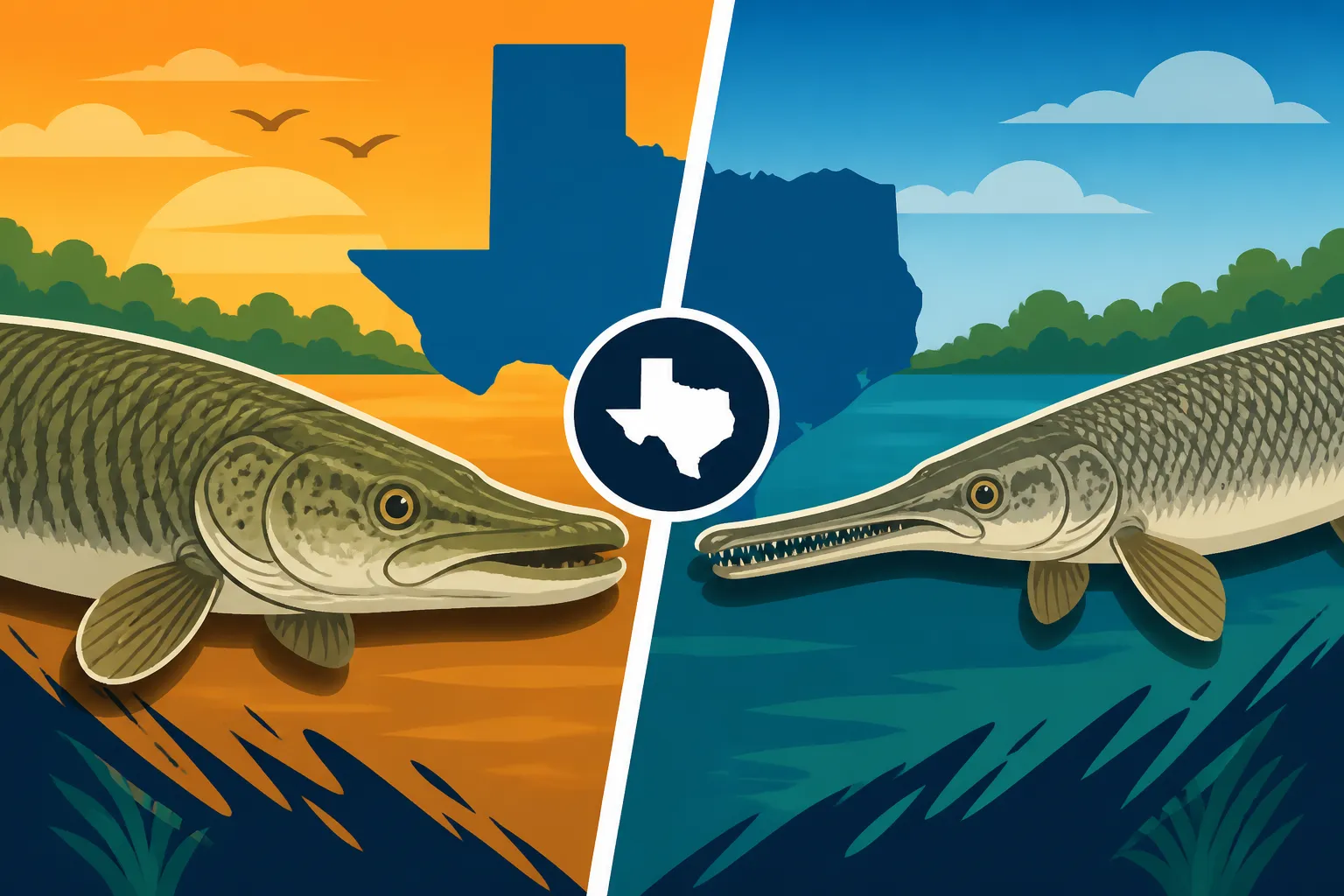
An alligator gar, true to its reptilian namesake, possesses a broad, flat, and noticeably short snout. Imagine a gator's head; it's wide and powerful, built for ambushing. Its upper jaw is wider than its lower jaw, and the snout itself is relatively short and triangular when viewed from above. This wide snout gives the alligator gar a formidable appearance, perfectly adapted for snatching large prey with a powerful sideways snap. The nostrils are located at the very end of this blunt, alligator-like snout, often visible as two small holes. You'll notice that the eyes are set relatively far back on the head compared to the length of the snout.
In stark contrast, the longnose gar lives up to its name with an incredibly elongated, slender, and almost needle-like snout. This snout is often more than twice as long as the rest of its head. Picture a pair of needle-nose pliers, and you're getting close. Both the upper and lower jaws are of similar width along the length of this impressive proboscis. This narrow, spear-like snout is perfectly designed for rapidly striking and impaling smaller, fast-moving fish. When you see a longnose gar, this long, thin snout will immediately stand out as its most defining feature, making it relatively easy to distinguish from its broad-snouted cousin. The nostrils are also at the very tip, but they blend more seamlessly into the tapered design of the snout.
Teeth and Jaw Structure
While both gar species are known for their formidable teeth, the arrangement and prominence of these pearly whites offer another excellent distinguishing mark, particularly in how they are presented within their respective jaw structures. Both have rows of sharp, conical teeth, but the differences in their mouths tell a story about their hunting strategies.
The alligator gar boasts two prominent, irregular rows of large, dagger-like teeth on each side of its upper jaw. When you look into an alligator gar's mouth, these teeth are impossible to miss. They are truly menacing, designed to grip and hold onto substantial prey like ducks, turtles, and large fish. This double row of upper teeth is a definitive characteristic. Their powerful jaws can exert immense crushing force, making them apex predators in their aquatic environments. If you ever have a chance to see one up close (with extreme caution, of course!), count those teeth; the dual row is a dead giveaway.
The longnose gar, on the other hand, typically has a single, more uniform row of smaller, but still very sharp, needle-like teeth in both its upper and lower jaws. While still effective predators, their teeth are more uniformly spaced and designed for piercing smaller, faster-moving prey rather than the crushing and holding power needed for larger animals. You won't see that distinctive double row of large fangs in a longnose. Their jaws are built for speed and precision, and their teeth reflect that specialization. When handling a longnose, you'll still need extreme care due to the sharpness of these teeth, but the overall impression is less "gator-like" and more "barracuda-like" in its dental arrangement.
Size and Weight Potential
This difference is perhaps the most awe-inspiring, as it speaks to the truly legendary status of the alligator gar. While both species can grow to respectable sizes, their maximum potential is vastly different, impacting everything from the tackle you might use to the regulations that apply.
Alligator gar are the undisputed giants of the gar family and among the largest freshwater fish in North America. They can reach truly astonishing lengths, often exceeding 6 feet and sometimes approaching 8 to 10 feet. Their weight can easily soar into the triple digits, with some individuals tipping the scales at over 200 pounds. The Texas state record, a truly magnificent specimen, was well over 8 feet long and weighed in at a staggering amount. This immense size means that catching and landing a large alligator gar is a monumental feat, requiring heavy-duty tackle, immense strength, and often a bit of luck. Their sheer bulk is unmistakable when you see one, even a juvenile, compared to a longnose gar of similar length. For more on these behemoths, check out Texas Alligator Gar Size and Growth.
Longnose gar, while still impressive, are considerably smaller in comparison. They typically reach lengths of 3 to 6 feet, with most adult fish caught by anglers falling into the 3 to 4-foot range. Their weight usually caps out at around 30 to 50 pounds, although larger specimens have been caught. While a 50-pound longnose is a fantastic catch, it pales in comparison to the potential of an alligator gar. You're much more likely to encounter longnose gar of various sizes, making them a more common catch for many Texas anglers. They are also significantly more slender for their length than the robust alligator gar.
Coloration and Markings
While coloration can vary based on water clarity, habitat, and even individual fish, there are some general patterns in their markings that can aid in identification, especially when combined with the other physical characteristics.
Alligator gar typically exhibit a mottled, olive-brown to greenish-gray coloration on their backs and sides, fading to a lighter, often white or cream, belly. Their bodies are usually adorned with large, irregular, dark brown or black spots and blotches that often run across their back and extend onto their fins. These spots are usually larger and less defined than those on a longnose gar, often appearing like splotches or patches rather than distinct dots. The fins, particularly the caudal (tail) fin, will also often have these large, dark splotches. This camouflage helps them blend into murky, vegetated environments where they lie in wait for prey.
Longnose gar generally have a lighter, often olive-green to silvery-gray body color, especially on their sides, with a white or off-white belly. Their most distinguishing markings are the numerous small, circular, dark spots that are typically concentrated along their back and sides, and prominently displayed on their fins. These spots are usually more uniform in size and distribution compared to the alligator gar's larger blotches. The long, slender snout itself might also have a few small spots, which are not usually seen on the broader snout of an alligator gar. These spots can be quite striking, forming almost a leopard-like pattern on some individuals. This pattern helps them disappear among aquatic plants and debris as they stalk their prey.
Alligator Gar: The Texas Titan
The alligator gar is a creature of legend in Texas, a true freshwater titan that commands respect from any angler. Its imposing size and prehistoric appearance make it one of the most sought-after, yet challenging, fish to target. Understanding this species means appreciating its unique adaptations and the vital role it plays in our ecosystems.
Appearance and Size Potential
Imagine a torpedo-shaped fish, covered in thick, diamond-shaped ganoid scales that are more like armor plating than typical fish scales. That's your alligator gar. Their body is exceptionally robust and muscular, built for immense power. As we discussed, the most defining feature is that broad, flattened, alligator-like snout, equipped with those two impressive rows of upper jaw teeth. Their eyes are relatively small and set high on the head. The dorsal and anal fins are located far back on the body, close to the powerful, rounded caudal fin, a design that allows for explosive bursts of speed when ambushing prey.
As for size, we're talking about potential world-record breakers here in Texas. While many alligator gar caught by anglers are in the 30-70 pound range, specimens over 100 pounds are not uncommon, especially in prime habitats. The truly massive ones, those reaching 200 pounds or more and exceeding 8 feet in length, are living relics. Catching one of these giants is often a once-in-a-lifetime experience. Their sheer weight and length require specialized gear and a serious commitment from the angler. These fish are not just big; they are incredibly strong, making for an unforgettable fight. They are truly the apex predators of many Texas waterways, and their size reflects their dominance.
Habitat and Behavior
Alligator gar are remarkably adaptable, but they generally prefer large, slow-moving rivers, bayous, oxbow lakes, and coastal bays and estuaries. In Texas, you'll find them in the Trinity River, Brazos River, and across the vast estuarine systems of the Gulf Coast. They are particularly fond of areas with abundant submerged vegetation, standing timber, and structure where they can hide and ambush their prey. They are often seen basking near the surface in warm weather, taking gulps of air into their swim bladders, which acts like a primitive lung, allowing them to survive in oxygen-poor waters that would kill most other fish. This unique adaptation makes them incredibly resilient.
Their behavior is characteristic of an ambush predator. They are not typically fast-pursuit hunters. Instead, they lie perfectly still, camouflaged by their mottled coloration, waiting for an unsuspecting fish, bird, or even small mammal to come within striking distance. When the opportunity arises, they lunge with incredible speed, snatching their prey with those powerful jaws. They are primarily nocturnal or crepuscular hunters but will feed during the day if the opportunity presents itself. Anglers often target them with large cut bait, whole fish, or even specialized flies, often at night or during the early morning hours. How to catch alligator gar in Texas provides some excellent strategies for landing these magnificent fish.
Fishing Considerations and Regulations
Fishing for alligator gar is not for the faint of heart, nor is it something you do on a whim. It requires preparation, respect for the animal, and adherence to specific regulations. Due to their status as trophy fish and their relatively slow growth rates, Texas Parks and Wildlife Department (TPWD) has specific rules to manage their populations. For instance, in many areas, there's a one-fish-per-day bag limit, and often, specific zones or special permits are required for taking large alligator gar. Always consult the current Texas Fish Bag and Length Limits and Texas Freshwater Fishing Regulations before you head out, as rules can change.
Successful alligator gar fishing often involves heavy-duty rods and reels, strong braided line, and robust leader material, typically steel or heavy mono, to resist their sharp teeth. You can find excellent selections of heavy-duty lines and durable hooks suitable for gar fishing on Amazon. Large cut baits, like carp or mullet, are common. Some anglers even use specialized bowfishing gear. Catching an alligator gar is a test of strength and patience. Handling them requires extreme caution due to their size, strength, and formidable teeth. Many anglers use long-handled pliers or specialized de-hookers, also readily available on Amazon, to ensure safe release. Respect for this powerful fish is paramount, whether you plan to keep it (if legal and within limits) or release it to fight another day. It's truly a unique Texas fishing experience.
Longnose Gar: The Common Striker
While the alligator gar often steals the spotlight with its enormous size, the longnose gar is arguably the most common and widespread gar species across Texas. Don't let its more "common" status fool you, though; it's a fascinating and challenging fish in its own right, offering plenty of excitement for anglers of all skill levels.
Appearance and Typical Size
The longnose gar's appearance is defined by its incredibly slender, elongated body and that distinctive, very long, and narrow snout, which can be two to three times the length of the rest of its head. This snout is typically straight, without the broad, flat profile of the alligator gar. Its body is also covered in those tough, ganoid scales, but it tends to be more cylindrical and less bulky than an alligator gar of comparable length. The coloration is usually olive to brownish on the back, fading to silvery sides and a white belly, often adorned with those characteristic small, dark spots concentrated along the back and fins.
In terms of size, most adult longnose gar encountered by Texas anglers will range from 3 to 4 feet in length, weighing between 10 and 20 pounds. However, they can definitely grow larger, with specimens reaching up to 6 feet and weights of 30-50 pounds being reported. While these are impressive fish, they are still significantly smaller than the potential giants of the alligator gar world. Their more manageable size, combined with their widespread distribution, means that longnose gar are a much more frequent catch, whether targeted specifically or hooked incidentally while fishing for other species. Many anglers consider them excellent sport fish due to their strong fight and acrobatic jumps once hooked. If you're looking for general information on this species, you might find What is a longnose gar helpful.
Habitat and Behavior
Longnose gar are incredibly widespread throughout Texas, inhabiting a vast array of freshwater environments, including rivers, lakes, reservoirs, and bayous. They are also quite tolerant of brackish water and can be found in coastal estuaries and bays. They thrive in areas with submerged vegetation, fallen trees, and rocky structures where they can hide and ambush prey. Unlike the alligator gar, which is often found in deeper, slower pools, longnose gar are frequently encountered in shallower areas, along shorelines, and in river currents. They are also known for their ability to gulp air, allowing them to survive in less-than-ideal water conditions.
Their feeding behavior is characterized by their quick, sideways strike with their long, needle-like snout. They primarily feed on smaller fish, often ambushing them from cover or slowly stalking them before a lightning-fast lunge. They are visual predators, relying on their keen eyesight to spot prey. Anglers often catch them using live baitfish, such as minnows or shad, suspended under a float, or by casting artificial lures like spoons, inline spinners, or soft plastics. Due to their hard, bony mouths, setting the hook can be a challenge, often requiring patience and a sharp hook. You might find a variety of suitable lures for targeting gar, including some effective spoons and spinners, on Amazon.
Fishing for Longnose Gar
Fishing for longnose gar is a popular activity for many Texas anglers, offering consistent action and a strong fight. They are not typically considered a prime table fish by most, but their sporting qualities are undeniable. Standard medium-heavy spinning or baitcasting gear can be effective, though a wire leader or heavy monofilament leader is highly recommended to prevent bite-offs from their sharp teeth. Many anglers rig live shiners or small sunfish, allowing them to swim naturally.
One unique and popular technique for longnose gar is using a frayed nylon rope lure. This simple "lure" consists of strands of nylon rope tied to a hook. The gar's teeth get tangled in the fibers, allowing the angler to reel them in. This method often results in fewer swallowed hooks, making for an easier and safer release. When handling longnose gar, always use a firm grip behind the head, or better yet, a specialized gripper. Their teeth are small but sharp, and they can twist and thrash. If you plan to release them, minimize their time out of the water. They are a resilient species, and with careful handling, they can continue to thrive in Texas waters.
Side-by-Side Comparison: Alligator Gar vs. Longnose Gar
To make it even easier to tell these two fascinating species apart, here’s a quick reference table summarizing their most prominent differences. Keep this in mind next time you're trying to identify your catch!
| Feature | Alligator Gar | Longnose Gar |
|---|---|---|
| Snout Shape | Broad, flat, and relatively short; alligator-like | Very long, slender, and narrow; needle-like |
| Upper Jaw Teeth | Two prominent, irregular rows of large, dagger-like teeth | Single, uniform row of smaller, needle-like teeth |
| Size Potential | Can exceed 8 feet and 200+ pounds (true giants) | Typically 3-6 feet, up to 50 pounds |
| Body Build | Very robust, muscular, and bulky for its length | More slender and cylindrical for its length |
| Color/Markings | Olive-brown/green-gray, large irregular dark spots/blotches | Olive-green/silvery-gray, numerous small, uniform dark spots |
| Primary Habitat | Large, slow rivers, bayous, coastal estuaries | Widespread in rivers, lakes, reservoirs, some brackish |
| Hunting Style | Ambush predator, powerful sideways snap | Ambush predator, quick, precise strike |
Why Distinguishing Matters for Texas Anglers
Understanding the nuances between an alligator gar and a longnose gar isn't just an academic exercise; it has real, tangible implications for every angler heading out onto Texas waters. From staying on the right side of the law to ensuring the safety of yourself and the fish, accurate identification is a cornerstone of responsible fishing.
Navigating Regulations and Limits
This is perhaps the most crucial reason for correct identification. Texas has very specific regulations for gar, and these often differ significantly between species. For instance, alligator gar often have much stricter bag limits (sometimes only one per day) and can even require special permits for certain sizes or areas. This is largely due to their slow growth rate and the desire to protect these iconic, large specimens. Failing to accurately identify an alligator gar could lead to inadvertent violations, which can result in hefty fines and penalties. Imagine accidentally keeping an oversized alligator gar because you thought it was a longnose, only to face a citation. It's a real concern for many anglers. You can dive deeper into the specific rules by checking out Texas Fishing License Requirements Explained and of course, Texas Fish Bag and Length Limits for the most current information. Always review the latest regulations before targeting any gar species.
Longnose gar, being more abundant, generally have more liberal regulations, often falling under a general gar bag limit or having no length limit in certain areas. However, this doesn't mean you can just assume; you still need to be sure of what you've caught. The conservation efforts for alligator gar, in particular, are stringent, and every angler plays a part in preserving these unique fish. If you're ever unsure about the specific rules for keeping gar, contacting TPWD directly or checking their official website is always the best course of action. It's not worth the risk of misidentification.
Tailoring Fishing Techniques and Tackle
Knowing which gar species you're targeting or might encounter influences your gear selection and fishing approach. You wouldn't use ultralight tackle to go after a potential 200-pound alligator gar, just as you might find heavy offshore gear overkill for a 15-pound longnose.
For the mighty alligator gar, anglers typically opt for incredibly robust equipment: heavy-action rods, large conventional or heavy-duty spinning reels spooled with 80-100 pound braided line, and heavy steel leaders. These fish demand serious stopping power. Baits are also larger, often whole carp or mullet, fished on large, stout hooks. Effective alligator gar fishing also often involves specialized techniques, like setting out large trotlines or jugs, which have their own specific regulations you can learn about in Texas Trotline and Jugline Rules. For this kind of heavy tackle, many anglers turn to retailers like Amazon for specialized equipment.
Longnose gar, while still requiring durable gear, are often caught on lighter, but still medium-heavy, tackle. A 7-foot medium-heavy rod with a reliable baitcasting or spinning reel spooled with 20-30 pound mono or braid, and a 30-50 pound fluorocarbon or wire leader, is usually sufficient. Live or cut bait (smaller chunks) or artificial lures like spoons and inline spinners work well. The fight from a longnose is still exciting, but it's a different beast entirely, often involving more jumps and runs rather than brute pulling power. Tailoring your gear not only improves your chances of success but also ensures a more sporting fight for the fish.
Conservation and Responsible Angling
Beyond regulations, proper identification is fundamental to conservation efforts. Alligator gar populations, while recovering in some areas, were historically impacted by overfishing and habitat loss. Responsible angling, including careful handling and correct identification for catch-and-release, is crucial for their future. Misidentifying a juvenile alligator gar as a longnose and treating it casually could inadvertently harm a slow-growing species.
Longnose gar, while more numerous, also benefit from responsible angling practices. Releasing fish carefully, especially if you're not planning to eat them (and for many, longnose gar aren't a top table fare choice), helps maintain healthy populations. Understanding the species helps you make informed decisions about whether to keep or release, and how to best handle the fish to ensure its survival if released. It’s all part of being a good steward of our Texas waterways and ensuring that these magnificent fish continue to thrive for future generations of anglers.
Practical Identification Tips for Anglers
Even with all the knowledge, making a quick identification when a gar is thrashing at the side of your boat or on the bank can still be tricky. Here are some practical, on-the-water tips to help you confidently distinguish between an alligator gar and a longnose gar.
The "Snout Test" is King
When in doubt, always go back to the snout. It's the most reliable and easiest visual cue.
- Broad, Flat, Alligator-like Snout? You've likely got an alligator gar. Its snout will look like a flattened shovel, much wider than its lower jaw.
- Long, Skinny, Needle-like Snout? This is almost certainly a longnose gar. Its snout will appear uniform in width, like a spear, and be disproportionately long compared to the rest of its head.
Train your eye to quickly assess this feature. It truly is the definitive characteristic that separates these two species. If you can get a clear look at the snout profile, you're 90% of the way to a correct ID.
Observe Body Shape and Scale Pattern
While the snout is primary, the overall body shape and how the dark spots are distributed can provide strong secondary confirmation.
- Bulky, Massive Body, Big Splotches? Alligator gar are built like tanks. Their bodies are deep and wide. The spots tend to be large, irregular, and somewhat smeared or blotchy, not neat and round.
- Slender Body, Uniform Small Spots? Longnose gar are more streamlined. Their spots are typically smaller, more numerous, and evenly distributed like polka dots, especially along the back and fins.
Remember, coloration can vary, so don't rely solely on how dark or light the fish appears, but rather on the pattern and size of the markings. If you're looking for more general ID tips on different gar species, articles on platforms like Amazon often link to illustrated field guides that can be useful to keep on your boat or even as a digital reference on your phone.
Exercise Extreme Caution with All Gar
Regardless of the species, always approach gar with caution. Their teeth are sharp, their bodies are powerful, and they can thrash violently. If you're not experienced in handling large, toothy fish, it's always safer to cut the line if you can't get a clean, safe release.
- Gloves and Tools: Carry sturdy gloves and long-nosed pliers or a de-hooker. These tools are invaluable for safety and for minimizing harm to the fish. A good pair of these is a wise investment and can easily be found on Amazon.
- Avoid Fingers Near Mouth: Never put your fingers or hands near a gar's mouth. A momentary lapse in judgment can lead to a serious injury. Their mouths can open surprisingly wide, and their teeth are designed for gripping.
- Respect the Fish: These are incredible creatures. Treat them with respect, whether you're releasing them or keeping them for the table. Proper handling ensures their survival and a positive experience for you.
By focusing on these key identification features and always prioritizing safety, you'll be well-equipped to confidently distinguish between an alligator gar and a longnose gar on your next Texas fishing adventure. It adds another layer of appreciation for the diverse and wild aquatic life that makes fishing in our state so truly special.
Disclaimer
This article is for general informational purposes only and does not constitute professional advice. Laws, prices and regulations vary by location and change over time. Consult a qualified professional for guidance on your specific situation.