How to Rig a Trotline in Texas
Oh, the trotline! There's something truly satisfying about setting a line overnight, letting the water do its work, and coming back to a mess of hungry catfish in the morning. But let's be real, the idea of rigging a trotline in Texas can feel a bit daunting, especially with all the regulations floating around. It's easy to get tangled up in what's legal, what's effective, and what's just plain safe. This guide is going to walk you through every single step, from understanding the rules to setting your line, so you can confidently and legally put some delicious catfish on your dinner table.
Understanding Texas Trotline Regulations
Before you even think about buying a spool of line or a hook, you absolutely have to know the rules. Texas Parks and Wildlife Department (TPWD) has specific regulations for trotlines, and ignoring them can lead to hefty fines and a ruined fishing trip. It’s not just about protecting the fish; it’s about safety for all water users and ensuring sustainable fishing practices for everyone who enjoys our beautiful Texas waterways. Trust me, a little research now saves a lot of headaches later, and it's far better than getting caught unaware by a game warden.
Legal Lengths and Material Restrictions
One of the first things you'll encounter in the regulations is the prescribed length of a trotline. In Texas, a trotline, also known as an "inland water setline," is limited to a maximum length of 300 feet. This isn't just an arbitrary number; it's designed to prevent anglers from monopolizing large sections of public waters and to minimize navigational hazards for boats. Using a line longer than this limit is a direct violation, and it's an easy one for game wardens to spot. You might think, "What's a few extra feet?" but those "few extra feet" can land you in hot water.
When it comes to materials, TPWD isn't overly restrictive, but common sense and durability should guide your choices. Most anglers opt for strong nylon or polypropylene rope for the main line. These materials are resistant to rot, abrasion, and UV degradation, which are all important factors when your gear is sitting submerged for extended periods in various Texas lake and river conditions. The main thing is to use a material that can withstand the strain of powerful catfish and hold up against snags and debris. Flimsy twine just won't cut it, and you'll end up losing your gear and potentially leaving hooks in the water, which is a big no-no environmentally. Remember, choosing the right materials from the start means your trotline will last longer and perform better, saving you money and frustration in the long run.
Hook Limits and Spacing Requirements
This is where many newcomers to trotlining can get tripped up. Texas has very specific rules regarding the number of hooks and their spacing on a trotline. You are allowed a maximum of 50 hooks per trotline. No more, no less, if you're trying to stay within the limits. This limit helps prevent overfishing and ensures that the resource remains healthy for future generations. It’s a conservation measure, plain and simple, and it's essential that every angler adheres to it. Don't try to sneak an extra hook or two on there; it's just not worth the risk.
Furthermore, these hooks must be spaced at least three feet apart along the main line. This spacing is critical for several reasons. Firstly, it prevents hooks from tangling with each other, which can happen easily when multiple fish are on the line or when the current is strong. Tangled lines are a nightmare to clear and can lead to lost fish and damaged gear. Secondly, proper spacing ensures that your baits are spread out effectively, covering a wider area and increasing your chances of attracting fish. Imagine trying to cast a line with all your lures bunched together; it just wouldn't work as well. This spacing also helps reduce the chance of foul-hooking fish, as it gives them more room to approach the bait naturally. For more details on this, you can check out the official Texas Trotline and Jugline Rules. Adhering to these specific guidelines is not just about legality, but about maximizing your success and minimizing hassle.
Gear Tag Requirements
Another non-negotiable regulation for trotlines in Texas is the gear tag. Every trotline, along with other non-game devices like juglines, must have a durable, legible gear tag attached. This tag needs to display the angler's full name and address, or their TPWD customer number. This might seem like a small detail, but it's crucial for accountability and enforcement. If a game warden finds an unattended trotline, this tag allows them to identify the owner, ensuring that regulations are being followed and that the line isn't abandoned. Abandoned fishing gear can become "ghost fishing" gear, continuing to catch and kill fish unnecessarily, which is something we all want to avoid.
The tag must be attached to the trotline so that it is clearly visible and easily read by law enforcement. Think about it – if they have to pull up your entire line just to find your information, that's not exactly "clearly visible." Typically, anglers attach the tag to one of the floats or near an anchor point where it's accessible. Ensure the information on your Texas gear tag requirements for trotlines and juglines is accurate and up-to-date. Using a waterproof marker and a durable material like plastic or metal for your tag is essential, as it will be exposed to water, sun, and potentially fish slime. Remember, this tag is your identification on the water, proving that you are a responsible angler operating within the legal framework. Without it, even a perfectly rigged and spaced trotline is illegal. And speaking of legality, always ensure you have your Texas Fishing License Requirements Explained in order before heading out.
Essential Gear for Your Texas Trotline
Now that you're well-versed in the regulations, it's time to gather your supplies. Think of rigging a trotline like building a simple machine – each component has a vital role, and the strength of the system is only as good as its weakest link. Skimping on quality here can lead to lost fish, lost gear, and a whole lot of frustration. Investing in good quality, durable materials from the outset will save you money and headaches in the long run.
Main Line and Anchors
The main line is the backbone of your trotline setup. It needs to be strong, durable, and resistant to environmental factors. For most Texas trotline applications, a heavy-duty braided nylon or polypropylene rope with a tensile strength of at least 150-200 pounds is a good starting point. You can find excellent options on platforms like Amazon that offer both strength and resistance to UV and rot. The diameter of the rope usually ranges from 1/8 to 1/4 inch, providing a good balance between strength and manageability. While braided line is preferred for its strength and resistance to stretching, some anglers use monofilament lines for their main line, though it's often more prone to tangling and can be harder to handle. Always opt for a color that's easily visible to you but less conspicuous to fish, or consider a darker color if you're trying to make it less noticeable to other boaters in heavily trafficked areas, though visibility for safety is often prioritized.
For anchors, you need something heavy and readily available. The goal is to keep your trotline firmly in place against currents, boat traffic, and the pulling power of potentially large fish. Common choices include concrete blocks, bricks, or purpose-built river anchors. Old barbell weights can also work if you have some lying around. You'll need two anchors for each trotline – one for each end. The weight needed depends on the current and depth of the water you'll be fishing. In calm lake environments, a 5-10 pound anchor per end might suffice. In rivers with stronger currents, you might need 15-20 pounds or more per anchor. Ensure your anchors have a sturdy attachment point where you can securely tie your main line. Using a strong knot, like a bowline or an anchor bend, is absolutely critical here. A lost anchor means a lost trotline, so don't skimp on the knots!
Branch Lines and Hooks
The branch lines, often called "gangions" or "snoods," are the individual lines that connect your hooks to the main trotline. These need to be slightly lighter in breaking strength than your main line. This might seem counterintuitive, but if a hook gets irretrievably snagged, you want the branch line to break before the entire main line does, allowing you to salvage the rest of your trotline. A good rule of thumb is to use a monofilament line with a breaking strength of 50-80 pounds for your branch lines. The length of each branch line typically ranges from 12 to 18 inches. This length provides enough play for the bait to move naturally in the water without getting tangled in the main line, while also keeping the hook clear for fish to strike.
When it comes to hooks, the type matters significantly, especially for trotlining. Circle hooks are overwhelmingly preferred for trotlines due to their design, which greatly increases the chances of a jaw hook-up rather than a gut hook. This is not only better for the fish if you plan to release some, but it also means fewer lost fish and easier hook removal. Sizes can vary, but for the common catfish species found in Texas, such as channel cats, blue cats, and flatheads, hooks ranging from 5/0 to 9/0 are generally effective. You'll need 50 of these, as per regulations! Quality matters here too; cheap hooks can bend or break under the strain of a big fish. Brands like Gamakatsu or Mustad offer excellent durability and sharpness. You can often find bulk packs of these on Amazon, which is convenient when you need so many. Remember, sharp hooks mean more hook-ups and fewer missed opportunities, which is precisely what you want when you're targeting those elusive Texas Catfish Species Guide.
Floats and Weights
Floats serve two primary purposes on a trotline: they help keep the main line suspended in the water column, preventing it from sinking to the bottom and getting snagged, and they act as visual markers for both you and other boaters. For the main marker floats at each end of your trotline, bright, high-visibility floats are best – think orange, yellow, or fluorescent green. These should be large enough to provide ample buoyancy and clearly visible from a distance. Standard fishing buoys or even recycled plastic bottles (though less durable) can serve this purpose. Make sure your Texas gear tag requirements for trotlines and juglines is securely attached to one of these end floats.
Depending on the depth and current, you might also want to add smaller, intermittent floats along the main line if you want to keep the line suspended above the bottom. These could be smaller foam floats or even pool noodles cut into sections. Their job is to keep the main line from sagging too much, especially in deeper water. If you want your trotline to lay on the bottom for flathead catfish, you would omit these smaller floats.
For weights, besides your main anchors, you might consider adding smaller weights strategically along the main line, especially if you're trying to fish a specific depth or in an area with varying bottom contours. These could be heavy sinkers or small lead weights crimped onto the main line. The idea is to counteract the buoyancy of the floats just enough to keep the trotline at your desired depth without letting it sag excessively or float too high. If you're targeting flatheads, which often hug the bottom, you'd want enough weight to ensure your main line and baits are resting on the lake or riverbed. Conversely, for channel catfish, suspending the baits a few feet off the bottom can be highly effective. The key is to experiment and adjust based on the specific conditions of your chosen fishing spot.
Step-by-Step Guide to Rigging Your Trotline
Now that you have all your gear, it's time to put it all together. This isn't just about tying knots; it's about creating a robust, functional fishing system that will hold up to the elements and, more importantly, to the powerful fish you're hoping to catch. Taking your time here will prevent frustrations later on the water.
Preparing the Main Line
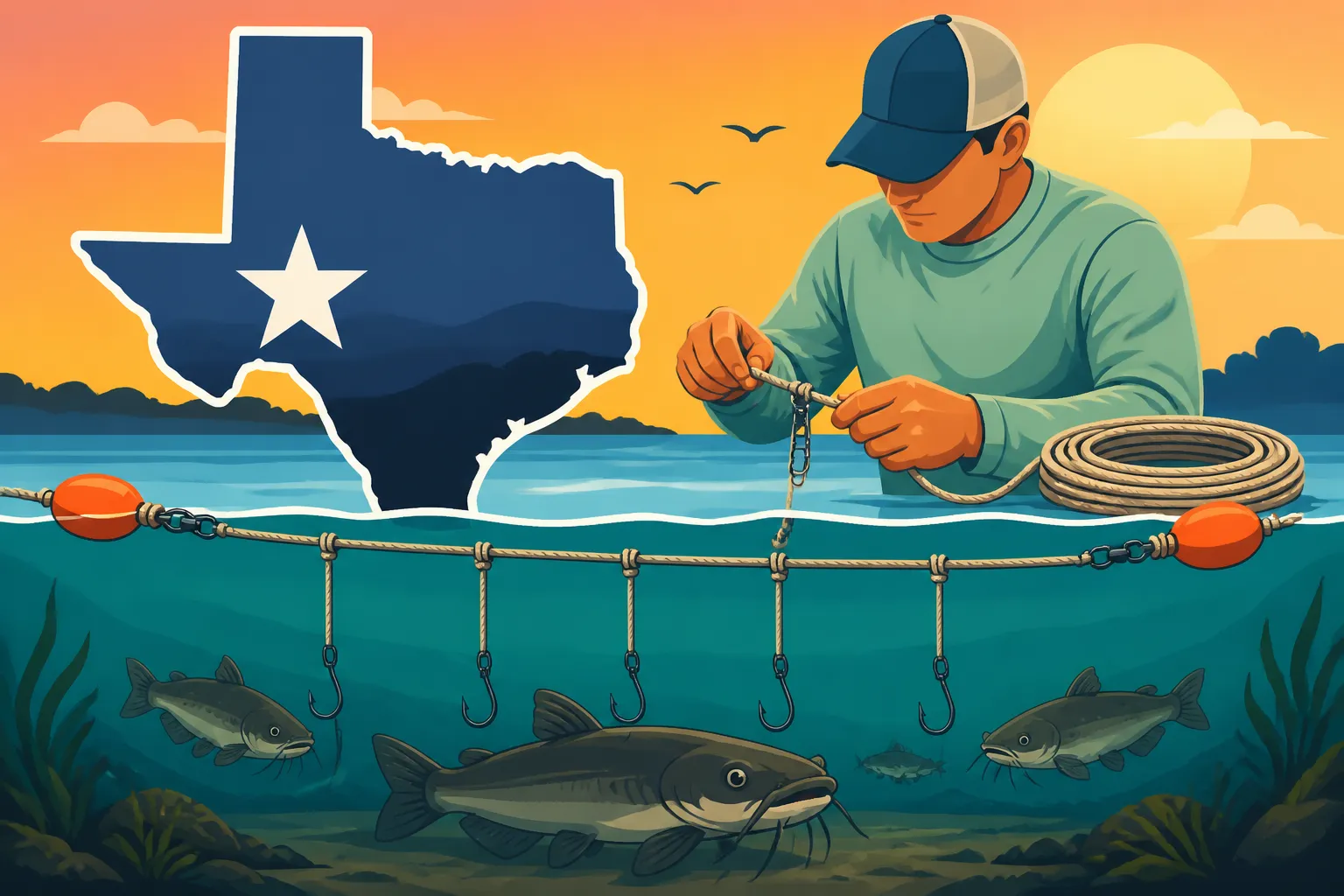
First things first, you need to measure out your main line. Remember, Texas Trotline and Jugline Rules specify a maximum length of 300 feet. It's often a good idea to cut your main line a little shorter, say 280-290 feet, to allow for knots and anchor attachments without accidentally exceeding the legal limit. Lay out your main line in an open area, like a driveway or backyard, to prevent tangles as you work. This gives you a clear view of what you're doing and makes the next steps much smoother.
Next, you'll want to create attachment points for your anchors at each end. A strong, reliable loop knot is essential here. The bowline knot is a classic choice, known for its strength and ease of untying even after being under strain. Alternatively, an anchor bend (also called a fisherman's bend) is incredibly secure for attaching directly to an anchor eye. Tie a robust loop at each end of your main line. These loops will be where your anchors are securely fastened once you're ready for deployment. Don't rush this part; a weak knot here means losing your entire trotline. Double-check your knots by giving them a good tug to ensure they hold.
Attaching Branch Lines and Hooks
This is the most repetitive, yet critical, part of the rigging process. You'll be attaching 50 branch lines with hooks, spaced exactly three feet apart. Precision here is key, both for regulatory compliance and fishing effectiveness. Start by measuring out your first three-foot section from one end loop. Mark this spot with a permanent marker, or even better, use a small piece of brightly colored electrical tape wrapped around the main line. This visual guide will help you keep your spacing consistent.
To attach your branch lines (gangions) to the main line, you have a couple of excellent options. The most common and highly effective method is to use a trotline swivel or a cross-lock snap swivel. These swivels are tied to your main line using a strong knot like a uni knot or a palomar knot, leaving a short tag end from the swivel. The branch line, with its pre-tied hook, is then attached to the other end of the swivel. The swivel allows the branch line and hook to rotate freely, preventing line twist and making it harder for a hooked fish to leverage itself off the line. Another method involves creating a simple loop knot directly on the main line and then attaching the branch line to this loop using a loop-to-loop connection. This method is simpler but doesn't offer the anti-twist benefits of a swivel. Regardless of the method, ensure your knots are strong and secure. I personally lean towards the swivels; they're just more effective.
Once you have your first branch line attached, measure another three feet down the main line and repeat the process. Continue this for all 50 hooks. It's a bit tedious, but consistent spacing is non-negotiable. As you attach each branch line, tie your chosen 5/0 to 9/0 circle hook to the end of each branch line using a strong knot like a snell knot (excellent for circle hooks) or a palomar knot. Make sure the hooks are facing the correct way (the point should be exposed once baited) and are sharp. Dull hooks miss fish, plain and simple.
Adding Floats and Weights
With your main line and hooks all set, it's time to add your floats and any additional weights. Start with your end floats. These are your primary markers and usually the first thing you'll see when you return to your trotline. Securely tie one large, high-visibility float to the loop at each end of your main line. Use a sturdy knot like a bowline or even a double fisherman's bend for extra security. Remember to attach your Texas gear tag requirements for trotlines and juglines to one of these floats.
Now, consider your target species and water depth. If you're targeting channel catfish or even smaller blue cats, you might want your baits suspended slightly off the bottom. In this scenario, you'd add smaller, auxiliary floats along the main line, strategically placed between your branch lines. These could be small foam floats, pool noodle sections, or even repurposed plastic bottles (ensure they're clean and sealed). These floats counteract the weight of your branch lines and bait, keeping the main line suspended. You can adjust their position to control how high off the bottom your baits will sit.
Conversely, if you're after those big, bottom-dwelling flathead catfish, you'll want your baits resting directly on the bottom. In this case, you might omit the smaller floats entirely, relying on the main line's natural tendency to sink. Instead, you might add small lead weights crimped onto the main line every 10-15 feet to ensure it stays anchored to the bottom. These weights also help keep the line from moving too much in strong currents. The key is to achieve the right balance of buoyancy and weight to position your baits exactly where you believe the fish will be feeding.
Deployment and Baiting Strategies
You’ve put in the work to rig your trotline, and now comes the exciting part: getting it into the water and tempting those Texas catfish. Proper deployment isn't just about tossing it in; it's a strategic operation that maximizes your chances of success and ensures your line stays put and legal.
Choosing the Right Location
Finding the sweet spot for your trotline is paramount. Catfish, whether they are Texas Channel Catfish Identification Guide or Texas Blue Catfish Identification Guide, are creatures of structure and current. Look for areas that offer both food and shelter. In lakes, deep channels, creek beds, old river runs, and submerged timber are prime locations. Catfish often patrol these deeper areas, especially during the day, seeking cooler water and ambush points. Pay attention to contour maps if you have them, identifying submerged humps, points, and drop-offs. Brush piles and rocky areas can also hold fish, but be wary of setting your line in places so snaggy that retrieval becomes impossible.
In rivers and larger creeks, current breaks are your best friends. Catfish love to sit just out of the main current, waiting for food to wash by. Look for eddies, the downstream side of islands or large rocks, and deep holes where the current slows. The mouths of smaller creeks entering a main river can also be hotspots, especially after a rain when nutrients and baitfish are being washed in. Remember, catfish have an incredible sense of smell, so placing your line where the current can disperse the scent of your bait is a huge advantage. Consider also how other boaters might use the area; you want to deploy your trotline in a location that minimizes interference with navigation, ensuring safety for everyone on the water.
Setting the Trotline
Deploying a trotline is best done from a boat, and it often requires two people, especially if it's your first time or if the current is strong. Safety first, always! Make sure you have all your Texas Boat Safety Equipment Requirements on board. Start by attaching one anchor to an end loop of your main line. Lower this anchor carefully into the water at your chosen starting point. As the anchor settles, slowly motor or drift away from it, allowing the main line to unspool smoothly behind you. This is where having a second person is incredibly helpful – one person steers the boat, while the other carefully pays out the line, ensuring it doesn't tangle with the motor or get snagged on anything in the boat.
As you deploy, keep an eye on your three-foot spacing and ensure your branch lines are not getting twisted around the main line. Once you've reached the full length of your trotline (remember that 300-foot maximum!), attach your second anchor to the other end loop. Lower this anchor into the water, ensuring the line is taut but not overly stretched. The goal is a relatively straight line, allowing your baits to present naturally. Finally, make sure both end floats are clearly visible on the surface. Double-check that your gear tag is affixed to one of the floats and easily readable. This careful, controlled deployment minimizes tangles, keeps your hooks where they belong, and ensures your line is legally and effectively set.
Baiting Your Hooks
This is arguably the most exciting part for the fish, and a critical component for your success. The type of bait you use will largely depend on the specific catfish species you're targeting. For common Texas catfish, such as channel and blue cats, stinky, oily baits are incredibly effective. Favorites include cut bait (chopped shad, carp, or perch), chicken liver, punch bait, or even commercially prepared catfish dough baits. Cut bait is particularly effective because the scent disperses widely in the water, attracting fish from a distance. If you're wondering which specific concoctions work best, you might want to look at Best Catfish Bait for Texas Lakes.
For flathead catfish, which are more predatory, live bait is often the king. Small sunfish, perch, or even live shad make excellent flathead baits. Ensure your live bait is legal to use in the waters you're fishing and properly hooked to stay alive and active, usually through the back without damaging the spine, or through the lips.
When baiting, load each of your 50 hooks generously. Make sure the hook point is exposed; a hook buried deep in bait is much less likely to set properly. The more scent you have in the water, the better your chances. Trotlining is often done overnight, allowing the bait to work its magic over several hours while the catfish are most active. You can learn more about this in How to Catch Catfish at Night in Texas. After baiting, retreat from the area quietly, minimizing disturbance, and let the fishing begin!
Maintaining and Retrieving Your Trotline
Your trotline is set, baited, and hopefully, working hard under the surface. But the job isn't over. Proper maintenance and careful retrieval are crucial for both your success and the longevity of your gear. Neglecting your line can lead to lost fish, tangled messes, and even regulatory issues.
Checking and Re-baiting
The frequency of checking your trotline depends on a few factors: regulations, water temperature, and your personal preference. While Texas law doesn't explicitly state how often you must check a trotline, it implies reasonable attention to prevent waste of fish and to ensure proper tagging. Generally, most anglers check their trotlines at least once every 12-24 hours. In hotter summer months, checking more frequently (every 6-8 hours if possible) is advisable to ensure fish remain fresh and vibrant if you intend to keep them. Hot water can spoil fish quickly.
Approaching your trotline cautiously is key. Motor slowly, or ideally, paddle silently to one of your marker floats. Start retrieving from one end. As you pull the main line, hand-over-hand, keep a close eye on your branch lines. When you encounter a hooked fish, carefully unhook it. If you're keeping the fish, place it immediately on ice in a cooler or in a well-aerated livewell. If you plan to release it, do so quickly and gently. After unhooking, inspect the branch line and hook. If the bait is gone, re-bait it with fresh bait. If a hook is bent or damaged, replace it. If a branch line is frayed, replace that too. This constant vigilance ensures that all your hooks are actively fishing and your gear remains in top condition. This is why having extra branch lines and hooks on hand, perhaps sourced from Amazon for convenience, is always a good idea.
Retrieving Your Catch
Retrieving fish from a trotline requires a systematic approach to prevent chaos. As you slowly pull the main line into your boat, you'll inevitably encounter fish. When you feel a tug, gently pull the line until the fish is alongside your boat. If it's a smaller catfish, you might be able to simply grab the branch line and carefully remove the hook. For larger, more powerful fish, especially those Texas Blue Catfish Length and Bag Limit monsters, a net or even a pair of specialized fish pliers can be invaluable. Always handle larger fish with caution, as their spines and teeth can cause nasty injuries.
Once the fish is in your boat, decide whether to keep it or release it. Always remember to abide by all Texas Freshwater Fishing Regulations, including length and bag limits for species like Texas Channel Catfish Length and Bag Limit. If keeping, immediately dispatch the fish humanely and place it on ice. This maintains the quality of the meat. If releasing, do so quickly, ensuring the fish is revived before letting it go. Be mindful of your surroundings as you retrieve. Strong currents can make handling both the line and fish more challenging, so always maintain control of your boat and be aware of any obstacles. Never let go of the main line, or you might find yourself chasing your entire trotline downriver!
Cleaning and Storing Your Trotline
After a successful fishing trip, proper cleaning and storage of your trotline are essential for its longevity. First, remove any remaining bait, debris, or fish slime from all hooks and lines. A good rinse with fresh water, perhaps with a mild soap, will help remove odors and prevent degradation. Pay close attention to the hooks, ensuring they are free of rust and sharp. If you notice any hooks are dull or corroded, replace them. The same goes for any frayed branch lines or damaged swivels.
Once clean, allow your entire trotline to air dry thoroughly before storing. Storing a wet or damp line can lead to mildew, rot, and a significantly shortened lifespan, especially for natural fiber ropes. Once completely dry, coil your main line neatly. A common method is to coil it into a bucket or a large storage tub, ensuring that the branch lines and hooks don't get tangled. Some anglers use a "trotline board" or a large spool to keep everything organized and tangle-free. This extra effort during storage will make your next deployment much smoother and quicker, rather than spending precious fishing time untangling a knotted mess from last season. Proper care means your trotline will be ready for many more successful Texas fishing adventures.
Tips for Successful and Ethical Trotlining
Trotlining is a time-honored tradition in Texas, a highly effective way to catch catfish, and a fantastic outdoor experience. But like all fishing methods, there are ways to do it better, and ways to ensure you're being a responsible steward of our natural resources.
Safety First on the Water
When you're out on the water, especially when dealing with gear like trotlines, safety should always be your top priority. You're working with sharp hooks, potentially strong currents, and often from a boat. Always wear a life jacket, especially if you're working near the water's edge or from a small craft. Even experienced anglers can have unexpected tumbles. Keep a first-aid kit handy, as hook punctures are common minor injuries. A good pair of pliers or a hook remover is crucial for safe unhooking, reducing the risk of getting barbed yourself.
Be mindful of other water users. Your trotline floats should be clearly visible to prevent other boats from running into them, which could cause damage to their propellers and your gear. Avoid setting lines in heavily trafficked areas or narrow channels where they could impede navigation. Also, be aware of the weather. Texas weather can change rapidly, and being caught in a storm while trying to retrieve a trotline is dangerous. Always check the forecast before heading out, and if conditions worsen, consider pulling your line and heading for shore. Knowing How to fish a Texas reservoir after a cold front or other significant weather events can also improve safety and success.
Species-Specific Baiting
While catfish, in general, are known for their opportunistic feeding habits, tailoring your bait to the specific species you're targeting can dramatically increase your success rate. As mentioned earlier, How to Catch Catfish in Texas often revolves around bait choice.
- Channel Catfish: These are the ultimate scavengers. They love strong-smelling, often fermented or processed baits. Chicken livers, punch baits (like Sonny's or Junnie's), blood baits, and smelly cut baits are irresistible to them. They're often found in a variety of habitats, from shallow flats to deeper channels.
- Blue Catfish: Blue cats can grow to impressive sizes in Texas waters and are more predatory than channel cats, especially when larger. While they will eat stink baits, fresh cut bait (shad, carp, perch, skipjack herring) is often more effective for landing bigger blues. They tend to prefer deeper, open water in large reservoirs and major river channels.
- Flathead Catfish: These are ambush predators. They almost exclusively prefer live bait. Small live sunfish, perch, or shad are the best baits for flatheads. Hook them carefully to keep them lively on the line. Flatheads are typically found near heavy cover, submerged timber, and rocky bottoms in rivers and large lakes. They are the true kings of the bottom.
By understanding the dietary preferences and habits of each Texas Catfish Species Guide, you can select the most appealing bait and deploy your trotline in the most productive locations, optimizing your chances for a bountiful catch.
Environmental Considerations and Ethical Practices
Responsible trotlining goes beyond simply following the rules; it involves a commitment to ethical angling and environmental stewardship. The first rule of ethical trotlining is never abandon your gear. An abandoned trotline becomes a "ghost fishing" device, continuing to catch and kill fish without purpose, and can also pose a hazard to wildlife and other water users. Always retrieve your line, even if it's empty.
Minimize your impact on the environment. Avoid leaving trash, bait containers, or discarded fishing line behind. Take out everything you bring in. If you're using live bait, ensure it's native to the waters you're fishing to prevent the spread of invasive species. This is a critical aspect of protecting our Texas Freshwater Fishing Regulations.
Finally, practice selective harvesting. While trotlines are highly efficient, you don't have to keep every fish you catch. Release smaller fish to grow larger, and consider releasing some of the bigger breeding stock to ensure healthy fish populations for the future. Handle released fish gently and return them to the water quickly. Knowing the Texas Fish Bag and Length Limits for catfish is paramount. Trotlining can be a fantastic way to put food on the table, but it comes with the responsibility to ensure that future generations can also enjoy the rich fishing opportunities Texas has to offer.
Disclaimer
The information provided in this guide is for general informational purposes only and is not intended as legal advice. Fishing regulations in Texas can change, and it is the angler's sole responsibility to consult the most current Texas Parks and Wildlife Department (TPWD) Outdoor Annual or website for specific, up-to-date rules and regulations before engaging in any fishing activities. Failure to comply with regulations can result in penalties.